
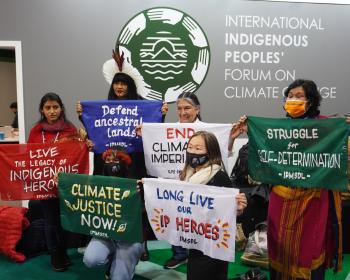
States Fail to Adequately Address Climate Change: An Indigenous Peoples’ Analysis of COP26 Decisions
Proyecto “Entrenando Mujeres Indígenas para la Defensa de sus Derechos Humanos”
Guatemala, México y Honduras
ÚLTIMA FECHA PARA APLICAR: 22 DE ENERO DE 2021
Sobre la organización y el proyecto
One year ago, on December 15, 2011, President Barack Obama announced that the United States would “lend its support” to the UN Declaration on the Rights of Indigenous Peoples. “The aspiration it affirms,” he said, “including the respect for the institutions and rich cultures of Native peoples, are one we must always seek to fulfill.”
In the shadow of the tenth anniversary of September 11, 2001, many people failed to recognize another significant event. Four years ago, on September 13, 2007, the United Nations General Assembly signed into existence the UN Declaration on the Rights of Indigenous Peoples (UNDRIP).
From September 24-27, 2026, Cultural Survival was proud to be part of Terra Madre Salone del Gusto in Turin, Italy. Organized by Slow Food International, Città di Torino, and Regione Piemonte, Terra Madre brought together over 1,500 delegates from 125 countries to "celebrate biodiversity, share stories, and reaffirm the power of food to build bridges across communities, cultures, and borders."
September 13, 2026, marks 19 years since the United Nations General Assembly adopted the UN Declaration on the Rights of Indigenous Peoples (UNDRIP).
By KATRIBU
In the Philippines, Indigenous Peoples continue to face land dispossession, militarization, environmental destruction, disinformation, and systemic marginalization. Amid these challenges, media has become an important tool for asserting Indigenous Peoples’ rights and ensuring that their stories are told and echoed.

Land Acknowledgement
We acknowledge that we are headquartered on Massachusett land, in Cambridge, MA, and we thank the past, current, and future Indigenous stewards of this territory.