
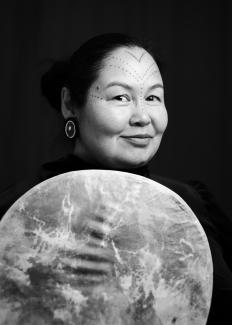
The Arctic city of Nuuk is host, each year, to the Suialaa Arts Festival, spotlighting contemporary visual art, film, literature, music, and other kinds of cultural performance and community conversations from across the circumpolar region—stretching from Alaska to Nunavit to Sápmi, and points in between. Forefronting this latest edition’s programming, culture-bearer Nuka Alice (Inuk) not only entertained but also galvanized and inspired festival audiences with the once-endangered, now joyfully reviving cultural practice known as drum dancing. For her, it’s not just an art; it’s a traversing of the physical, mental, and spiritual worlds of Kalaallit Nunaat (Greenland).
Cristina Verán spoke with Alice about her trajectory from what was once a cultural disconnection to become now a transmitter of this vital expression—inscribed on the UNESCO List of Intangible Cultural Heritage of Humanity—that has long helped her People survive and thrive in an environment that is as perilous and harsh as it is beautiful.
Cristina Verán: What does being a drum dancer mean for you?
Nuka Alice: This term in English doesn’t cover all of what I do, but we use it for someone who uses the qilaat, my drum. I beat this drum to follow my heartbeat, using my voice to create a melody and my body to dance. I have to bring out the emotion of the song to tell its story with a spiritual intention, aiming not only to make music, but to travel between dimensions.
CV: How do you define these dimensions—are they physical? Metaphysical?
NA: As an Inuk, I recognize three elements that together make up the whole person: a physical part, a mental part, and a spiritual part. When I can embody them all at once, that’s when the goosebumps appear. There’s an energy coming out of our bodies beyond the limitations of where our skin ends. We feel it whenever we pass by another— something I’ve noticed whenever I’ve met other Indigenous people. I’m also summoning my ancestors—not as physical beings but rather their spirits, their energy. When I perform, I try to beam this out to whoever I share my drumming with, surrendering myself to the song.
CV: While traditions of this performance were developed communally, you also write your own songs. How do you reconcile the personal and the collective?
NA: The concept of “owning” a song is not really a part of my culture. I’m just a channel for something that is bigger than us as people. While I do create new melodies, that ancestral knowledge, the mental and spiritual parts, are where the old ways come forth. I may have written a particular song, but Iunderstand as an Inuk that it ultimately belongs to what we call Sila—the universal force that connects all living beings of this world with life and energy, as part of one consciousness. It’s not so much me, as Nuka Alice, performing; rather, it’s me as a channel for the force of Sila, to share it with the audience.
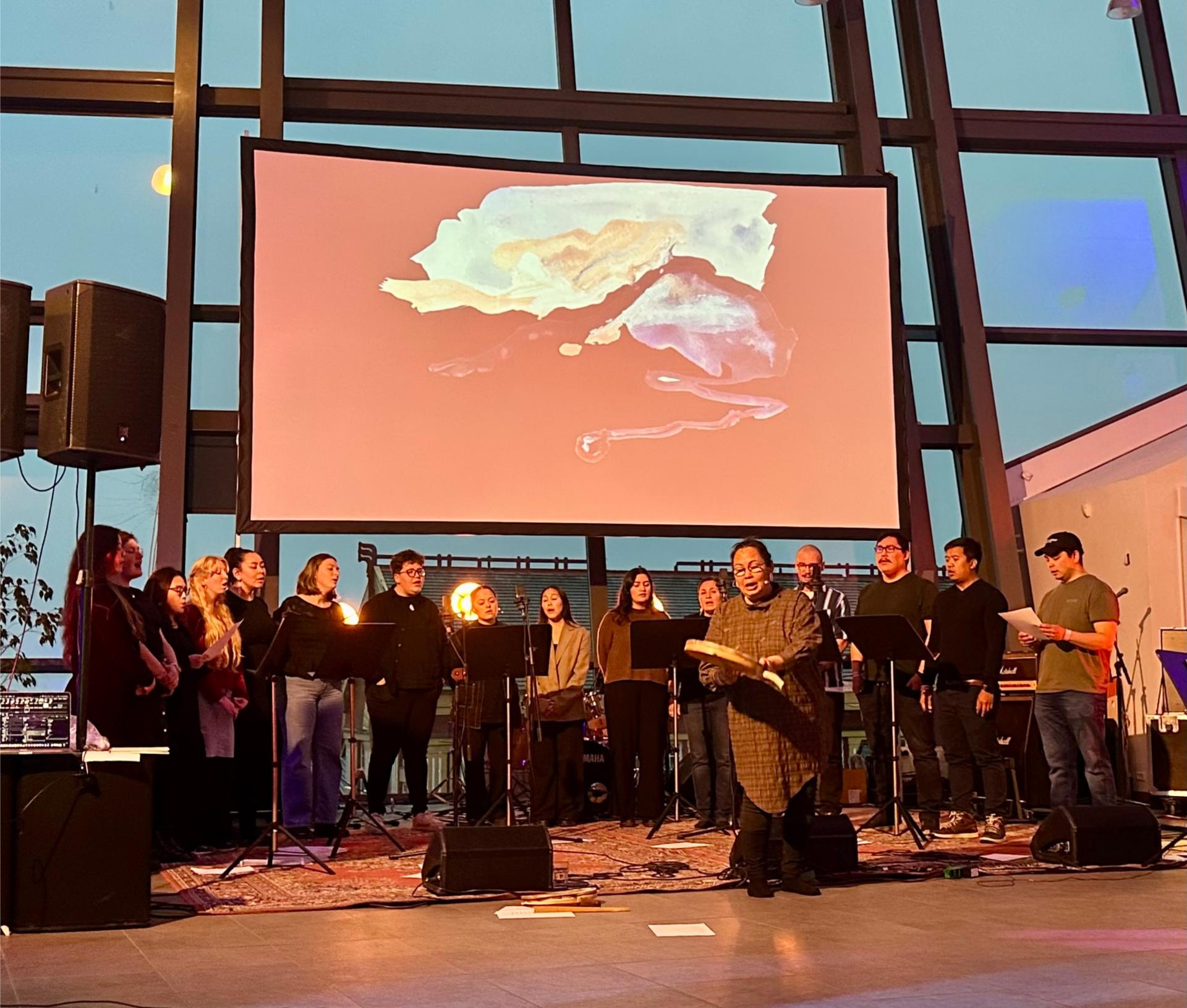
Nuka Alice performs a drum song with Ingiulik, a music project and performance group of which she’s a featured member, at GUX venue in Nuuk, Greenland. Photo by Cristina Verán.
CV: How does this relate with your ancestors’ understandings of such things?
NA: I follow the same principles when performing my songs as you’ll hear in our older, traditional ones. While sharing the song in a physical setting, where living, physical beings are listening, I believe that the souls of my ancestors are [listening] as well, helping me to bring out the soul in each song.
CV: How does this inter-realm interconnectedness speak to the broader experience and ways of living Inuit Peoples share across Kalaallit Nunaat?
NA: As with many other Indigenous cultures, for Inuit Peoples, the individual ego isn’t viewed as something great. Instead, the well being of the group is most important. A person cannot survive alone in the harsh environment of the Arctic. You have to be part of a group. I want to always create, through my performances, a space where everyone in the audience can truly feel a sense of belonging.
CV: How was the tradition of drum dancing passed on to you?
NA: I come from the west coast of Greenland, where this cultural practice almost disappeared with colonization. Unlike my ancestors, I did not directly inherit any of my community’s traditional songs. Neither my grandmother, my great-grandmother, nor even her grandmother had retained them. I had to reclaim them.
I had grown up around my mother’s singing, in a choir, so I had an idea of what beautiful music sounded like, where you may hit certain notes and follow a specific beat. But then one time when I was a child, back in the 1980s, I heard an east Greenland drum song on the radio whose beauty was something different. The singer Miilikka Kûitse, from a village called Kulusuk, had this nasal-sounding voice, for one thing. Her song had been recorded at a gathering a decade earlier, when there was a revitalization movement for Inuit culture. Sometime after, I saw a drum dancer on TV, singing with a choir—yet I could also sense that he was somewhere else, not completely there.
The first time I actually experienced someone performing the music in the same room as me was in 1997 when Katuaq (the Greenlandic culture house in Nuuk) opened, and a group of drum dancers, including Miilikka’s daughter, Anna Kûitse, would perform. The singers spoke a different dialect from my own, so I couldn’t fully understand the words. I felt both disconnected and somehow still connected, all at once. Not having the knowledge of those songs, though, made me very sad.
CV: How did the experience of invasion and colonization impact intergenerational knowledge transmission in Greenland?
NA: It starts with Christianity, which arrived here in 1721. The first missionary, Hans Egede, a Lutheran priest from Norway, came here looking for Vikings. When he realized there weren’t any left, he looked to convert the Inuit People instead. He and the missionaries who followed frowned upon our drum dancing, because it contains a spiritual element they didn’t see as compatible with what they wanted to plant here. It took an Indigenous Greenlandic priest (Matthias Storch) to change things. For him, the practice wasn’t inherently threatening to Christianity. He saw the cultural value of drum dancing and actually encouraged the people there to preserve it.
CV: How did your personal journey of reclamation begin?
NA: Since I didn’t inherit traditional songs from my own community, I had to learn them elsewhere. My teacher, Paulina Lumholdt, from the west coast of Greenland, had met with the Elders there, who told her that fewer and fewer members of those communities were carrying on the tradition. She could see then how important it was to make sure the songs did not disappear.
In her class, she’d spend so much time telling us about the meaning of the songs and their stories. I was young and very impatient back then, and was like, ‘Come on, let’s just take the drum and do this!’ But she’d tell us, ‘No, not yet. You have to first understand what it means.’ In that way, she also taught me patience.
CV: From your repertoire of drum dance songs, please share something about one that has particular meaning for you.
NA: A favorite thing I perform now is called an aqaat, a charm song, which is a kind of love song but for a child, created for just one person. It’s like an ego booster that will give that person a lot of confidence. When I was growing up, apparently, I was a very charming child. I was a little sister for a big sister, and so I had to compete a lot, to try to beat her level, using my charm to get attention. I had a lot of charm songs that gave me affirmation, and I think that’s what gave me the strength to be able to enter and really claim a room, standing in front of people to share my stories.
CV: How does your teaching experience compare with your student days?
NA: When I teach my own workshops now, the participants get impatient—just as I used to feel.
But I say to them: The Inuit have survived for generations in Greenland because, through our drum songs, each generation passed its knowledge on to the next. This is knowledge our people had lost, and we are here to regain it together.
*Nuka Alice’s new songbook, Inggerta, presents a collection of her drum dance songs, with accompanying history and cultural context. Contact Ipera for inquiries.
Cristina Verán is an international Indigenous Peoples- focused specialist researcher, educator, advocacy strategist, network weaver, and mediamaker, as well as adjunct faculty at New York University’s Tisch School of the Arts.
Main photo: Nuka Alice. Photo by Angu Motzfeldt.
Special thanks to Visit Greenland for its gracious assistance in facilitating travel, access, and local coordination in support of this reporting project.
