By Angel Yraê Ferreira (Payayá, CS Intern)
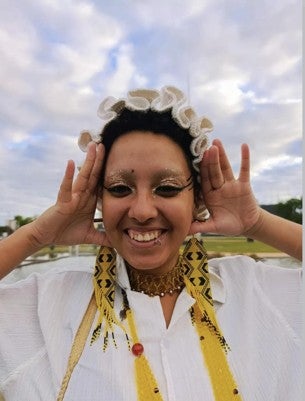
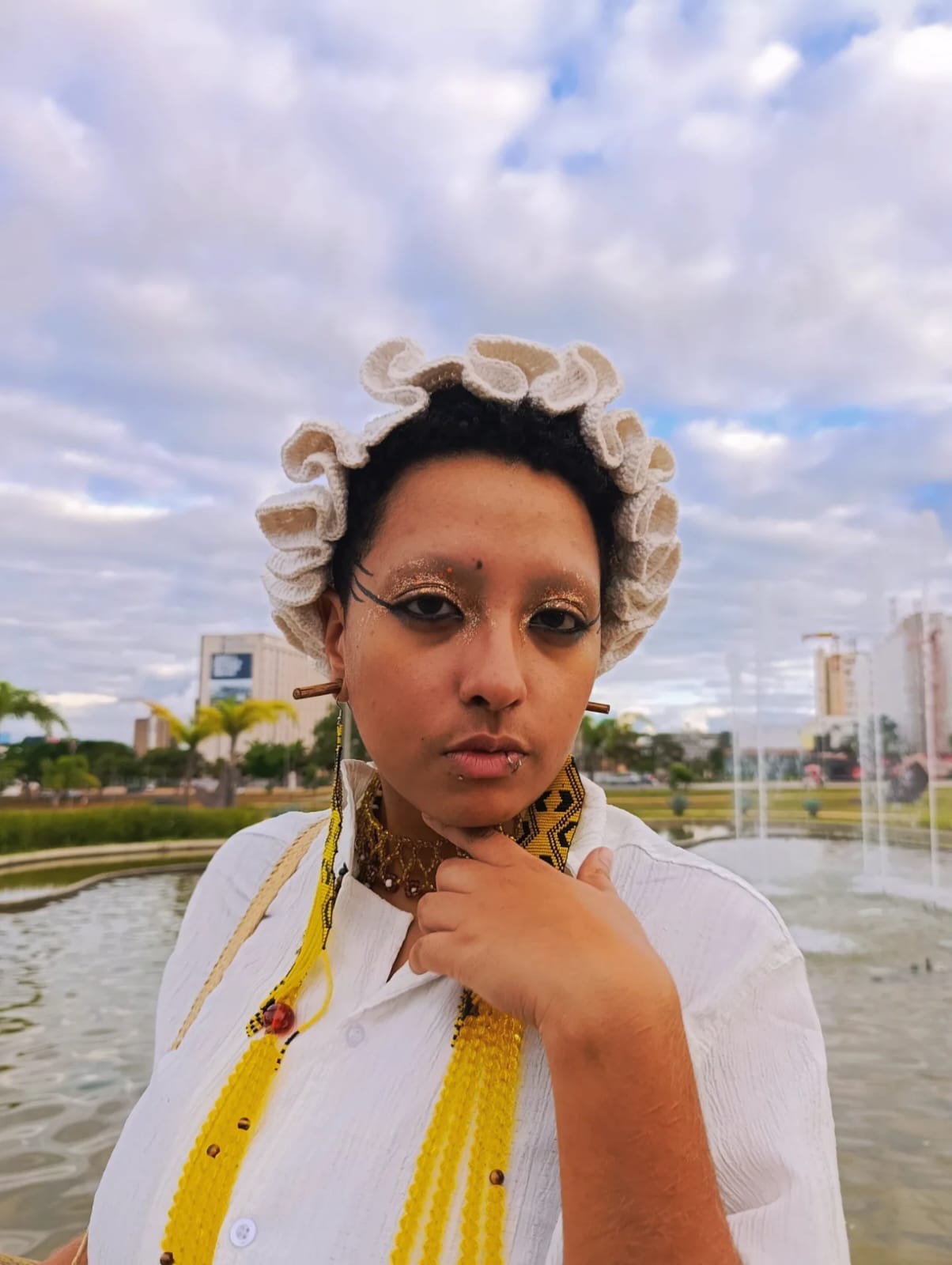
The outskirts of Brazil’s Federal District can feel worlds away from traditional Indigenous territories, but it is here that Cati Paprep Mykwyj (Kanela), a 22-year-old non-binary transmasculine artist, is carving out a vital space. As a digital collage artist, bio-jewelry craftsman, and audiovisual producer, Cati uses his work to reclaim a narrative that refuses to be fragmented, embodying an Indigenous 2SLGBTQ+ resistance that challenges both western queer standards and colonial shifts within traditional communities.
Cultural Survival recently spoke with Cati about his identity, world, and work.
Follow Cati on Instagram at @rayzseca.
Cultural Survival: What does it mean to you to live Pride from an Indigenous identity, and how does it differ from more visible or urban 2SLGBTQ+ narratives?
Cati Paprep Mykwyj: For us, as trans Indigenous people, the experience is different because it directly involves our ancestry. We feel the need to maintain contact with our elders, even if there is a risk of experiencing violence from them due to our gender identity. For urban trans people, detaching from elders is usually easier, and they also do not experience the same relationship of connection with nature.
Particularly, I find it difficult to relate to the urban environment; I perceive that there is an overvaluation of appearance and status. The concept of 'making it in life' for them is closely tied to having money and getting a university degree. For us, making it in life is fighting for our territory.
CS: Pride is often talked about as visibility, but visibility can also bring risk. How do you balance the desire to be seen with the need to protect yourself and your community?
CPM: I usually open up only to people I already know. I talk about myself as little as possible as a protection strategy, because I know that many people are just waiting for an opportunity to confirm their own prejudices.
CS: What aspects of your culture, language, spirituality, or territory have helped you understand your gender identity or sexual orientation in a deeper way?
CPM: Something that strengthened me a lot was my people's connection to the Cerrado (the Brazilian savanna). We have many animalistic graphisms (traditional patterns) that bring us closer to the animal world. Personally, I identify heavily with that 'strangeness': the freedom of not necessarily being a man or a woman, and being able to be something beyond that, even an animal.
CS: What colonial ideas do you think still influence the way some communities understand gender, sexuality, or diversity?
CPM: There are many. There is the social gender role; my people's current culture is patriarchal, even though I, personally, do not tolerate being spoken to disrespectfully. I face the rigidity of this gender organization and the strong influence of Christianity. In ancient times, my people were not monogamous, but that is something that has changed drastically over time.
CS: When you hear the phrase “this didn’t exist before in our cultures,” how would you respond from your experience or from the memory of your People?
CPM: "Everyone in my reservation repeats that phrase. However, these identities did exist, but they were erased by Christian impositions. Nowadays, talking about this is still a huge taboo.
CS: What wounds are caused by having to choose between belonging to your Indigenous community and belonging to the 2SLGBTQ+ community? Is it possible to inhabit both without fragmenting yourself?
CPM: That is a major question in my life. Whether we like it or not, those of us who are 2SLGBTQ+ Indigenous people resist in a much more viable way within the city than in the traditional community. It is only possible to resist inside the villages if the person has an immense psychological and emotional strength to hold that up alone. It is extremely difficult to be 2SLGBTQ+ and live alongside your community when there is no acceptance.
CS: What does Indigenous 2SLGBTQ+ resistance look like beyond marches, flags, and institutional spaces?
CPM: Resistance is occupying public space, being on the street wearing my traditional graphisms, and being a visibly 2SLGBTQ+ person. People generally do not expect to see an Indigenous person, let alone a 2SLGBTQ+ person; seeing both identities in a single body causes a huge impact. Living, smiling, and feeding myself are also fundamental forms of resistance.
CS: What role do Indigenous languages play in naming identities, affections, and bodies that often do not fit into western categories like “gay,” “lesbian,” “trans,” or “queer”?
CPM: There are various Indigenous languages that do not even use feminine or masculine pronouns. Furthermore, there is a great wealth of terms for non-cis-heteronormative identities that already existed historically across several Peoples.
CS: What would you say to organizations, media, or allies who want to support 2SLGBTQ+ Indigenous people, but sometimes end up using their stories in a tokenistic or extractive way?
CPM: There are very practical ways to support, such as making donations and strengthening independent collectives that are already organizing autonomously. It is also necessary to give genuine visibility, voice, and attention to 2SLGBTQ+ Indigenous individuals.
CS: Imagining a truly free future, what would an Indigenous community look like where 2SLGBTQ+ people are not only accepted, but recognized as bearers of knowledge, leadership, and healing?
CPM: On a personal level and within my people, I would like to have the freedom to use masculine and feminine graphisms freely, whenever I want. I want to walk through the reservation without hearing insults or prejudiced comments. And, above all, I want to be able to form a family, regardless of my partner's gender."