April 23, 2026
New York
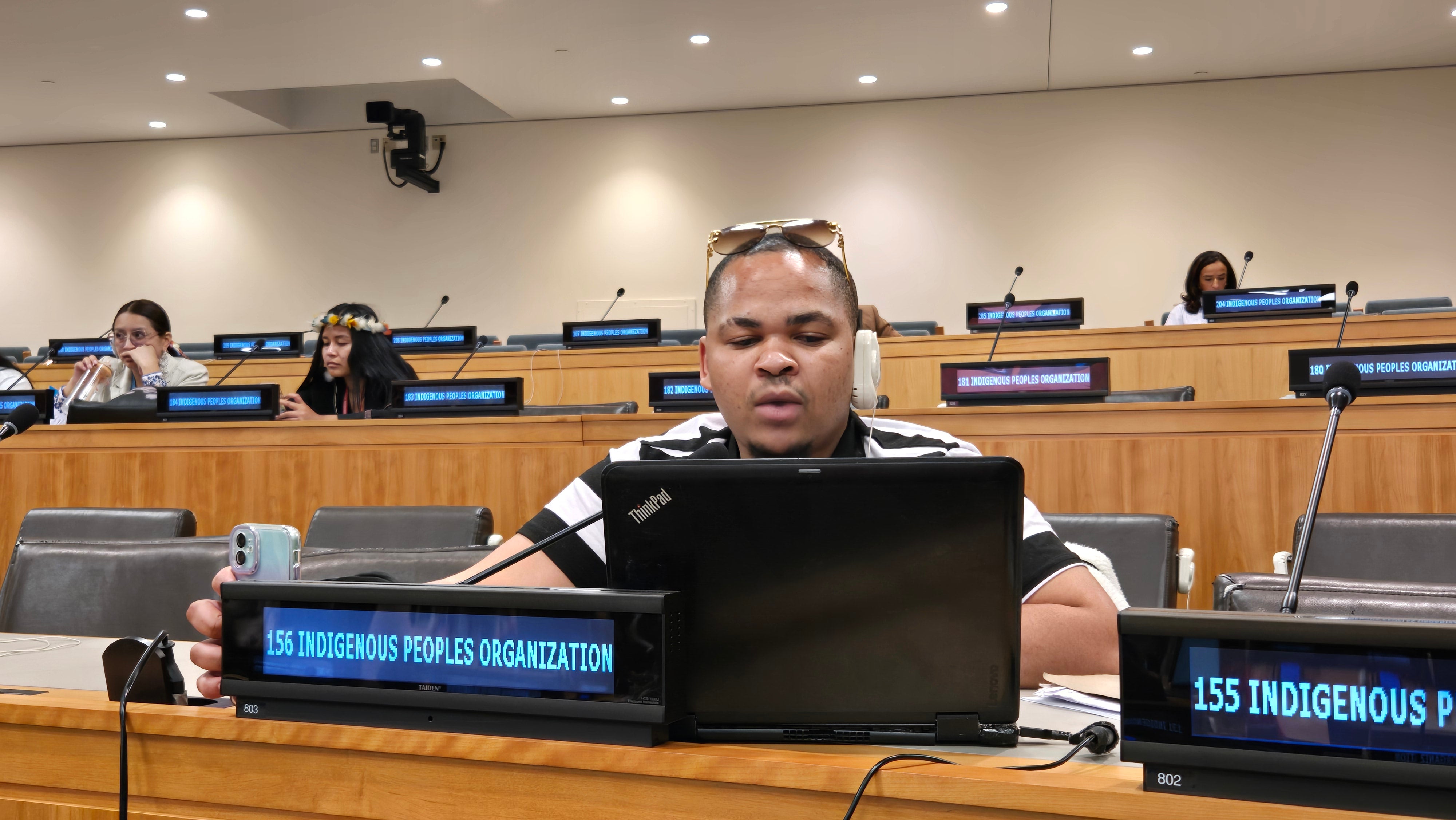
The following is a statement delivered at the 25th session of the UN Permanent Forum on Indigenous Issues by Cultural Survival grant partner, Samuel Stanley, from Botswana. Samuel is Chairperson of the Indigenous Ink Network and the Director of the Indigenous Youth Summit.
Madam Chair,
Distinguished Members of the Forum, Excellencies, Indigenous brothers and sisters.
I have the honour to take the floor on behalf of Indigenous youth, with particular reference to the situation of the San and Nama Peoples in Botswana.
At the outset, we welcome the growing recognition by the Government of Botswana of the importance of human rights, including recent commitments expressed at the highest political level. We also acknowledge the positive steps taken toward a more human rights-based approach to governance, including engagement with United Nations mechanisms and the development of national policies aimed at youth empowerment. These are important foundations upon which stronger, more inclusive frameworks can be built.
We further appreciate the recent visit of the UN Special Rapporteur on the Rights of Indigenous Peoples and encourage continued cooperation with international human rights systems.
However, despite these positive developments, significant gaps remain. In particular, we note with concern that the recently developed national youth policy does not adequately recognize or address the specific realities and rights of Indigenous youth, including those of the San Peoples. This omission risks reinforcing existing inequalities and excluding Indigenous youth from national development processes.
A human rights–based approach requires that all policies be inclusive, non-discriminatory, and responsive to the distinct identities and lived experiences of marginalized groups. Indigenous youth are not a homogenous category of ―youth‖; they are rights holders with unique cultural, social, and historical contexts that must be explicitly recognized.
Central to these concerns are land rights. For the San Peoples, land is not merely an economic asset—it is the basis of identity, culture, spirituality, and survival. Continued displacement, restricted access to ancestral territories, and lack of legal recognition of traditional land tenure systems constitute serious violations of fundamental human rights, including the rights to self-determination, culture, and livelihood.
We therefore stress that any meaningful human rights–based governance framework must prioritize the recognition, protection, and restitution of Indigenous land rights. Without secure land tenure, other rights such as education, health, and participation cannot be fully realized.
In this regard, we call upon the Government of Botswana to:
- Explicitly integrate Indigenous youth into national youth policy frameworks by recognizing them as a distinct constituency with specific rights and needs. This includes disaggregated data collection, targeted programming, and dedicated budget allocations to ensure that Indigenous youth are not left behind in national development agendas.
- Strengthen the legal recognition and protection of Indigenous land rights by formally recognizing customary land tenure systems and ensuring they are afforded equal protection under national law. This should include clear legal safeguards against dispossession, transparent land governance systems, and accessible legal remedies for communities whose rights have been violated.
- Address historical injustices through restitution and redress by establishing inclusive and transparent mechanisms to review past forced evictions, including those from ancestral territories. This should include land restitution where possible, fair compensation, and guarantees of non-repetition, in line with international human rights standards.
- Ensure meaningful participation of Indigenous youth in decision-making processes by institutionalizing mechanisms for free, prior, and informed consent. Participation must go beyond consultation to include active leadership and representation of Indigenous youth at local, national, and international levels.
- Adopt a comprehensive human rights-based approach across all sectors by embedding principles of equality, non-discrimination, accountability, and participation into all laws, policies, and development strategies. This includes aligning national frameworks with international standards such as the UN Declaration on the Rights of Indigenous Peoples.
- Improve access to essential services in culturally appropriate ways by ensuring that education, healthcare, water, and social protection systems are accessible, inclusive, and respectful of Indigenous languages, knowledge systems, and ways of life. Special attention should be given to overcoming geographic and structural barriers faced by remote communities.
- Protect Indigenous human rights defenders, including youth, by establishing effective legal and institutional safeguards against intimidation, harassment, and reprisals. This includes ensuring access to justice, accountability for violations, and safe spaces for advocacy and civic engagement.
- Strengthen partnerships and accountability mechanisms by fostering collaboration between government institutions, Indigenous communities, civil society, and United Nations bodies. Monitoring and evaluation frameworks should be participatory and transparent, ensuring that progress is measurable and responsive to community realities.
In conclusion, while we acknowledge the positive steps taken by Botswana toward strengthening human rights governance, these efforts must be deepened and made more inclusive. The realization of Indigenous Peoples’ rights, particularly for youth, requires deliberate, targeted, and sustained action grounded in human rights principles.
The dignity, knowledge, and rights of the San Peoples must not only be recognized in principle, but fully realized in practice.
I thank you.