By Edson Krenak (Krenak, CS Staff)
On October 25, 2026, Luiz Inácio “Lula” da Silva won a historic fourth term as President of Brazil in the runoff election, after trailing in the first round of voting. According to official data from the Superior Electoral Court (TSE), Lula secured 51.79% of the valid votes. For many Indigenous organizations and leaders in Brazil, the new term is an opportunity to consolidate recent advances and demand that the State fully meet its obligations to Indigenous Peoples. In their words, it opens new possibilities to dream of better futures without fear of death, without the “fear of the sky falling on our heads,” to use Davi Kopenawa's image.
Brazil currently has not only the Ministry of Indigenous Peoples guided by Indigenous leadership, but also Indigenous presence and participation in several other ministries and in Brazil's international climate agenda and policies. Also, after years of stagnation, roughly 20 Indigenous and Quilombola Territories have been homologated and recognized as part of justice, cultural, and environmental protected areas.
The environment and enforcement will continue to be rebuilt, adding to the most recent significant official figures: Amazon deforestation fell 41.8% in the most recent monitoring period, reaching the lowest level since measurements began in 1988; and Cerrado deforestation declined 23.8%. These achievements matter for Indigenous Peoples because they guarantee a safer, cleaner environment, water, and food, as well as cultural protection.
The next challenge for Indigenous Peoples in President Lula's new term is to build political and economic power on the access to political institutions opened in recent years. That access has not yet translated into change on the ground: major projects like the FICO railway (short for Ferrovia de Integração Centro-Oeste or Central-West Integration Railroad, which is a major, ongoing mega-infrastructure project in Brazil designed to connect the agricultural heartland and minerals like rare earth of the Midwest to global export markets) are impacting several Indigenous Peoples' headwater bodies in the Cerrado biome. Transmission corridors, mines, and the oil projects in the Amazon forest move forward without Indigenous Peoples being able to control, limit, or influence decisions.
Brazil’s obligations to Indigenous Peoples do not depend on any election: they derive from the 1988 Federal Constitution, ILO Convention 169, and the UN Declaration on the Rights of Indigenous Peoples. Indigenous organizations that engage with the government expect those obligations to become real influence over decisions that affect their territories. Their engagement cannot be met with silence.
Between 2019 and 2022, Indigenous Peoples in Brazil faced escalating violence, fear, the dismantling of Indigenous and environmental policies and institutions, the halt of territorial demarcations, and the looming loss of rights, access to water, a safe environment, and food security, as documented by Indigenous organizations and human rights bodies. Culture, songs, dreams, and ceremonies were all at stake. No government is a savior for Indigenous Peoples, and the current one is no exception. What Indigenous Peoples demand from any government is the possibility to fight for rights without the fear of death, discrimination, and violence.
This election will shape Brazil's role in a changing regional and global landscape, including its relations with the United States, Europe, and China. For Indigenous Peoples, the stakes go beyond any left-right reading of Latin American politics. Brazil is too important on the global stage: it is part of the G20, a BRICS founder, a major agricultural exporter, a climate leader, and an increasingly important source of the minerals demanded for the global energy and technological transition. Indigenous Peoples in the country hope that the new term will not only strengthen Brazil's international standing but also open up spaces for Indigenous Peoples, including those who may be critical of his policies and of the megaprojects already approved under his administration, such as green infrastructure projects that create sacrifice zones.
Indigenous communities and organizations want a say and the power to decide over the negotiation of the Amazon rainforest, lithium, rare earths, forests, water, and energy corridors among States and corporations. The Free, Prior and Informed Consent (FPIC), for example, is a starting point for Indigenous Peoples' participation in decisions that affect their territories.
Brazil's emerging green industrial strategy, including its new critical mineral policy, risks reproducing fossil-fuel-era injustices unless Indigenous authority is strengthened through mechanisms such as Free, Prior and Informed Consent (FPIC), which gives them real power to change, delay, condition, reshape, and refuse projects.
The biggest shift for Indigenous Peoples is to go from participation to Indigenous authority, recognizing Indigenous peoples as political and territorial authorities whose governance, demarcation, and consent rights must be built into climate and strategic policies rather than treated as side safeguards and nice PR.
The hardest test for Lula's reelection is whether geopolitical competition over critical minerals and just transition becomes an arena in which Indigenous territories are treated as bargaining commodities for U.S., European, or Chinese companies and investors. Indigenous Peoples, Quilombola, and local communities should be ready to negotiate here, where big decisions affect them and their territories. At its core, the Indigenous movement sees this as more than just Lula's electoral victory. It concerns the possibility of imagining futures without the constant threat of violence and death. It is about the right to dream without fear.
The A'uwē Xavante in the Cerrado and the Yanomami People in the Amazon are among the most affected by government decisions, and they share the ceremony of daydreaming as a means to defend a democracy that includes forests, animals, and other more-than-human entities. As I wrote in 2022, “a democracy that brings hope to biomes, trees, rivers, and animals, big and small, a democracy that allows Indigenous people to walk freely on the Earth singing their songs.” Through their practices of dreaming and collective imagination, they articulate a broader democratic horizon. This democracy should be a condition for justice.
By 2030, success should not be measured by how many Indigenous leaders stand beside officials at summits, but by whether Indigenous Peoples gain real authority to prevent their territories from becoming sacrifice zones, but territories of life, reciprocity, and generosity.
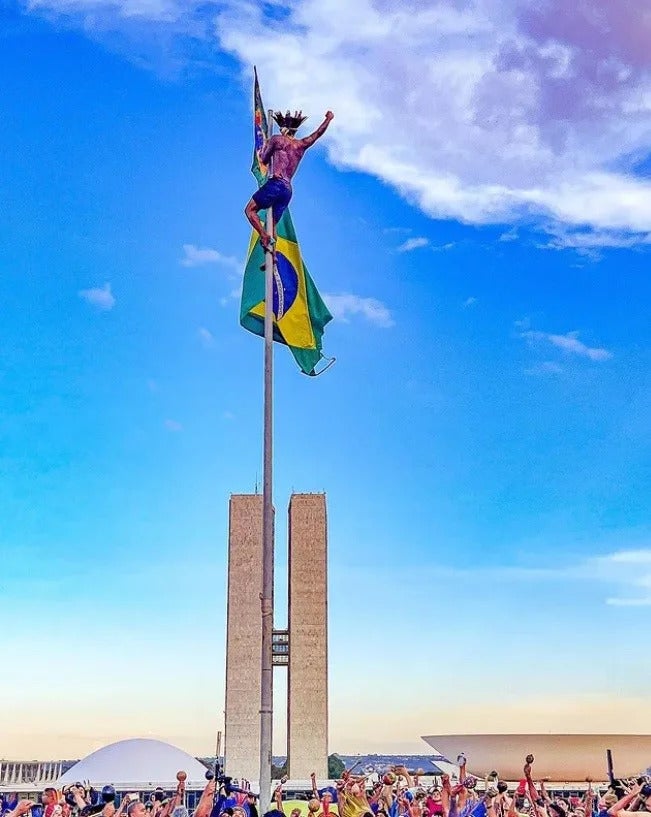
Top photo courtesy of @ricardostuckert “Indigenous people protest in Brasília against a project that authorizes the exploitation of land for mining.”