
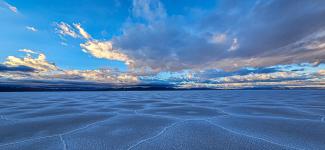
At 6:00 a.m., illuminated by the first rays of sunlight, the Salinas Grandes salt flat in northwestern Argentina is tinged with shades of pink, yellow, and blue. Beneath this vast salt crust spanning more than 200 square kilometers across the provinces of Jujuy and Salta lies one of the planet’s most coveted metals: lithium. Lithium is used to manufacture batteries for cell phones, laptops, electric vehicles, and energy storage systems, and is looked at as a key element in reducing demand for fossil fuels. However, in the Salinas Grandes and Laguna de Guayatayoc Basin, its extraction is destroying the territories that Indigenous Kolla and Atacama communities have inhabited for generations. In response, the Assembly of the Salinas Grandes and Laguna de Guayatayoc Basin—formed by these communities in 2010—is spearheading the defense of the salt flat and territory.
The first time Clemente Flores (Kolla), president of the El Angosto community, heard the word lithium was in 2009. Until then, the region’s communities were unaware that this metal lay beneath their lands. They were also unaware that on global mining maps, the place they inhabit is part of what is known as the “Lithium Triangle.” “We didn’t know what lithium was. We didn’t know what it was or what it looked like. They arrived and said, ‘We want the Salinas territory to produce lithium,’” Flores recalls.
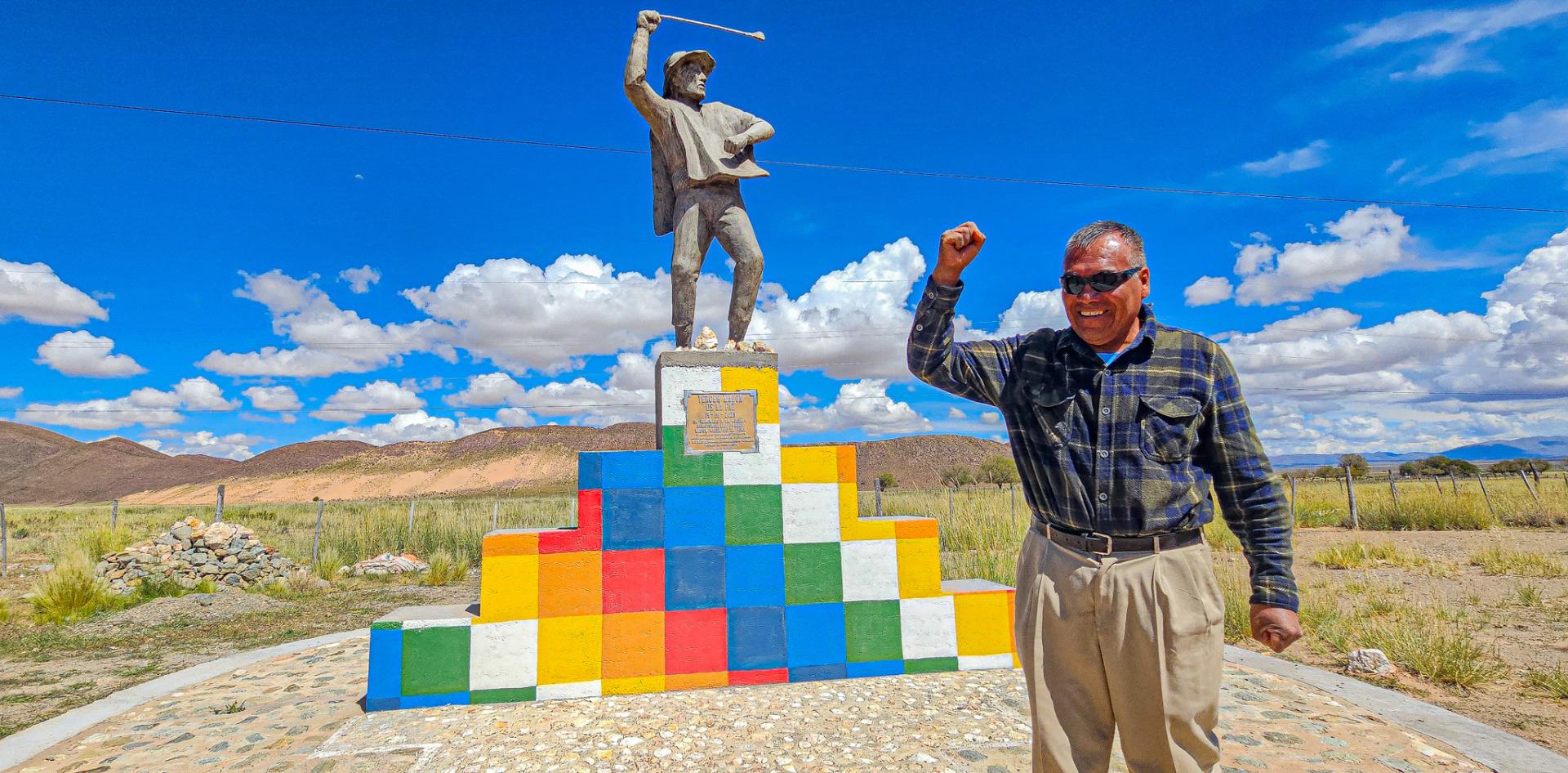
Clemente Flores (Kolla), President of the El Angosto community. Photo by Guadalupe Pastrana.
The Lithium Triangle is a geographic zone spanning Argentina, Bolivia, and Chile where, according to the U.S. Geological Survey’s Mineral Commodity Summaries 2026, nearly half of the world’s identified lithium reserves are concentrated. Consequently, it is a region highly coveted by multinational corporations and major mining consortia. But for the communities living here, the salt flat, the hills, the wetlands, the springs, and the grazing grounds are far more than just the metal lying beneath the surface. For artisan José Chávez (Kolla), for instance, “the salt flat is a living being” that provides his livelihood; he calls it “Mother Salt Flat.” Macedonio Carrillo (Kolla), a community tourism guide, explains that salt has historically sustained the families of this region. “Blocks of salt were used for human consumption, for preserving meat, making charqui, and for bartering. Salt functioned as the currency of that time,” he says.
In high altitude salt flats like Salinas Grandes, lithium is not found in rocks or mineral veins. Here, it remains dissolved in brines beneath the salt flat’s surface. Extraction involves pumping this brine from the subsoil and depositing it into large, open-air pools. Over the course of months, the sun evaporates the water, concentrating the salts. Subsequent chemical processes are then used to obtain lithium carbonate. Beyond brine pumping, the procedure is known to require vast quantities of water. Indigenous communities fear that this extraction will disrupt the region’s water balance.
Rainfall is scarce in this ecosystem, the puna (high plateau). In the driest areas, precipitation amounts to around 100 millimeters per year, and under such conditions life depends on small streams, wetlands, and natural springs. During a tour of the communities in the Salinas Grandes Basin, water scarcity emerged as a widespread concern. Lithium extraction is viewed as a threat because it entails the privatization and destruction of the Salinas Grandes salt flat, as well as the demand for thousands upon thousands of liters of precious water. Residents like Franco Vedia (Kolla), are rightfully concerned that “If all the water goes to the mining companies, what water will the communities use?”
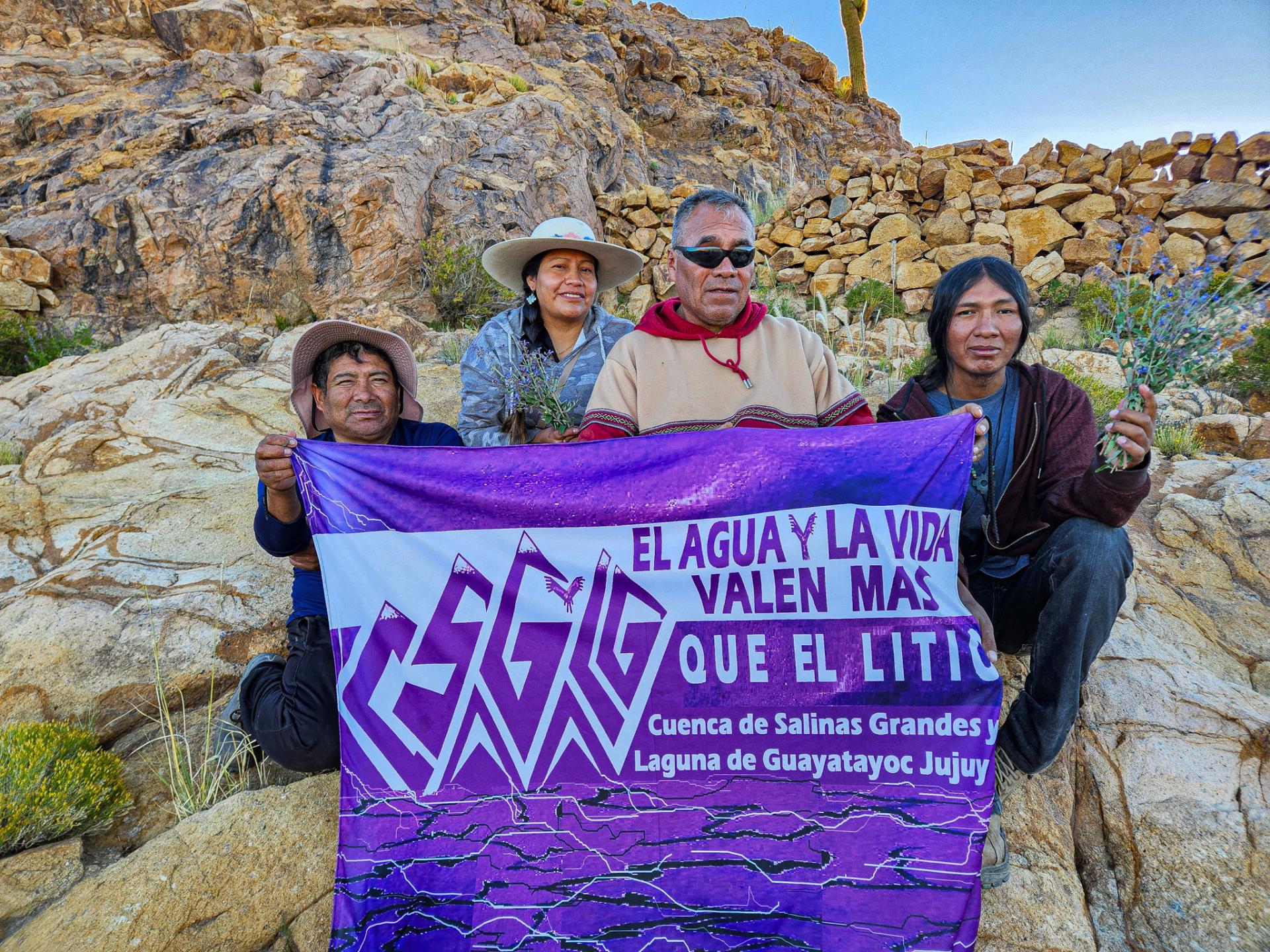
Members of the Assembly of the Salinas Grandes and Laguna de Guayatayoc Basin. Photo by Edison Andrango.
To halt the advance of mining companies, 33 Indigenous communities have undertaken various legal actions since 2010. Their primary demand has been respect for the right to Free, Prior and Informed Consent as recognized in ILO Convention 169, which Argentina ratified in 2000. In addition to these actions, between 2013 and 2015, they drafted their own consultation protocol. They named it Kachi yupi, which means “Salt Tracks” in Quechua. While mining companies are not currently exploiting the Salinas Grandes salt flat, the territory continues to face constant encroachment. The Jujuy Mining Registry reveals the intense pressure on mining in the area: data shows that vast stretches of the Jujuy puna, including parts of the Salinas Grandes and Laguna de Guayatayoc basin, are subject to exploration permits and projects primarily linked to lithium.
Yet, just as the threats persist, so, too, does the resistance. In 2019, several communities, together with the Environment and Natural Resources Foundation, initiated further legal action before the National Supreme Court of Justice. Alicia Chalabe, a lawyer who has supported the communities since 2010, explains that this new amparo (constitutional protection) suit “calls for the establishment of an environmental baseline” and demands that “environmental impact assessments not be conducted on an individual, project-by-project basis, but rather cumulatively—meaning [determining] the impact not just of a single project, but of the aggregate of projects approved over time.”
In 2023, the Supreme Court requested information from the national government and the provincial governments of Jujuy and Salta regarding mining permits and environmental assessments linked to these projects. Subsequently, in 2025, the Court accepted the amparo lawsuit. While the core of the claim remains unresolved, there is hope for the communities. “We are now entering a stage where the Court must rule on precautionary measures. One of the measures requested is the suspension of lithium exploration projects in Salinas Grandes until environmental standards are met,” Chalabe says.
During a walk through the community of Tusaquillas with Vedia and his family, we arrived at a natural spring. Amidst the arid landscape of the puna, there are fruit trees cultivated by the locals. There are also vegetable gardens growing corn, fava beans, and other produce, as well as medicinal plants. All of this depends on the spring. This means that for the Kolla and Atacama communities living here, the struggle has never been solely about lithium. The fight is for what makes life in the puna possible: Mama Yaku—Mother Water. Before saying our goodbyes, Vedia unfurled a flag that had accompanied marches, assemblies, and community gatherings for years. Set against a lilac background, the design features the mountains, the Salinas Grandes salt flat, and a phrase that encapsulates the struggle of these communities: “Water and life are worth more than lithium.”
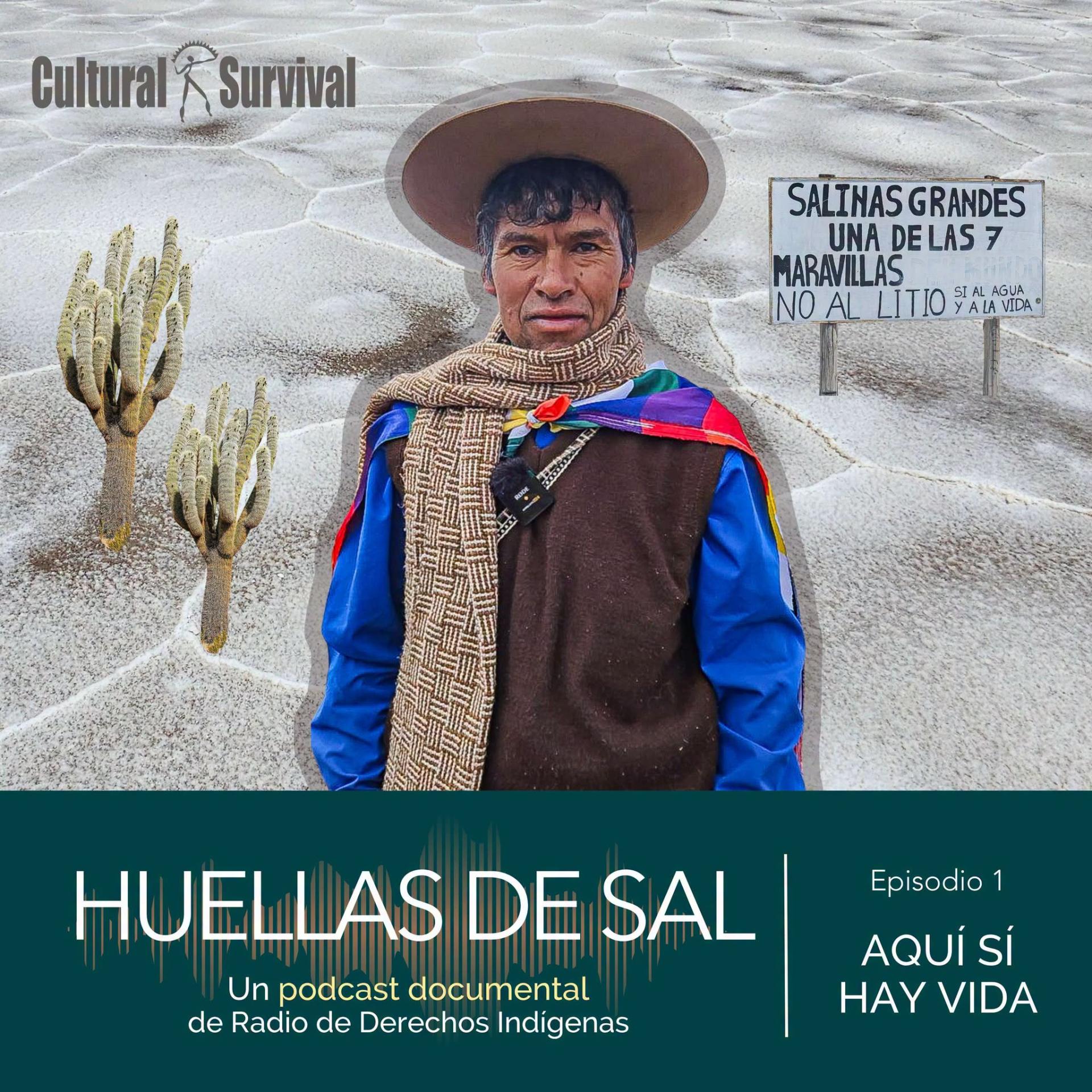
Podcast cover.
“Traces of Salt” Podcast
In March 2026, two Cultural Survival Indigenous Rights Radio staff members traveled across the Salinas Grandes and Laguna de Guayatayoc basin to document the struggle of the Kolla and Atacama communities defending this territory. Using the material gathered, we produced a three-episode documentary podcast series titled “Huellas de Sal” (Traces of Salt). We invite you to listen and reflect on who bears the costs of the so-called “green” energy transition at soundcloud.com/culturalsurvival/sets/huellas-de-sal-podcast.
--Guadalupe Pastrana (Nahua) is Cultural Survival Indigneous Rights Radio Producer.
Top photo: Sunrise at the Salinas Grandes Salt Flats, Jujuy, Argentina. Photo by Guadalupe Pastrana