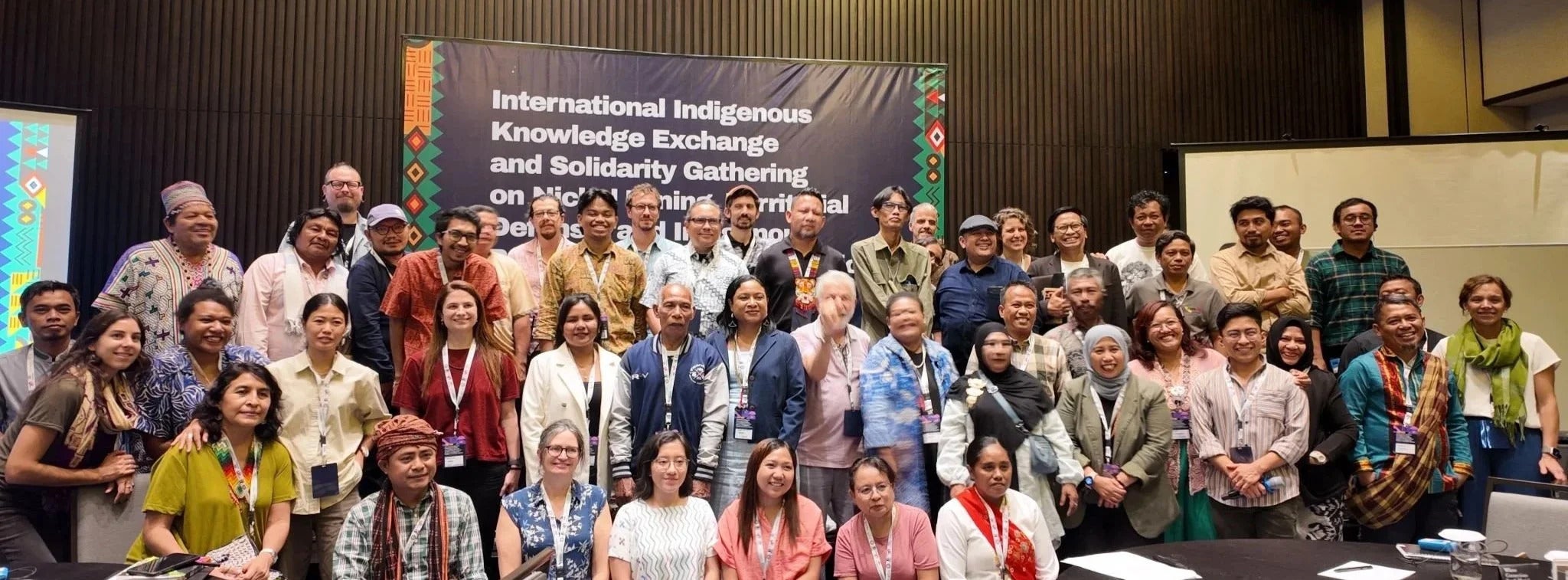
The following is a culminating document of the International Indigenous Knowledge Exchange and Solidarity Gathering on Nickel Mining, Territorial Defense, and Indigenous Peoples in Voluntary Isolation, which took place in Jakarta, Indonesia on January 26-29, 2026.
Jakarta Declaration: Indigenous Peoples and Civil Society Organizations for the Protection of Indigenous Peoples in Isolation
On this day, Thursday, 29 January 2026, we, representatives of Indigenous Peoples, Indigenous organizations and civil society organizations, united in a shared commitment to uphold human rights, ecological justice, and the sustainability of life, hereby declare our position and commitment to protect Indigenous Peoples in Isolation, namely Indigenous Peoples living in limited contact as well as those who choose to have no contact at all, known in international agreements as PIACI. This includes the protection of Indigenous Peoples’ rights, both individual and collective, to full physical and mental integrity, as well as the right to live free from forced assimilation and cultural destruction.
Based on the above, we state the following positions:
1. We urge States and Multilateral Institutions to:
a. Recognize, respect, and protect the existence of Indigenous Peoples, particularly Indigenous Peoples in Isolation, as the legitimate owners of their Indigenous territories, natural resources, and knowledge, with full rights to determine their own ways of life.
b. Cease all forms of forced contact, exploitation, criminalization, and violence against Indigenous Peoples in Isolation, whether carried out by states, corporations, including missionaries, adventure tourists, and influencers, or other actors.
c. Guarantee absolute protection of Indigenous territories, natural resources, and knowledge, particularly those of Indigenous Peoples in Isolation, by affirming that for Indigenous Peoples in Isolation, the right to Free, Prior and Informed Consent (FPIC) must be interpreted and applied as a principle of non-intervention in their territories and in the exercise of their rights.
d. Establish specific policies on protection mechanisms, including the designation of Indigenous territories, particularly those of Indigenous Peoples in Isolation, as No-Go Zones.
e.Revoke and halt all permits and activities related to extractive industries and other projects that may threaten the safety and survival of Indigenous Peoples, particularly Indigenous Peoples in Isolation.
2. We urge national and international financial institutions and global supply chains to cease all financing of projects that threaten Indigenous territories, natural resources, and Indigenous knowledge systems, particularly those of Indigenous Peoples in Isolation.
Protection of Indigenous Peoples, particularly Indigenous Peoples in Isolation, is a State obligation. This must be carried out based on the right to Self-determination, the precautionary principle and the establishment of no-go zones, the principle of non-contact with Indigenous Peoples who choose to remain without contact, Indigenous knowledge systems, FPIC, and the permanent protection of the rights of Indigenous Peoples, particularly Indigenous Peoples in Isolation, as stipulated in the United Nations Declaration on the Rights of Indigenous Peoples and various international human rights instruments.
Indigenous Peoples in Isolation are Indigenous communities that consciously choose to live separately from, or without maintaining sustained contact with, the outside world. As a result, they face extremely high levels of vulnerability to violence, territorial dispossession, disease, and the physical, cultural, and collective knowledge extinction of their peoples. Indigenous Peoples hold individual and collective rights, including the right to physical and mental integrity, as well as the right to live free from forced assimilation and cultural destruction.
In many regions, the existence of Indigenous Peoples in Isolation is increasingly threatened by the expansion of extractive industries, infrastructure development, and similar activities. These threats largely stem from state policies that disregard Indigenous Peoples’ rights. The presence of such development projects endangers the sustainability and future of Indigenous Peoples, particularly Indigenous Peoples in Isolation.
Conclusion
This Declaration is issued as a joint statement of position, as well as a moral and political call to states and all stakeholders to guarantee the right to life, dignity, and the future of Indigenous Peoples in Isolation.
We commit to strengthening solidarity among Indigenous Peoples, affected communities, and civil society organizations in advocating for the protection and fulfillment of the rights of Indigenous Peoples and Indigenous Peoples in Isolation (PIACI).
Adopted in: Jakarta, Indonesia
Date: 29 January 2026
Signatories:
Aliansi Masyarakat Adat Nusantara (AMAN)
AMAN Maluku
AMAN Tana Luwu
AURIGA NUSANTARA
BATANI Foundation
Business Human Rights Center (BHCR)
Cultural Survival
EARTHWORKS
Fala Lamo
International Work Group for Indigenous Affairs (IWGIA)
International Working Group for the Protection of Indigenous Peoples in Isolation and Initial Contact (GTI-PIACI): Bolivia: CEJIS - Centro de Estudios Jurídicos e Investigación Social; CITRMD - Central de Comunidades Indígenas Tacana II del Río Madre de Dios. Brazil: COIAB - Coordenação das Organizações Indígenas da Amazônia Brasileira; CTI - Centro de Trabalho Indigenista; EAPIL/CIMI - Equipe de Apoio aos Povos Ingenas Livres du Conselho Indigenista Missionário; OPI - Observatório dos Direitos Humanos dos Povos Indígenas Isolados e de Recente Contato; Instituto Maíra. Colombia: OPIAC - Organización de los Pueblos Indígenas de la Amazonia Colombiana; ACT- Amazon Conservation Team. Ecuador: FEPP - Fondo Ecuatoriano Populorum Progressio; LIL - Land Is Life. Paraguay: OPIT - Organización Payipie Ichadie Totobiegosode; IA - Iniciativa Amotocodie: Peru: AIDESEP - Asociación Interétnica de Desarrollo de la Selva Peruana; COMARU - Consejo Machiguenga del Río Urubamba; FENAMAD - Federación Nativa del Río Madre de Dios y Afluentes; ORPIO - Organización Regional de los Pueblos Indígenas de Oriente; ORAU - Organización Regional AIDESEP Ucayali. Surinam: OIS - Organization of Indigenous People of Suriname. Venezuela: ORPIA - Organización Regional De Pueblos Indígenas De Amazonas; WATANIBA - Wataniba Grupo de Trabajo Socioambiental de la Amazonia.
Jaringan Advokasi Tambang (JATAM)
JATAM Central Sulawesi
Perhimpunan Pembela Masyarakat Adat Nusantara (PPMAN)
Pusat Studi Dan Pembelaan Hak-Hak Masyarakat (PuSPAHAM)
Rainforest Foundation Norway
Samahanng Nagkakaisa Ng Katutubong Kabataan / Association of United Indigenous Youth
Satya Bumi
SIRGE Coalition
Survival International
Tallgrass Institute
Voices
Wahana Lingkungan Hidup Indonesia (WALHI)
WALHI North Maluku
WALHI South Sulawesi
Yayasan Kompas Peduli Hutan (KOMIU)
Yayasan Sagori