Cultural Survival's community includes people from all walks of life, with beautiful stories to tell of their own about why they decided to become advocates for Indigenous Peoples' rights. Sharing these stories further connects our community, provides much-needed solidarity and validation to our staff and partners on the ground, and helps us inspire others to join our movement. We are excited to spotlight members and former interns of our community and highlight your contributions and perspectives through our Cultural Survival Spotlight series.
Are you a former Cultural Survival intern or a passionate member of our community? We'd be honored to hear and share your story!
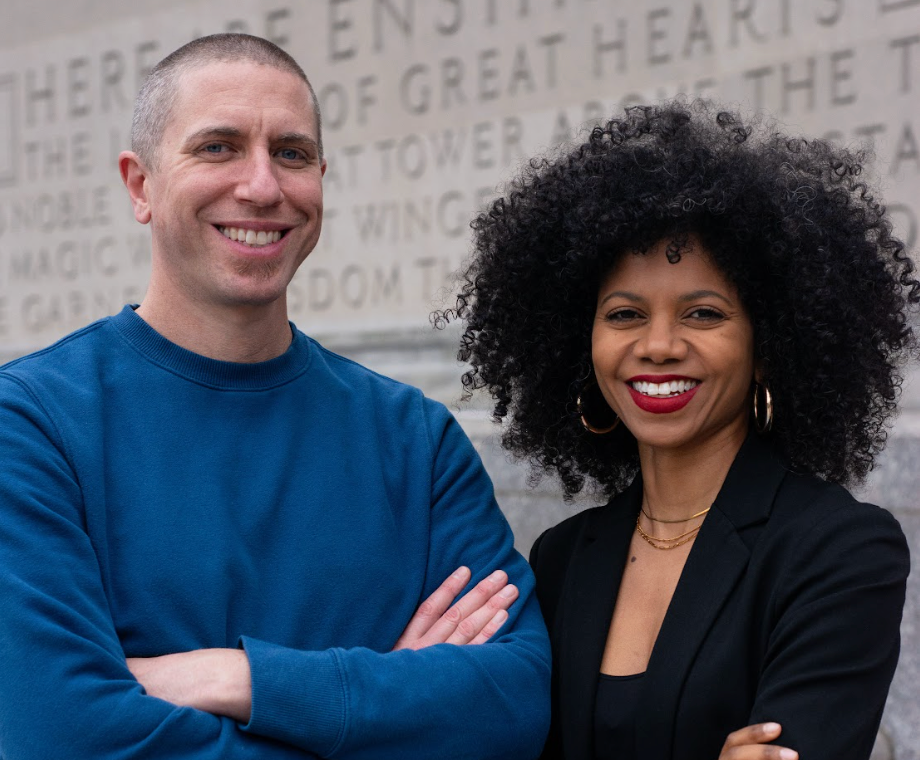
Tabitha St. Bernard-Jacobs & Adam St. Bernard Jacobs, Cultural Survival Sustainers Circle Members
CS: Please tell us a little bit about yourself.
Tabitha St. Bernard-Jacobs: I'm from Trinidad & Tobago, which is a tiny twin-island in the Caribbean, and I moved to New York when I was 19. Trinbago is a somewhat young country. Growing up, I didn't have the language to identify and express it, but we were greatly impacted by the effects of colonization. As a child, this was evident to me through practices like corporal punishment in schools and the rigidity of the education system. There was a sense that we have our own identity and that we have our own very vibrant and beautiful culture as Trinidadians, but we're still pretty new and still a bit in the shadow of our former colonizers.
I came to the US when I was 19 and earned a scholarship to go to St. Francis College in Brooklyn Heights where I got my first degree in psychology. At 23, I started working with people with disabilities. At 25, I had sort of a quarter-life crisis and went to the Fashion Institute of Technology. I soon started working in fashion. I launched a sustainable fashion line that was around for about 6 years. We showed at New York Fashion Week, and were blessed to be able to sell our clothing at stores around the country. After the results of the 2016 elections, I got involved in organizing the Women’s March on Washington. I’ve since moved away from fashion and pivoted to feminist organizing with Women’s March. It’s impactful work as we prepare to celebrate our 10th anniversary in 2027.
I also do anti-racist parenting work [Tabii Just Strategies] with my partner, Adam. We have been blessed with two children, ages 6 and 11 who inspire our work. We work with libraries and schools and host parenting workshops. I also write for magazines like Parents and Good Housekeeping about parenting.
Adam St. Bernard Jacobs: I was born and raised in Minneapolis, MN, and have also lived in Maryland outside Washington, D.C. as well as New York City, New Jersey, and some time abroad. I was raised in a Conservative Jewish home, and when I went to school, I studied international politics, Jewish law, and conflict resolution/peace education. Judaism teaches that it is on all of us to make the world a better place, which means questioning inequitable systems. My brother and I created a peace and arts education program in New York City and we started a band for kids, getting the opportunity to share the joy of music with children around the world. In addition to my work with Tabitha, I am also an educator and support schools in becoming safer and more equitable for everyone.
CS: When did you first learn about Cultural Survival?
T.S.B.J. & A.J.: We learned about Cultural Survival through research on organizations working with global Indigenous communities that are led by Indigenous People.
CS: What motivated you to become a member of the Cultural Survival community?
T.S.B.J. & A.J.: The CS mission statement talks about envisioning the future and that really resonated with us. We have to be grounded in a vision of what we're fighting for. We have to be grounded in something tangible in the future that we can build together as people who are fighting for liberation. We really want to uplift that part of the work that CS is doing, thinking about the big picture and also thinking about being forward-facing to the future. Especially now, there are a lot of things to be raging against and there are a lot of things to be angry about – and there's space for rage in every movement. It's actually very necessary. And there's space for hope and for a belief in what we're building together as a community.
T.S.B.J.: As an immigrant from Trinidad & Tobago, I also admire the work CS is doing internationally. When I lived in Trinidad, we frequently visited Lopinot, which was our local Indigenous community site based in the east and we would learn about the local native community. Of course, as a kid, I didn't make the connections between Indigenous People in Trinidad and other parts of the world so that’s a lesson we hope we are imparting to our children and the families we teach – that global connection.
CS: Cultural Survival advocates for Indigenous Peoples' rights and supports their self-determination. Why is this cause important to you?
T.S.B.J. & A.J.: When we're doing anti-racism work, whether it’s through parenting or organizing, we work to recognize not just the land that we live on, but also how white supremacy tries to erase Indigenous cultures while seeking to frame Indigenous causes and communities as in the past. We want to ensure that people see self-determination for Indigenous People as a part of anti-racism work now, not just on Indigenous Peoples' Day, but as a part of the work we do when we're having conversations with kids about the earth and about respecting the land we live on and thinking about our history as a country. We also write a newsletter called Raising Antiracist Kids, so we have featured articles written by folks within the Cultural Survival network. We [Tabii Just Strategies] also list Cultural Survival in our resource list as an organization for people to donate to. We’re also honored to be Cultural Survival Sustainers Circle Members because supporting Indigenous organizations with financial resources also helps enable them to continue their work.
CS: Do you have a connection or interest in a particular country/region or one of our programs?
T.S.B.J.: I am a writer, so I am always interested in the articles that CS puts out. We also support the radio work CS does because it's free, it's open, and it's accessible to communities that may not have dependable internet access. I am also eager to attend one of the bazaars when I’m able.
CS: Is there anything else you would like to share with us?
T.S.B.J. & A.J.: Cultural Survival has a willingness to experiment with support from non-Indigenous people like us, which we are grateful for. There is an openness to figuring it out together – an openness to the messiness. In our anti-racist parenting work, we focus on imperfection, that while you're striving to always unlearn and learn, you're going to make mistakes along the way. The focus needs to be on repair which includes learning how to do better in the future. Cultural Survival has been an organization that we've been able to bounce support ideas off of. Some examples of this have been the article series and Women's March work that included advocacy around Missing and Murdered Indigenous Women and Girls Day (MMIWG) in May. I've really appreciated that ability to be on a learning journey with an organization that is very open and guides with a compassionate hand.
Top Photo: Tabitha St. Bernard-Jacobs (right) & Adam St. Bernard Jacobs (left)
Cultural Survival's Sustainers Circle is made up of our committed donors who generously give recurring gifts to advocate for Indigenous Peoples' rights and support Indigenous communities’ self-determination, cultures, and political resilience - become a Sustainers Circle member today!