By CS Staff
Missing and Murdered Indigenous Women and Girls (MMIWG) and Missing and Murdered Indigenous People (MMIP) statistics in the United States reveal a crisis of undercounted violent crime that is not being addressed. As of 2023, over 5,800 American Indian and Alaska Native women were reported missing, with 74% being children.
A 2018 Urban Indian Health Institute study of 71 cities identified 506 unique cases of these crimes, with 56% pertaining to murder and 25% to missing persons. Over 75% of cases were not found in federal databases, highlighting severe data deficiencies and a lack of justice for survivors. The Bureau of Indian Affairs (BIA) estimates there are approximately 4,200 unsolved missing and murdered cases.
Indigenous people are overwhelmingly more impacted by violence than the population at large. The statistics are shocking. Indigenous women are murdered at a rate 10 times higher than the national average of their counterparts, with murder being the third leading cause of death for Native American and Alaska Native women and girls. Approximately 84% of Indigenous women experience violence in their lifetime. The majority of crimes go unreported or are misclassified, making it impossible to know the true figures.
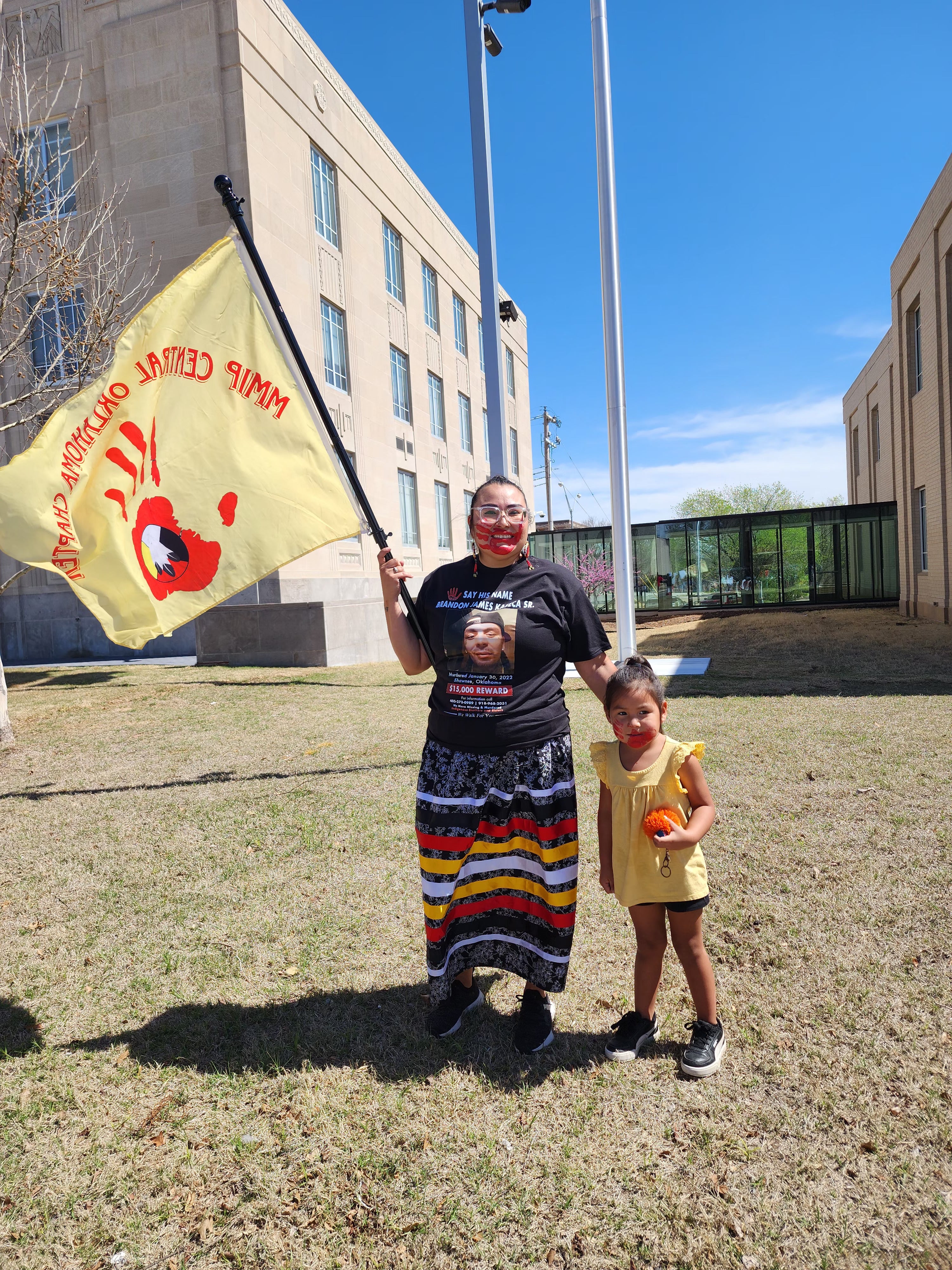
Christa McClellan (Prairie Band Potawatomi Nation) is the President of the Missing and Murdered Indigenous People Central Oklahoma Chapter and is working tirelessly to bring attention to this epidemic. Cultural Survival recently spoke with McClellan about her work.
Cultural Survival: Please tell us what you do at the MMIP Central Oklahoma Chapter.
Christa McClellan: I create justice flyers for our murder cases and distribute them when we have a missing person. I do a lot. I post everything on our social media—Facebook, Instagram, and TikTok. I talk with the families. I plan and speak at events.
CS: What motivated you to become involved in advocacy around Missing and Murdered Indigenous People?
CM: My sister started her own advocacy in New Mexico; she's been doing this far longer than I have. I've always admired her for that, and she's a big inspiration. But what really got me started was when we lost our cousin in 2022, whom we looked at as a brother. He was shot and killed on January 30, 2022. We are still fighting for justice. We have not had any answers. I made a promise to him that I wouldn't stop until we got him justice.
CS: What are the biggest misconceptions about the MMIP crisis?
CM: Many people feel that a lot of our Indigenous people are alcoholics and drug addicts, and that leads them not to want to look for them. Often, we hear that people have the right to go missing. They're just out on a bender. They'll come home when they're done, or they've done this before. They'll come back. Even with our youth, they label them as runaways and don't see the urgency of looking for them. A lot of times our youth fall into sex trafficking, and they don't see it as a crisis. It's different when you have a person who is not a person of color; you can clearly see the difference because a Caucasian person is more likely to get their story and their face on the news and in newspapers, and more help when they go missing or even if they're murdered.
When you have a Person of Color, regardless of whether they're Indigenous or if they're African-American, if they're Hispanic, they are not treated the same. They are less likely to be on the news or receive help of any kind. A lot of it goes back to how they see our people as being drug addicts, alcoholics, and a lot of times they see them as criminals. They don't see beyond that. Even in the criminal justice system, the court system. Even when we have numerous people with education. We have people who are opening their own businesses, and doing things they didn't think they would ever do.
CS: What is the mission of the MMIP Central Oklahoma Chapter, and how does it serve the community?
CM: When we first started, our mission was to help the families look for their missing and fight for justice for their murdered family members. Eventually, along the way, we realized that it's not just about finding our missing Indigenous people, but about working for justice. We need to find a way to prevent all of this. One of the ways we try to do that is to pull them back into their cultures and be more involved, because it creates a bond that will help them get through whatever they're going through. I can say that I am a recovering addict. I have gotten back into my culture, and it feels like healing and peace when you do. We have gourd dances, and that's what my family usually does. It's like a healing ceremony. We want to create that circle for our families and our community. We don't just focus on our MMIP families; we focus on the community as a whole. We want to do whatever we can to prevent further cases.
It seems like it's almost impossible, but I think we can at least decrease numbers and make it not so high of a rate if we build that trust within the community and show them there is more to their lives than just the drinking, the drugging, the turmoil that we sometimes put ourselves in.
We have an annual gourd dance, but we are looking into doing other cultural dances, like a stomp dance and a powwow, because only certain Tribes do stomp dances and only certain Tribes do gourd dances. We're trying to reach a wider area. Another thing we do is an annual honor walk for our families and the community, along with several events throughout the year. We will set up at powwows and participate at whatever events come up.
CS: What changes in policy or law enforcement practices would make the greatest difference in addressing MMIP cases?
CM: A big one is to create an alert specifically for Indigenous people. One recently passed, called Casey's Alert, isn't just for Indigenous people. It's for every race and ethnicity. It covers from, I believe, 18 to 55, which wasn't covered before.
The issue with that is it's not used the way it should be. It's used when someone feels like somebody's in danger, and it's not normal for them to go missing. It's been a couple of years since it was enacted, and I think we've only seen about six [alerts], and we have a lot of missing people. So it's not effective like it should be. I think we need a more effective alert. I know they have to have certain criteria to use them, but they don't work when you use them that way. I feel that if everyone were alerted the way those alerts were meant to be, regardless of the urgency, we would have a lot easier time finding people because those alerts go out instantly and across the entire state at a time, compared to if we share on Facebook or social media, people will see it when they come across it.
CS: How has coverage of MMIP issues changed over the past few years?
CM: I don't see a change, and I think that could have a lot to do with our current administration in the White House. I think it's created another barrier for our people, and it's made it harder for us to let people see that it's a crisis, because now we are being told, oh, well, everybody needs to be treated equally. They're not seeing that our people aren't being treated equally. They're just seeing that we're trying to bring more attention to the crisis, and they're not seeing the crisis, if that makes sense.
I suggest they talk to the families, especially the parents or children of missing persons or murder victims. If they speak to the families, they will see the impact that the cases have on people. It's gut-wrenching. It's alarming. Being a part of an MMIP family, when I talk to them, it keeps my grief and my emotions on day one. It keeps it fresh. I don't know how it would make somebody else feel, outside of not experiencing that. But I know if I feel the way I feel, and if somebody has a heart, they're going to feel the people's pain.
CS: How can people support your organization, and where can they reach you?
CM: We accept any type of donation. We are a grassroots organization, and if we don't have money in our account, then it comes out of our pockets. I'm a stay-at-home mom, and a lot of the other people in our office, including my vice president, also don't work [outside the home]. So it takes a lot out of our pockets, but we do it. Many organizations like ours are grassroots, and we raise our own money. And it goes pretty quickly because flyers aren't cheap. We cover the entire state of Oklahoma, so that's gas money to get to where we need to go. I know the furthest we've gone is probably two hours each way. On top of that, as I mentioned, we would like to put out a call for volunteers. If you can't commit to being a member, we don't mind if you just want to be a volunteer. That works as well. You can find us on Facebook. We are under the Missing and Murdered Indigenous People Central Chapter, and it is the same on Instagram.
I always tell everybody, the best way to [volunteer] is if you see a flyer, share it. If you can come out and help whenever we put up flyers, it does wonders because we can cover a larger area. Half the time when we hang up flyers, it is just my nine-year-old daughter and me. So if we had more people to help, we could cover a larger area than just a 5-10 block radius, because that puts a lot of work on just two people. In an hour, we can get a lot done. Volunteers are always welcome, even during our events. Our events are a healing ceremony for us, because we all get to gather and enjoy each other's company. And it just helps.