By Angel Yraê Ferreira (Payayá, CS Intern)
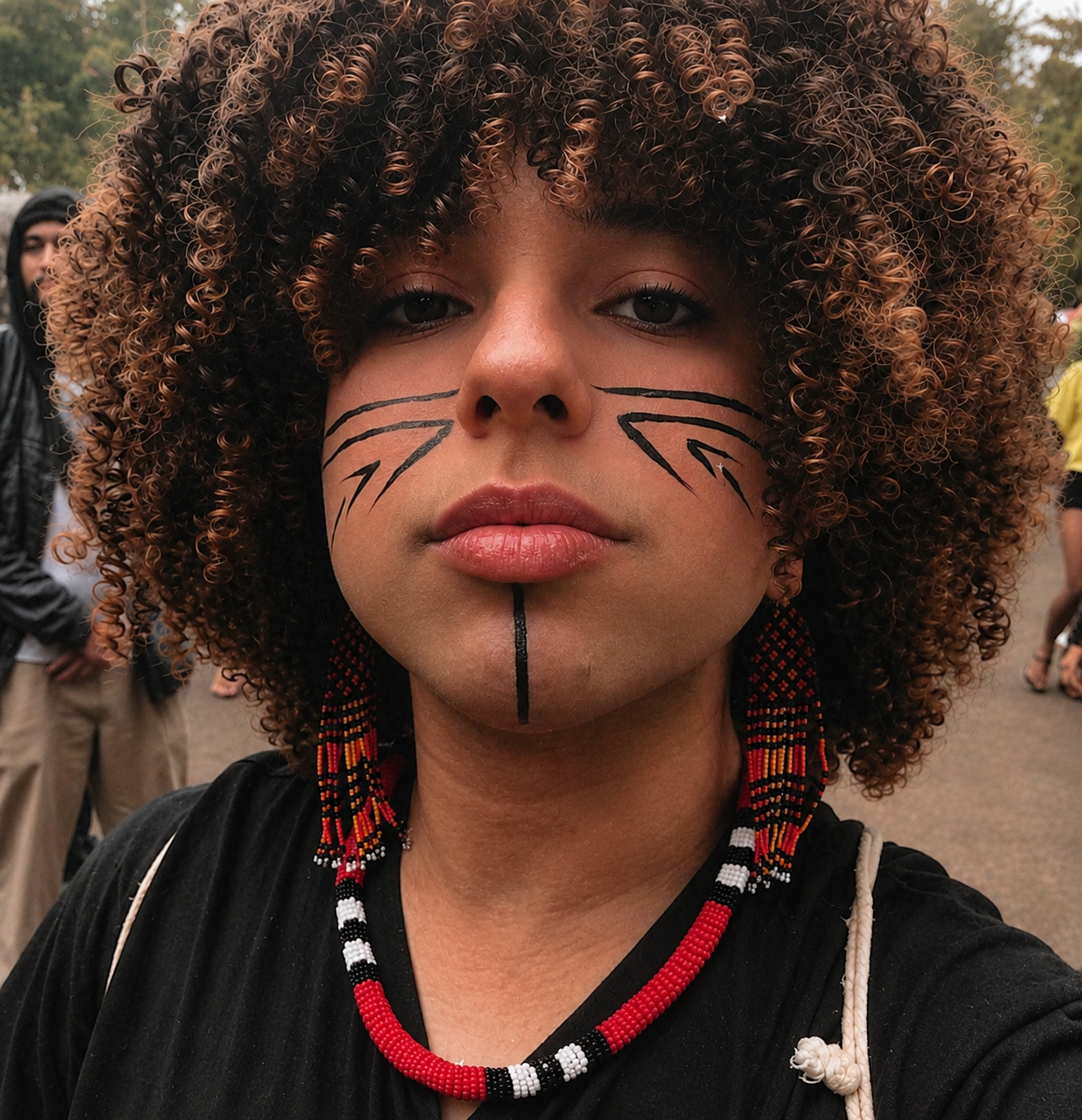
The journey of Lana Potiguara (Potiguara), a 28-year-old trans/Tybyra woman, is a living manifesto that existence cannot be fragmented. Walking between the coast of Paraíba and the streets of Rio de Janeiro in Brazil, she weaves her identity through art and education. An illustrator, visual artist, and 2D Animation graduate from Estúdio Escola, Lana uses her lines to give shape to memories that colonialism tried to erase, a powerful impact that also echoes in the digital world, where she has built a community of over 50,000 followers on social media (@lanaflowerz). A pedagogy student at Universidade Federal Fluminense (UFF), she co-founded the Indigenous Students' Collective (CEI-UFF) to ensure that her people had not only access but also permanence in the academic space. Today, she divides her routine between her studies and an internship at the Guarani Para Poty Indigenous School in the Mata Verde Bonita Village, in Maricá, where she collaborates on building the new Political-Pedagogical Project. Dreaming of creating an animated feature film that celebrates Indigenous cultures and Brazilian folklore through an authentic lens, Lana invites us in this interview to rethink the limits of visibility, the urgency of belonging, and the power of collectivity. Cultural Survival recently spoke with Lana.
Cultural Survival: What does it mean to you to feel pride in your Indigenous identity, and how does it differ from more visible or urban 2SLGBTQ+ narratives?
Lana Potiguara: To feel pride in my Indigenous identity is to recognize that I am part of a history larger than myself. It means honoring my ancestors, my Potiguara Peoples, and the knowledge that has resisted despite centuries of erasure.
As an Indigenous trans woman, I notice that my experience does not always fit into the most visible 2SLGBTQ+ narratives, which are generally built in urban contexts. My lived experience also involves ancestry, territory, and community belonging. I do not separate my Indigenous identity from my trans identity: when I fight for the rights of one, I am also fighting for the other.
CS: Pride is often discussed in terms of visibility, but visibility can also bring risks. How do you balance the desire to be seen with the need to protect yourself and your community?
LP: I learned that visibility, on its own, is not freedom. In 2020, I was kicked out of my home for being a trans woman and spent days experiencing homelessness during the pandemic. This taught me that existing publicly can bring recognition, but also exposure and violence.
Because of this, I believe that visibility must go hand in hand with responsibility. I seek to occupy spaces through art, education, and knowledge production, always thinking about strengthening my community and avoiding unnecessary simplifications or exposure. Not all resistance needs to be under the spotlight to have value.
CS: What aspects of your culture, language, spirituality, or territory helped you understand your gender identity or sexual orientation more deeply?
LP: I am a trans woman from the Potiguara people. By drawing closer to Indigenous histories, ancestral wisdom, and the relationship with the territory, I understood that human diversity is much greater than the rigid categories imposed by colonization.
Today, my experience at the Guarani Para Poty Indigenous School reinforces this perception daily. Learning from the children, the educators, and the community shows me that identity is also about belonging, memory, and relationship with the collective.
CS: What colonial ideas do you think still influence how some communities understand gender, sexuality, or diversity?
LP: One of the main colonial legacies is the idea that only two legitimate genders exist, with rigid roles for each of them. There is also a persistent notion that 2SLGBTQ+ people are something "imported" or incompatible with Indigenous cultures.
In reality, it was the colonial and religious processes that attempted to erase diverse ways of existing that were already part of the human experience before the European invasion.
CS: When you hear the phrase “this did not exist in our cultures before,” how would you respond based on your experience or the memory of your people?
LP: I would respond that the absence of records does not mean the absence of existence. Many Indigenous stories were silenced over the centuries. Furthermore, Indigenous peoples did not always understand identity and sexuality through the same categories used today. The historical erasure caused by colonization cannot be mistaken for nonexistence.
CS: What wounds are caused by the need to choose between belonging to your Indigenous community and belonging to the 2SLGBTQ+ community? Is it possible to inhabit both without fragmenting yourself?
LP: The deepest wound is feeling that you cannot exist as a whole. When someone is forced to choose between their Indigenous identity and their 2SLGBTQ+ identity, they receive the message that a part of themselves must be denied. I experienced the consequences of this rejection firsthand when I was kicked out of my home for being trans.
I believe it is possible to inhabit both spaces without fragmenting oneself. I am Indigenous, and I am trans. My existence is not a contradiction, but the convergence of these two lived experiences.
CS: How does Indigenous 2SLGBTQ+ resistance manifest beyond marches, flags, and institutional spaces?
LP: Resistance happens in everyday life: by studying, creating art, strengthening communities, and preserving memories. It was present when I helped found the Indigenous Students' Collective at UFF, when I participated in building the Political-Pedagogical Project of the Para Poty School, and when I tell Indigenous stories through illustration and animation. Often, resisting is simply continuing to exist.
CS: What is the role of Indigenous languages in naming identities, feelings, and bodies that often do not fit into Western categories like “gay,” “lesbian,” “trans,” or “queer”?
LP: Indigenous languages carry their own ways of understanding the world. While Western categories tend to be more rigid, many Indigenous wisdoms emphasize relationships, belonging, and processes. Therefore, valuing Indigenous languages also means valuing other ways of understanding human diversity.
CS: What would you say to organizations, media outlets, or allies who want to support 2SLGBTQ+ Indigenous people but sometimes end up using their stories in a tokenistic or exploitative way?
LP: I would say that true support requires commitment, not just representation. 2SLGBTQ+ Indigenous people need to participate in the decisions and the construction of narratives about their own lives. It is also fundamental to recognize our artistic, intellectual, and community work with respect, autonomy, and fair compensation.
CS: Imagining a truly free future, what would an Indigenous community look like where 2SLGBTQ+ people are not only accepted but also recognized as bearers of knowledge, leadership, and healing?
LP: I imagine a community where no one has to justify their existence. A place where 2SLGBTQ+ people can occupy spaces of leadership, education, art, spirituality, and care without their identity being seen as an obstacle.
A truly free future is one where Indigenous children can be who they are without giving up their roots, and where diversity is recognized as part of the community's collective strength.