
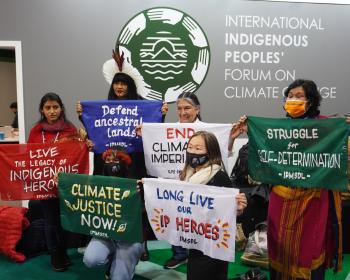
States Fail to Adequately Address Climate Change: An Indigenous Peoples’ Analysis of COP26 Decisions
Proyecto “Entrenando Mujeres Indígenas para la Defensa de sus Derechos Humanos”
Guatemala, México y Honduras
ÚLTIMA FECHA PARA APLICAR: 22 DE ENERO DE 2021
Sobre la organización y el proyecto
One year ago, on December 15, 2011, President Barack Obama announced that the United States would “lend its support” to the UN Declaration on the Rights of Indigenous Peoples. “The aspiration it affirms,” he said, “including the respect for the institutions and rich cultures of Native peoples, are one we must always seek to fulfill.”
In the shadow of the tenth anniversary of September 11, 2001, many people failed to recognize another significant event. Four years ago, on September 13, 2007, the United Nations General Assembly signed into existence the UN Declaration on the Rights of Indigenous Peoples (UNDRIP).
By Maya Lazzaro (Quechua, CS Staff)
Seventeenth meeting of the Conference of the Parties to the Convention on Biological Diversity 19–30 October 2026, Yerevan, Armenia
COP17 AGENDA ITEM: Opening Statement on behalf of the International Indigenous Forum on Biodiversity (IIFB) delivered by Andrei Isakov
Seventeenth meeting of the UN Conference of the Parties to the Convention on Biological Diversity, Yerevan, Armenia, 19–30 October 2026
Agenda Item 1.
This statement is submitted to UN CBD COP17 on behalf of Cultural Survival, an Indigenous-led organization.
We request that the Parties pay attention to and support the following set of issues regarding Indigenous Peoples.
From October 19 to October 30, 2026, the United Nations Convention on Biological Diversity (CBD) Conference of the Parties (COP17) is happening in Yerevan, Armenia.

Land Acknowledgement
We acknowledge that we are headquartered on Massachusett land, in Cambridge, MA, and we thank the past, current, and future Indigenous stewards of this territory.