By Jagat Man Lama Dong, Chairperson, Indigenous Rights Foundation
The rural municipality of Umakunda, located in the ancestral homeland of the Sunuwar Peoples, is a prime example of the disruption to communities caused by climate change. Many Sunuwar are leaving for cities because they can no longer earn a living from farming, their traditional occupation. Biren Sunuwar (Sunuwar) from Kubukasthali articulates the trend: “There is nothing in the village. It’s impossible to make a living here.”
Local residents confirm this alarming shift. Bharat Sunuwar (Sunuwar), a former teacher at a local school, attributed the increasing migration directly to climate change. “Traditional agriculture has disappeared, and modern farming has ruined the soil. The search for alternatives is forcing young people to choose their destiny in the city for foreign employment,” he says.
Ramesh Kumar Sunuwar (Sunuwar), Secretary of Sunuwar Welfare Society, says the presence of Sunuwar people in their ancestral territories along the Likhu, Khimti, and Sunkoshi rivers has become scarce. Rukman Sunuwar (Sunuwar), an official at the Umakunda Rural Municipality, says there had been a trend among Sunuwar to join the British or Indian military, but lately there has been a sharp increase in the number of people emigrating to Malaysia, Dubai, or Saudi Arabia for employment, mostly as cheap labor.
Indigenous Knowledge Under Threat
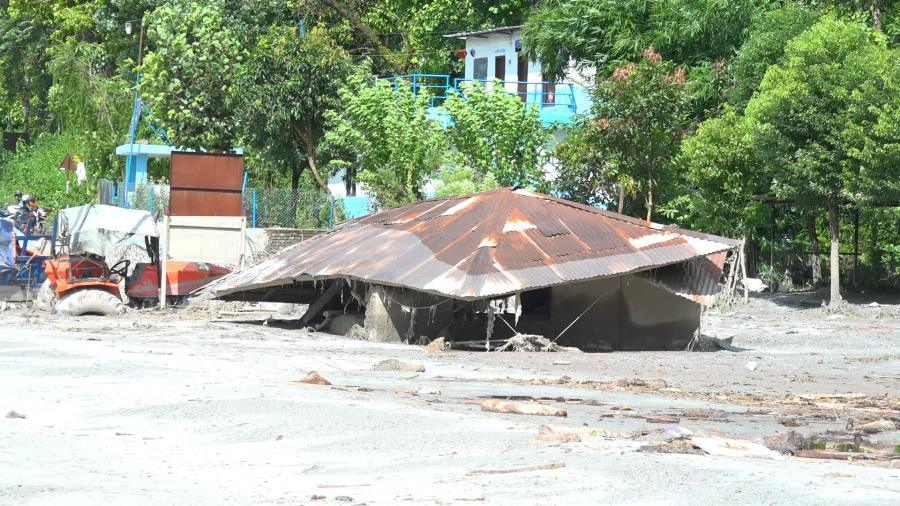
The field visit and interactions among Sunuwar community members highlight how environmental degradation is destroying the cultural and ritual practices of the Sunuwar Peoples. Kabita Sunuwar (Sunuwar) from Priti village says that the effects of climate change, such as irregular rainfall, flooding, and prolonged droughts, have caused a sharp drop in crop production. “Our indigenous crops like kaguno (foxtail millet) and ghaiya (upland rice) have stopped growing. Only a few plants [have survived], like millet, buckwheat, and maize,” she says.
Food insecurity is one factor forcing locals to leave their ancestral village. Another major factor, according to Anudevi Sunuwar (Sunuwar) from Kyadalu, is the drying up of important water sources in several villages, affecting both irrigation and drinking water. "Animals cannot survive without water, and this water shortage, along with food insecurity issues, is driving the crisis," she says. "Not just water, but the very foundations of life have been taken from us. Wild food and fruit sources have decreased. Medicinal herbs in the forests are no longer available."
Adding to the environmental degradation is the erosion of the Sunuwar Peoples' customs and rituals. Sunita Sunuwar (Sunuwar), also a resident of Kyadalu, points to the weakening of the traditional self-governance system, the Koich-Chuplu. She notes that the Neng Machha, a special species of fish necessary for the Syadar-Pidar rituals, has been lost due to more than 13 hydropower projects operating on the Likhu River alone.
The decline of Indigenous Ecological Knowledge is equally concerning. Kumar cites the Indigenous practices of Tharo Kyucha, an ancestral tradition for conserving pastures and medicinal herbs, and Safa-Phuilu Kyucha, a customary boundary demarcation method, that have been destroyed "in the name of so-called modernity."
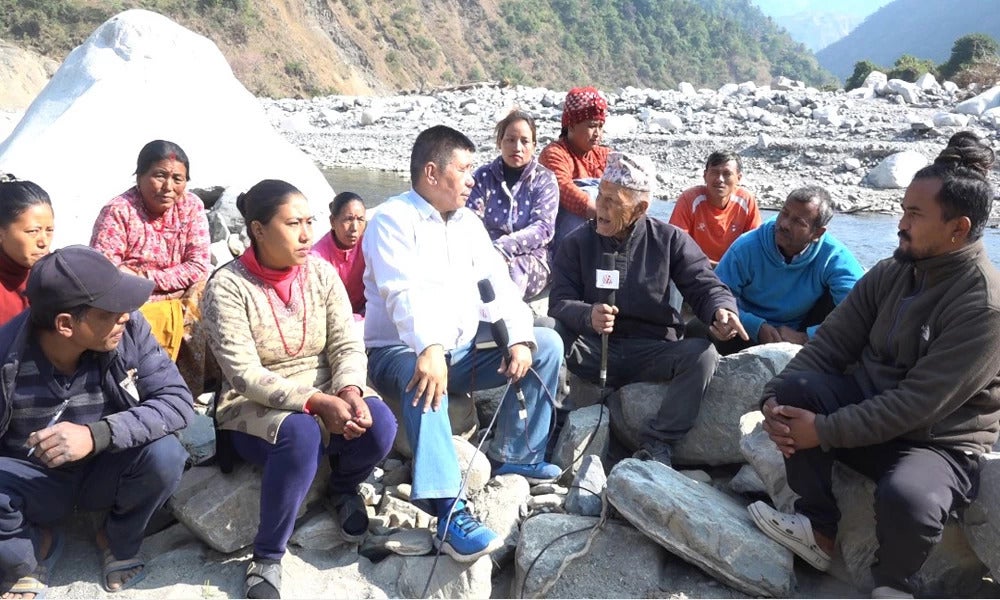
The media project was strategically designed to counter this systematic neglect by providing a platform for 16 different Indigenous nationalities. The Indigenous Rights Foundation conducted 17 media dialogues, which brought together local government representatives, Indigenous rights activists, and Indigenous community members to discuss the impacts of harmful government plans, including the construction of mega-hydropower projects, national park expansions, and forest conservation on their traditional land and territories.
Hour-long television programs based on these dialogues were broadcast live or on delay on satellite and cable channels, focusing on Indigenous and Ecological Knowledge held by 16 Indigenous Peoples and the critical challenges they face—loss of their language, forced displacement, the struggle for cultural identity, and challenges to accessing natural resources, which are important to their livelihoods, cultures, and rituals.
The media dialogues included key voices from particularly marginalized groups among the Indigenous nationalities, namely the Kusunda, whose critically endangered language faces extinction due to displacement and non-supportive government plans and policies, and the Hayu, who spoke out about their identity crisis. The media dialogue also highlighted the Ecological Knowledge of the Kulung, who shared their practices of using nettle for clothing and protection—a climate adaptation strategy rooted in Traditional Knowledge.
The dialogue also provided a platform for the Bote Peoples, who struggle to make a living by searching for gold raw materials in the Narayani River; the Dhimal, who have been forced into relocation and displacement; and the Meche, who shared their loss of ancestral land and resources. Rajbansi and Tajpuria women showcased their role in disaster preparedness, while the Kisan Peoples discussed how non-recognition has led to the erosion of their civilization, and the Nachhiring Rai shared their efforts to tackle their identity crisis.
The media dialogue also highlighted the discrimination faced by Santhal Peoples in accessing resources, the intense climate crisis-induced hardship faced by the Raji, who have been displaced from riverbanks and forests, and the impacts on the Tharu Peoples due to the establishment of Bardia National Park on their land and territories. The Baram Peoples shared how they are losing their language, culture, and knowledge due to the government’s failure to implement the constitutional guarantee for special protected areas for them.
A key example of neglected Traditional Knowledge that could be used in climate crisis mitigation is that of the Tajpuria Peoples, who live mainly in Jhapa and Morang districts in eastern Nepal, and their traditional practice of preserving ponds. “It is necessary for every Tajpuria person’s house to have a pond in their courtyard. This is both our custom and culture,” says Tej Narayan Tajpuria (Tajpuria), a resident of Sunbarshi municipality in Morang district.
The ponds are not just water reservoirs; they are essential for carbon sequestration, flood and drought control, and temperature management. Tajpuria ancestors developed and practiced these crucial climate mitigation practices for generations. Sumitra Tajpuria (Tajpuria), chairperson of Tajpuria Women’s Association, explains that rivers, streams, and ponds are closely linked to the Tajpuria people’s livelihood, culture, and festivals such as Siruwa, Jituwa Paun, and Holi. However, increased sand extraction, diverted river paths, and nationalization of public ponds are drying up these important sources, directly affecting their culture.
The spiritual philosophy of the Tajpuria Peoples further reinforces their environmental ethics. Tajpuria are nature worshipers. “Gods or divinity are not confined within the idols of a temple. They are alive in the scent of the soil, the flows of water, and the whisper of the wind,” explains Aetwarlal Tajpuria (Tajpuria). This spiritual foundation is itself a silent, yet effective practice of climate mitigation.
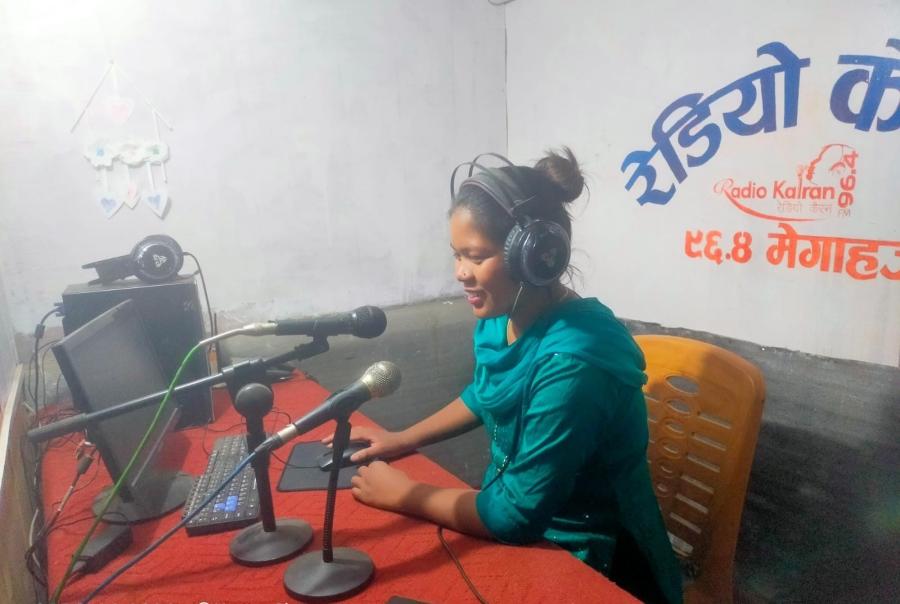
In addition to the media dialogue, the Indigenous Rights Foundation raised public awareness through a series of Public Service Announcements, created in different Indigenous languages and broadcast across television and social media platforms. These PSAs educated wider audiences on Indigenous Peoples’ rights, Traditional Ecological Knowledge, and preservation of languages and cultural practices.
A documentary was also produced with the Tajpuria community as a case study to illustrate how Indigenous Peoples are working to adapt to the evolving climate crisis. The documentary showcases the systemic disconnect between national climate action strategies and the grassroots realities of Indigenous Peoples.
The Foundation also produced special reports, 17 TV programs, and in-depth field reports highlighting the exclusion of Indigenous Peoples’ voices in Nepal’s Nationally Determined Contribution (NDCs), government plans and programs, and the disproportionate impact of the climate crisis on Indigenous Peoples, all due to neglect of Traditional Knowledge. The media initiative has been instrumental in providing Indigenous Peoples’ perspectives to the national dialogue.
In 2024, Media Aid for Indigenous and Pastoralists Community (MAIPAC) received a grant from Cultural Survival’s Indigenous Community Fund, which provides opportunities for journalism, broadcasting, audio editing, technical skills, and more for community media from Indigenous communities around the world. In 2025, the Fund provided $502,000 in grants to 63 Indigenous communication projects benefiting Indigenous communities in 29 countries across the Americas, Africa, and Asia, and Ocenia, including Argentina, Bangladesh, Bolivia, Botswana, Brazil, Chile, Ecuador, Colombia, United States of America, Philippines, Guatemala, India, Kenya, Mexico, Nepal, Peru, South Africa, Democratic Republic of Congo, Indonesia, Honduras, Mali, Nicaragua, Cambodia, Chile, Canada, Panama, Paraguay, Papua New Guinea, New Zealand, Nicaragua, and Tanzania.