February 13 is World Radio Day!
Today marks the 15th annual celebration of World Radio Day, as proclaimed by UNESCO.
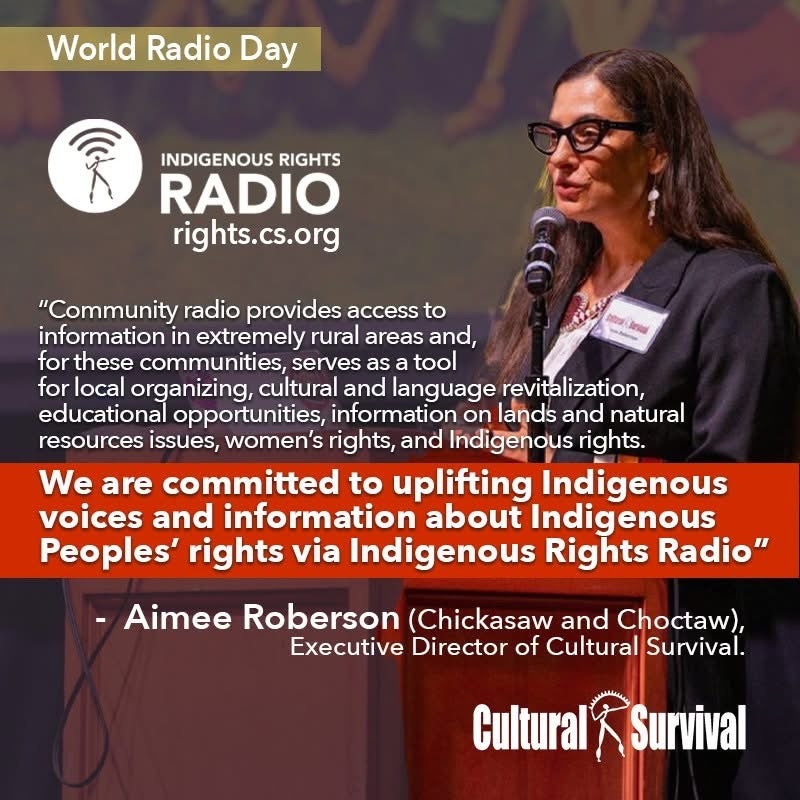
On the first celebration of World Radio Day in 2012, former UN Special Rapporteur on the Rights of Indigenous Peoples James Anaya (Apache and Purépecha) emphasized the importance of community radio for the world's Indigenous Peoples, "Radio has been a fundamental means for Indigenous Peoples to maintain their languages and to exercise and defend their rights."
Cultural Survival continues to work to implement Indigenous Peoples' right to establish their own self-determined communication platforms as enshrined in Article 16 of the UN Declaration on the Rights of Indigenous Peoples. In 2025, our Indigenous Community Media Fund supported 63 community media projects in 29 countries, totaling $502,000. Our Indigenous Rights Radio program released 157 Indigenous Rights Radio programs in Spanish, English, and 17 Indigenous languages and distributed them to over 800 radio partners across the globe.
Our advocacy for Indigenous community media focuses on pushing for the democratization of radio frequencies by changing telecommunication laws in countries where Indigenous Peoples want to have their own radio stations and where they face criminalization for claiming their right to freedom of expression. We continue to push for the implementation of the 2021 Inter-American Court of Human Rights ruling related to community radio stations in Guatemala.
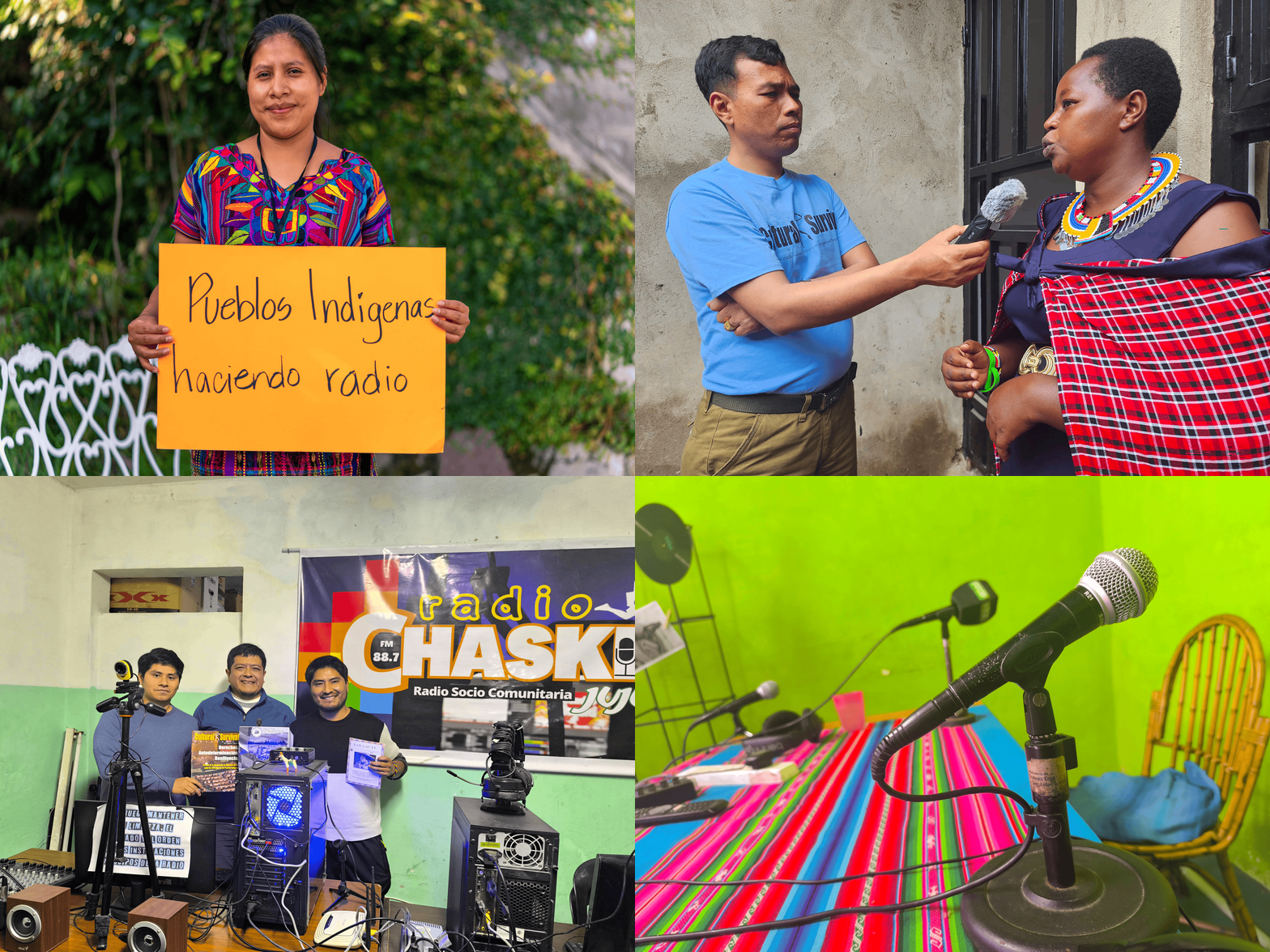
In many parts of the world, despite the risk of police raids, jail time, threats, and even death for community journalists, community radio stations serve a vital function by distributing information about important news and educational programming like emergency disaster relief, voter registration, and public health campaigns. The power of radio reaches even the most rural areas, providing Indigenous communities with access to programming in their own languages and serving as a voice that promotes Indigenous cultures, traditions, and belief systems.
Support Indigenous Community Radio Today!
Learn about the Historic Win for Indigenous Community Radio!
 On December 17, 2021, the Inter-American Court of Human Rights announced its decision in the case Indigenous Maya Kaqchikel Peoples of Sumpango vs. Guatemala, declaring the Republic of Guatemala “internationally responsible for the violation of the rights to freedom of expression, equality before the law and participation in cultural life” of Indigenous Peoples. This decision is historic in protecting Indigenous Peoples' rights to expression and culture and promoting pluralism in media. The Court ordered the Guatemalan government to allow Indigenous broadcasters to operate "freely and without interference" and to legalize community radio stations. Learn more.
Meet Our Indigenous Community Media Grant Partners!


Because Knowledge is POWER
Cultural Survival continues to celebrate the power of radio by representing diverse voices and perspectives in the Indigenous world through our ever-expanding Indigenous Rights Radio audio program library.

A New Chapter For Khoekhoegowab - Nama Online Radio Is Here
The Nama people of Botswana are a small Indigenous community belonging to the wider Khoekhoe cultural and linguistic group of southern Africa. To preserve the Nama language in Botswana and to communicate in the language of the Nama people, a new online Nama language radio station was launched in 2026. Nichodimas Cooper tells us more.

A Platform To Preserve Our Language and Culture - Vemuganga FM - Zimbabwe
Vemuganga Community Radio (FM 106.8) is a grassroots media initiative based in Chipinge district in south-eastern Zimbabwe. Vemuganga Community Radio has played a transformative role in bridging this gap by ensuring consistent and community-centred dissemination of news, educational programming, and cultural content. We spoke to the station manager, Claris Maduku, who told us about some of the challenges he and the station's staff face.
Language Revival Initiatives in Asia
Of the estimated 7,000 known languages globally, 32 percent of them, which means as many as 2,300 languages, are spoken by Indigenous Peoples living in Asia. But lately, Indigenous languages are disappearing at an alarming rate around the globe.
Radio Promotes Diversity
Radio is a powerful medium for celebrating humanity in all its diversity. For Indigenous Peoples in many countries, radio is the most accessible platform to have their say in their native languages. Radio, therefore, is a fundamental means of communication for Indigenous Peoples to maintain their languages and to exercise and defend their rights. Moreover, radio is a means of ensuring the right to information in all sectors of society. For Indigenous Peoples, however, access and ownership of the radio station, and means of production of information in our languages, are essential. nership of the radio station, and means of production of information in our languages, are essential.

¡Celebremos el Día Mundial de la Radio!
Las radios comunitarias Indígenas son una herramienta para la memoria, para la defensa del territorio, para asegurar la existencia de las lenguas originarias, de la música y de la cultura. Por esta razón, en el marco del Día Mundial de la Radio, en Radio de Derechos Indígenas queremos celebrarlas y presentar a algunas de nuestras emisoras socias.
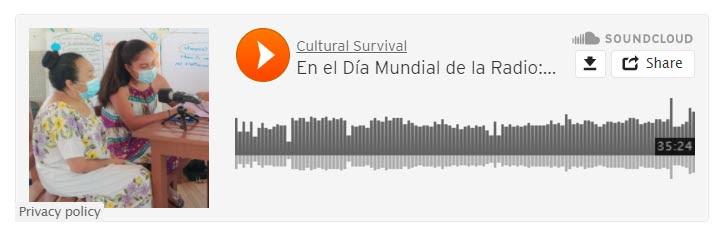
Día Mundial de la Radio
En el marco del Día Mundial de la Radio, Cultural Survival ha preparado un programa especial sobre la importancia de la radio para los Pueblos Indígenas, y cómo por medio de ella han promovido y defendido sus derechos al territorio, la cultura, los idiomas, entre otros. Los invitamos a escuchar y aprender con nosotros sobre este medio de comunicación tan importante. ¡Que vivan las radios comunitarias Indígenas!

Apropiación tecnológica y mujeres en la radio
¿Cuál es la importancia de que las mujeres que forman parte de radios comunitarias Indígenas sean autosuficientes en temas tecnológicos? ¿Por qué es necesario que en las radios comunitarias los saberes y aprendizajes se compartan entre todas y todos? En este programa, mujeres Indígenas comunicadoras reflexionan sobre esta y otras preguntas.