
In recent years, global health and environmental institutions have increasingly recognized that Indigenous Peoples are central to biodiversity conservation, human health, and climate resilience. Yet, a persistent gap remains between the recognition of Indigenous leadership and the concepts and frameworks these leaders use to understand health, the environment, and the interconnectedness of all that exists. The Indigenous Determinants of Health (IDH) Framework emerged as a practical tool to guide policy, financing, and implementation based on the provisions of cultural safety and the UN Declaration on the Rights of Indigenous Peoples to address this gap.
Sponsored by the UN Permanent Forum on Indigenous Issues, the IDH Framework was unveiled in 2023 with a study “Indigenous Determinants of Health in the 2030 Agenda for Sustainable Development,” which reframed health beyond conventional indicators. It established Indigeneity as an umbrella determinant of health, including 33 risk and protective factors specifically impacting Indigenous Peoples’ health. This assertion established that Indigenous health is not solely defined by access to services, but through the integrity of relationships among Peoples, lands, governance systems, and knowledge. At its core, this study positioned self-determination as a primary determinant of health, shifting the narrative from vulnerability to rights.
The 2024 IDH study “Improving the Health and Wellness of Indigenous Peoples Globally: Operationalization of Indigenous Determinants of Health” expanded this foundation more broadly, reinforcing that Indigenous worldviews are interconnected with all aspects of life and Mother Earth. This study marked a decisive shift toward structural and operational guidance explicitly designed to provide tools for UN entities, member states, and other institutions to implement Indigenous determinants of health in policy and practice. It outlines the institutional transformation required to do so, including recognizing Indigenous Peoples as rights-holders, embedding Free, Prior and Informed Consent, ensuring meaningful representation in decision-making, and developing organizational policies and procedures that support Indigenous-led approaches.
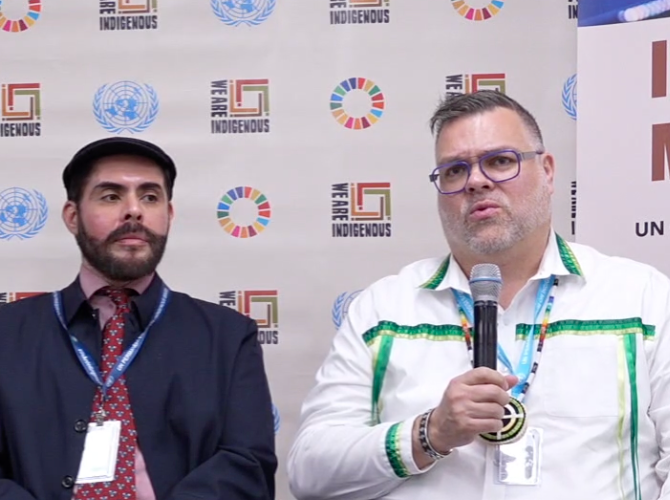
Geoffrey Roth speaking at the UNPFII Indigenous Media Zone. Photo by Jamie Malcolm-Brown.
The 2025 study, “Evaluating Institutional Structures to Improve the Health and Wellness of Indigenous Peoples Globally: The Indigenous Determinants of Health Measurement Instrument” introduced the IDH Evaluation Instrument to assess how well institutions are addressing Indigenous health risks and protective factors, and whether they are equipped to uphold Indigenous rights in practice. It expands evaluation to include governance, environment, and community well being, offering a scorecard tool to support culturally safe, rights-based approaches and institutional accountability.
The IDH Framework does not simply add new indicators: it redefines the system of analysis, requiring institutions to account for rights, governance, and relationships, not just outputs. For that reason, the 2026 IDH study, “Restoring Indigenous Health by Connecting Systems Through the Indigenous Determinants of Health: Local to Global Evidence,” focused on demonstrating how
Indigenous health is a systems integrator and an indicator of the outcomes across sectors. In other words, Indigenous health must be understood as a diagnostic indicator of the integrity of policies across sectors, reflecting how decisions related to land, environment, governance, culture, and knowledge systems directly shape Indigenous well being.
In 2023, 2024, and 2025, the UN Permanent Forum on Indigenous Issues put forward targeted recommendations urging member states and UN agencies to adopt the concept of Indigeneity, the IDH Framework, and its evaluation instrument as tools to advance Indigenous rights, promote peace, and support Indigenous-led environmental governance and global justice.
Following the 2023 World Health Organization’s Executive Board recommendation to recognize Indigeneity as a determinant of health, the WHO Report on the Social Determinants of Health Equity, released in 2025, officially recognized Indigeneity and acknowledged Indigenous Peoples’ specific determinants of health. Such recognition reflects the understanding that Indigenous health is holistic and encompasses all aspects of life beyond the clinical setting into the environment and the health of Mother Earth.
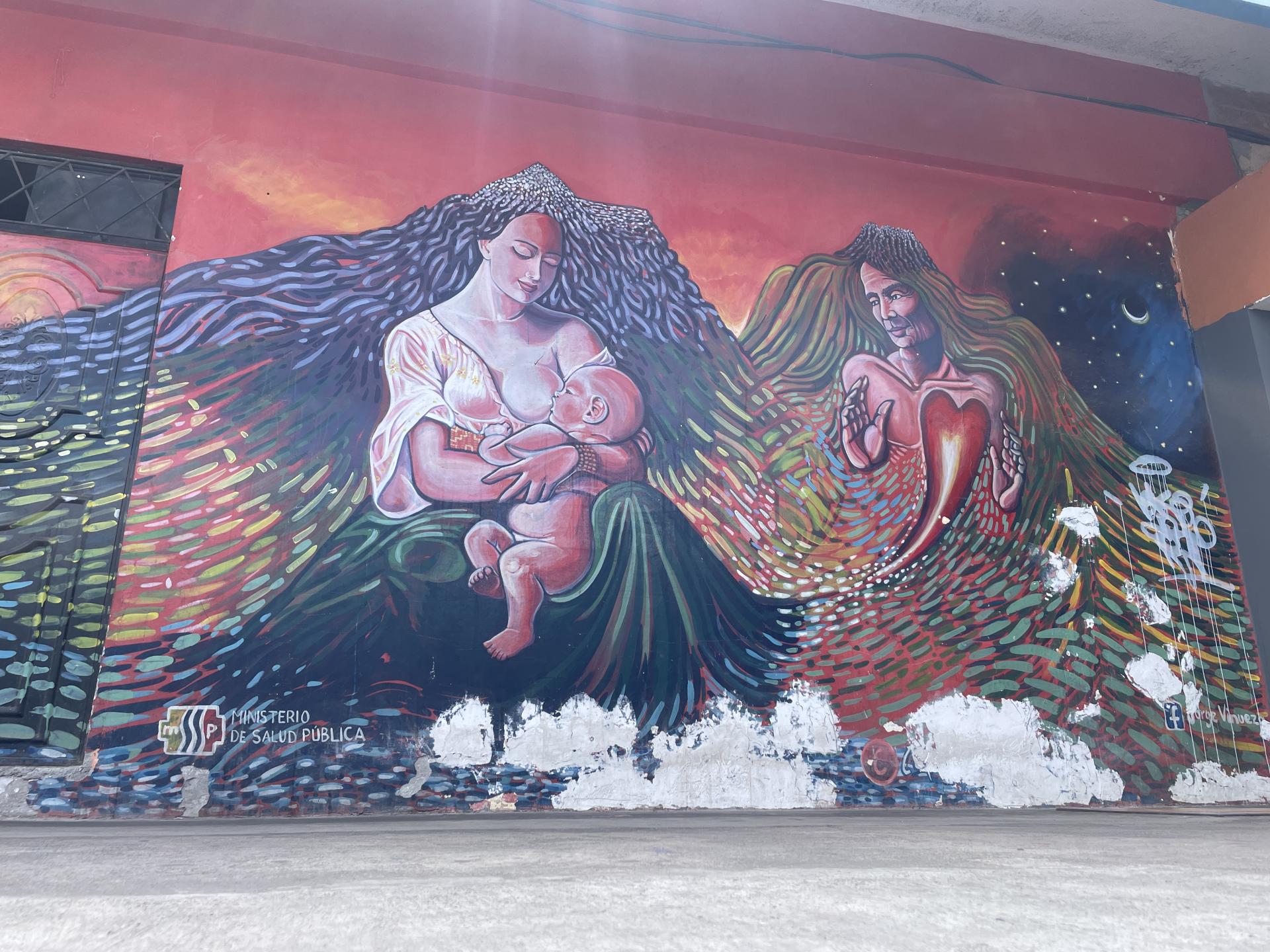
Mural by Jorge Vinueza in Ecuador commissioned by the Ministry of Public Health.
Subsequent to the UN Permanent Forum’s recommendation, the UN Convention on Biological Diversity issued Decision 16/19 in 2024, which officially references the IDH Framework as part of its Global Plan of Action on Biodiversity and Health. The implementation of the IDH Framework across UN agencies allows for Indigenous Peoples to have an encompassing platform to advance local Indigenous needs through a framework that respects, fosters, and protects Indigenous rights in all aspects of life.
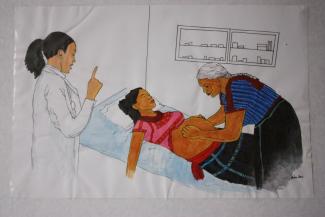
One of the clearest examples of the relevance of the IDH evolution as a holistic platform is Indigenous midwifery. Indigenous midwifery is not limited to childbirth as a clinical event; it is a system of health, rooted in relationships between people, land, knowledge, and spirituality. Midwives serve as knowledge holders, caregivers, and community leaders, guiding not only the birthing process but the full integration of new life into cultural, territorial, and spiritual systems. This reflects a core principle of the IDH Framework: that health is relational, intergenerational, and grounded in Indigenous governance and knowledge systems.
Indigenous midwifery practices are deeply connected to territory. Birth is supported through culturally specific practices that draw on local ecosystems such as medicinal plants, traditional foods, and environmental conditions appropriate to each region. Indigenous midwifery demonstrates that people’s health is inseparable from the health of their land, biodiversity, and knowledge systems.
However, Indigenous midwives face many systemic barriers that reflect broader structural issues, including a lack of recognition of Indigenous governance, knowledge systems, and rights. Their ancestral knowledge is often subordinated and devalued by policies that treat the practice as auxiliary to biomedical systems, denying its autonomous character. Processes of professionalization and certification—often framed as ensuring safety or “inter-culturality”—can regulate and reshape Indigenous midwifery to conform with external standards. And in some areas, their practices are criminalized.
At the same time, Indigenous midwifery has shown resilience. During public health crises and in remote regions with limited biomedical access, midwives often serve as primary providers of care, sustaining community health through culturally grounded practices. Their work illustrates that Indigenous health systems are not peripheral, but fully functioning systems of care beyond clinical settings.
The IDH Framework helps make these realities visible. It underscores that strengthening Indigenous health requires not only improving access to services, but recognizing, protecting, and supporting Indigenous systems of care—including midwifery—as autonomous, rights-based systems fundamental to communities’ well being. It affirms that protecting Indigenous Knowledge, governance, and relationships to land is essential to sustaining health across generations.
--Geoffrey Roth (Lakota descendant of the Standing Rock Sioux Tribe) is Chair of the Indigenous Determinants of Health Alliance, and former UNPFII Expert Member and Vice-Chair. Dora-Lucia Mendez-Alfonzo (Tseltal) is a midwife from the Alianza Continental de Parteras Tradicionales e Indigenas de las Americas. Alejandro Bermudez-del-Villar (Mestizo) is part of the Cedar Rock Alliance and the Indigenous Determinants of Health Alliance.
Key aspects of the WHO-recognized Indigenous Determinants of Health
• Core Pillars: Indigeneity as an overarching determinant of health; Connection to traditional lands, territories, and resources; cultural continuity; language revitalization; and self-determination.
• Structural Factors: Impacts of colonization, systemic racism, and the need for Indigenous-led governance in health systems.
• Holistic Wellness: Balance of spiritual, environmental, physical, and mental dimensions, often viewed as a collective rather than purely individual right.
• Environmental Connection: The relationship with Mother Earth and the stewardship of biodiversity.
• Key Drivers: Intergenerational wisdom, traditional healing practices, and community resilience.
Photo Caption:
Geoffrey Roth speaking at the UNPFII Indigenous Media Zone.
Photo by Jamie Malcolm Brown.
Top photo: Drawings of midwives from the Área de Mujeres y Parteras de la Organización de Médicos Indígenas del Estado de Chiapas, Mexico.