An investigation into how unregulated sand extraction is draining water sources and reshaping pastoral life in Kenya’s drylands.
By Lucas Kasosi (Maasai, CS Fellow)
At sunrise along the Olkeriai River in Mashuuru, Kajiado County, the riverbed no longer looks like a waterway. Instead, it looks like an open quarry: scarred, excavated, and restless.
Young men plunge spades into the sand with a practiced rhythm as heavy trucks idle nearby waiting to be filled, engines throbbing in the cool morning air. The lorries sit like patient predators on the riverbed, their tires cutting deep grooves into what used to be a living system of sand, water, and vegetation.
A few meters away, women kneel quietly in the same sand, digging not for profit, but for water. They scrape deeper and deeper until a thin seepage begins to pool at the bottom of a small pit. The water is cloudy, slightly brackish. But it is still water.
“Before, the river was good. We fetched clean water easily,” says Leah Peter (Maasai) from Nairagie Enkare, Olkeriai. “Now we dig. The water is salty. And whether you like it or not, you must drink it; we have no alternatives.”
For communities living along the Olkeriai River, water is no longer collected—it must be excavated. And what is unfolding here is not simply a local environmental change; it is the frontline of a vast and largely invisible supply chain that connects Kenya’s rural drylands to the cranes and skyscrapers rising hundreds of kilometers away in Nairobi.
Every truck leaving Olkeriai carries sand that will become concrete, to be poured into apartment blocks, highways, and shopping malls in East Africa’s fastest-growing city.
Nairobi’s skyline, home to more than 5 million people, is expanding at breakneck speed. Few residents pausing to admire the towers understand that much of the material holding those buildings together is mined from rivers like Olkeriai.
Kajiado is part of Kenya’s Arid and Semi-Arid Lands (ASAL), ecosystems that carry the country’s contradictions. The ASALs are richly endowed with natural resources and make a significant contribution to the national economy, yet they remain the zones of deepest poverty and vulnerability. More than 30% of Kenya’s population lives in these drylands. Their livelihoods are built on adaptation and ecological intelligence, but increasing pressure on land, rising temperatures, and unreliable rains have tightened the margins of survival.
As rural incomes decline, communities are pushed into desperate coping strategies of clearing land for cultivation, cutting trees for fuelwood, quarrying, and increasingly, uncontrolled sand harvesting. In policy speak, it is “resource utilization.” In the language of the riverbed, it is extraction. And in the language of women digging for salty water, it is loss.
Sand harvesting, as residents describe it, has become both livelihood and threat. It is a daily wage for the unemployed and an emergency cash economy for households hit by drought. But it is also dismantling the very hydrology that makes life possible in this landscape.
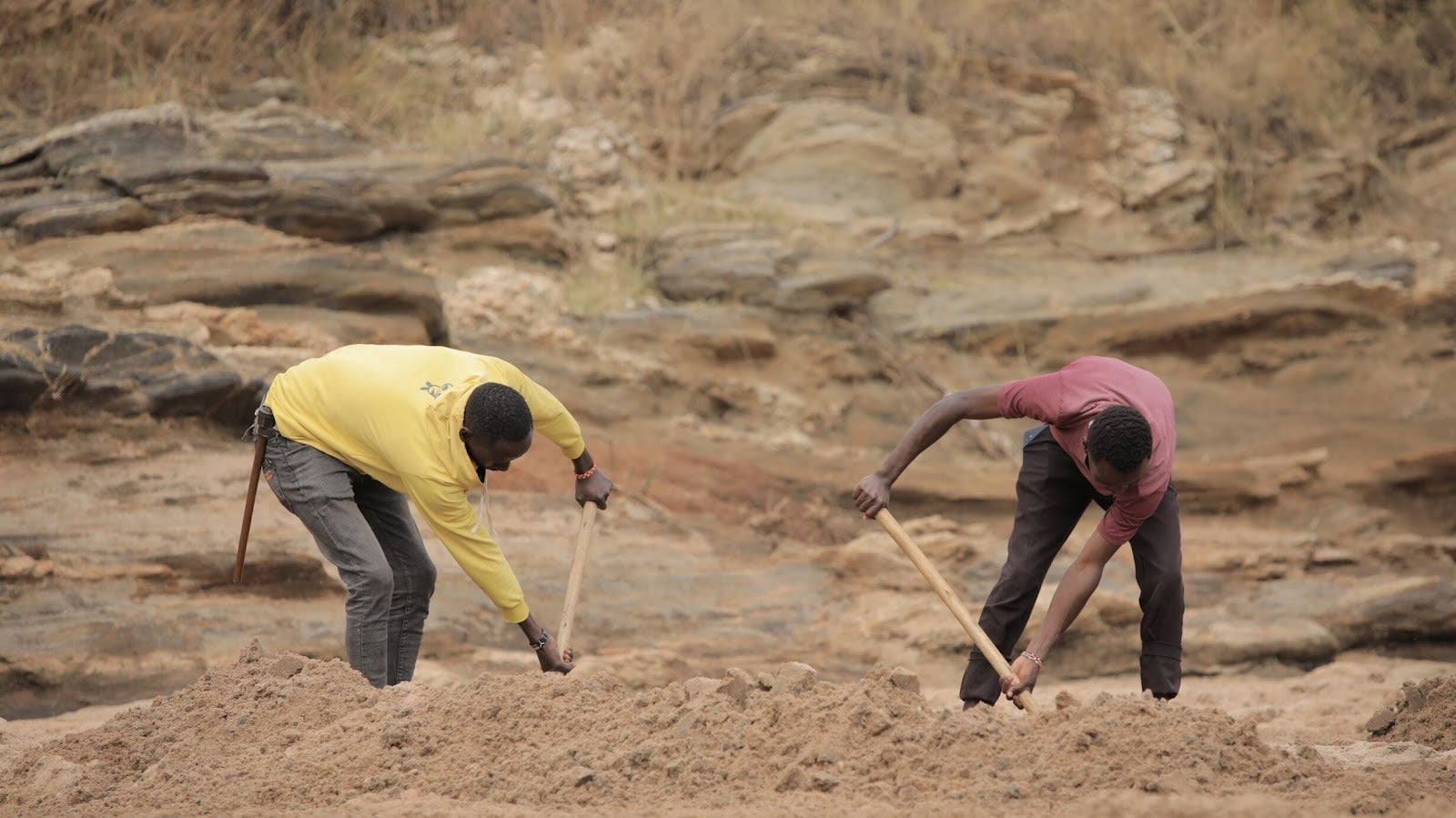
Young men harvest sand from the Olkeriai Riverbed in Kajiado County, where growing demand for construction materials is transforming seasonal rivers.
The humanitarian consequences are already visible. Women now wake before dawn to dig water from the sand. Livestock trek further each season to find drinking water. Children abandon classrooms to work loading trucks. Dust from constant lorry traffic settles over homes and schools, while oil spills from excavation machinery seep into shallow wells.
In schools near harvesting sites, teachers describe dust clouds drifting into classrooms while heavy trucks thunder past throughout the day. Residents report rising respiratory illnesses linked to dust pollution, while gastrointestinal diseases are increasingly associated with contaminated water sources.
Heavy vehicles transporting sand also create safety risks along rural roads. Residents describe frequent accidents involving overloaded trucks speeding along narrow dirt roads used by pedestrians and livestock. For pastoralist communities whose survival depends on water and grazing lands, the crisis goes far beyond economics. It threatens culture itself.
The story of Olkeriai is therefore not simply about sand. It is about who bears the costs of development, who benefits from resources, and whose rights and governance systems are respected when the land is transformed.
A River that Sustained Pastoral Life
For generations, the Olkeriai River formed part of a pastoral ecology that sustained Maasai communities through seasons of abundance and seasons of scarcity. Pastoralism is not just an economic activity here; it is a cultural system, one built on movement, reciprocity, and a deep understanding of what land can bear.
In Maasai landscapes, rivers are more than channels of surface water. Seasonal rivers store water underground through sand. When it rains, water filters into thick deposits in the riverbed, forming a natural aquifer. In dry months, people can dig shallow wells in the sand and draw clean water long after surface flows disappear.
This is one reason sand matters: it is ecological infrastructure. It holds water. It stabilizes banks. It protects soil from eroding into gullies. It supports vegetation that anchors the river corridor. This is the role the sand played for Olkeriai, until it was removed faster than the river could replenish it.
Sylvia Nkaadu (Maasai) grew up here. When she speaks about the river, her words carry both memory and warning. “We grew up when this place was beautiful,” she says. “The riverbanks were not even visible because the water filled the whole place. But now the water has vanished, and stones lie bare on the surface.”
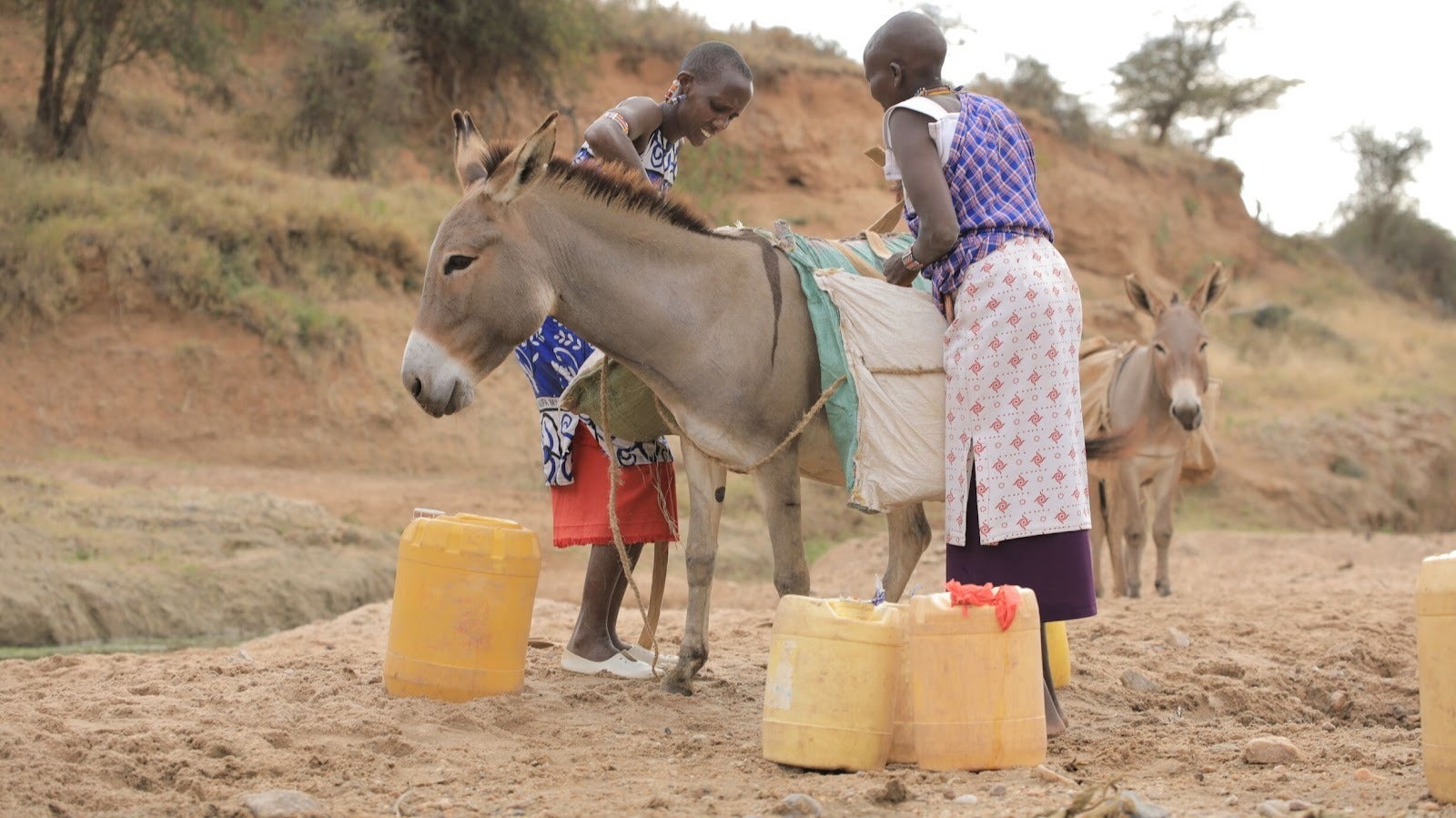
Women load jerrycans onto a donkey after collecting water from the Olkeriai Riverbed, where sand harvesting has made access to clean water increasingly difficult.
She connects the decline to the arrival of commercial sand harvesting. “When the trucks started coming, that is when the river started declining. Now even getting water is difficult. You must dig deep to reach it,” Nkaadu says.
In pastoral landscapes, such a change reshapes household routines, livestock health, and the ability of families to withstand drought. “If this continues for five more years, this river will dry forever. Only stones will remain,” Nkaadu warns.
The Sand that Builds Cities and the Inequality It Leaves Behind
The sand removed from Olkeriai does not stay here. It leaves the county in long convoys headed north toward Nairobi, Kitengela, Athi River, and other rapidly growing urban centers. Kenya’s construction boom has created an enormous demand for river sand, which builders often prefer for concrete. The proximity of Kajiado to Nairobi, especially along the Nairobi–Namanga Highway, has turned sand into what many residents call “the new gold.”
This is not only a Kenyan story. Around the world, sand and gravel, collectively known as aggregates, are among the most heavily extracted materials, globally recognized as the second most extracted resource after water.
The United Nations Environment Program’s 2019 assessment warns that uncontrolled sand harvesting reduces water availability in riverbeds, dries boreholes, increases erosion, destabilizes riverbanks, and degrades ecosystems, particularly in regions where governance is weak and enforcement is inconsistent. That warning resonates sharply in Kajiado’s drylands, where climate stress already narrows the margin for ecological damage.
In Kajiado, the trade has reached an industrial scale. More than 500 trucks haul sand out of Kajiado’s riverbeds every day, feeding construction projects in Nairobi, Athi River, Machakos, and other growing urban centers. County revenue projections reflect the scale of the business: in the 2023-24 fiscal year, sand, gravel, and ballast extraction fees were budgeted at about KSh 126 million, or just under $1 million USD.
The numbers suggest a thriving industry. But in Olkeriai, residents describe an economy where value is extracted outward while harm remains at the source. “It is our sand that is going,” Sylvia Nkaadu says, “but our land is left ruined.”
A trailer sits at a sand loading site in the Olkeriai Riverbed at night, awaiting transport.
The imbalance becomes clearer when residents speak about prices. A truckload may bring around KSh 3,000 ($23 USD) at the source, often shared among landowners, loaders, and community arrangements. Yet along the supply chain, that same sand can fetch far more in urban markets.
Investigations into illegal and informal sand trade in Kenya have shown transport companies making extraordinary profits, with some reports describing margins up to 900% per lorry once the sand reaches final buyers. In that arithmetic lies a moral question: who bears the environmental cost of wealth accumulated elsewhere?
“We sell a lorry [load] for about 3,000 shillings,” says Sylvia Nkaadu, standing beside the scarred riverbed. “But our cattle drink salty water now.”
In drylands, degradation deepens poverty. The very places supplying the raw materials for Kenya’s urban modernity are left with collapsing riverbanks, dust-choked villages, and shrinking water sources. For communities whose identity and economy are tied to livestock, water loss is not merely an inconvenience. It is existential.
Women Digging for Water, Men Loading for Survival
As extraction increases, women carry the daily consequences most directly. In Maasai households, women traditionally manage domestic water, food, and care work. When water sources vanish, the labor of survival expands. The loss is measured not only in liters, but in hours, health, and safety. When wells dry, it is women who dig deeper.
“People come from far away to dig water here,” Peter says. “Women wake very early because it takes time to find water.” What they find is often salty. But the choice is not between clean water and salty water. It is between salty water and no water at all.
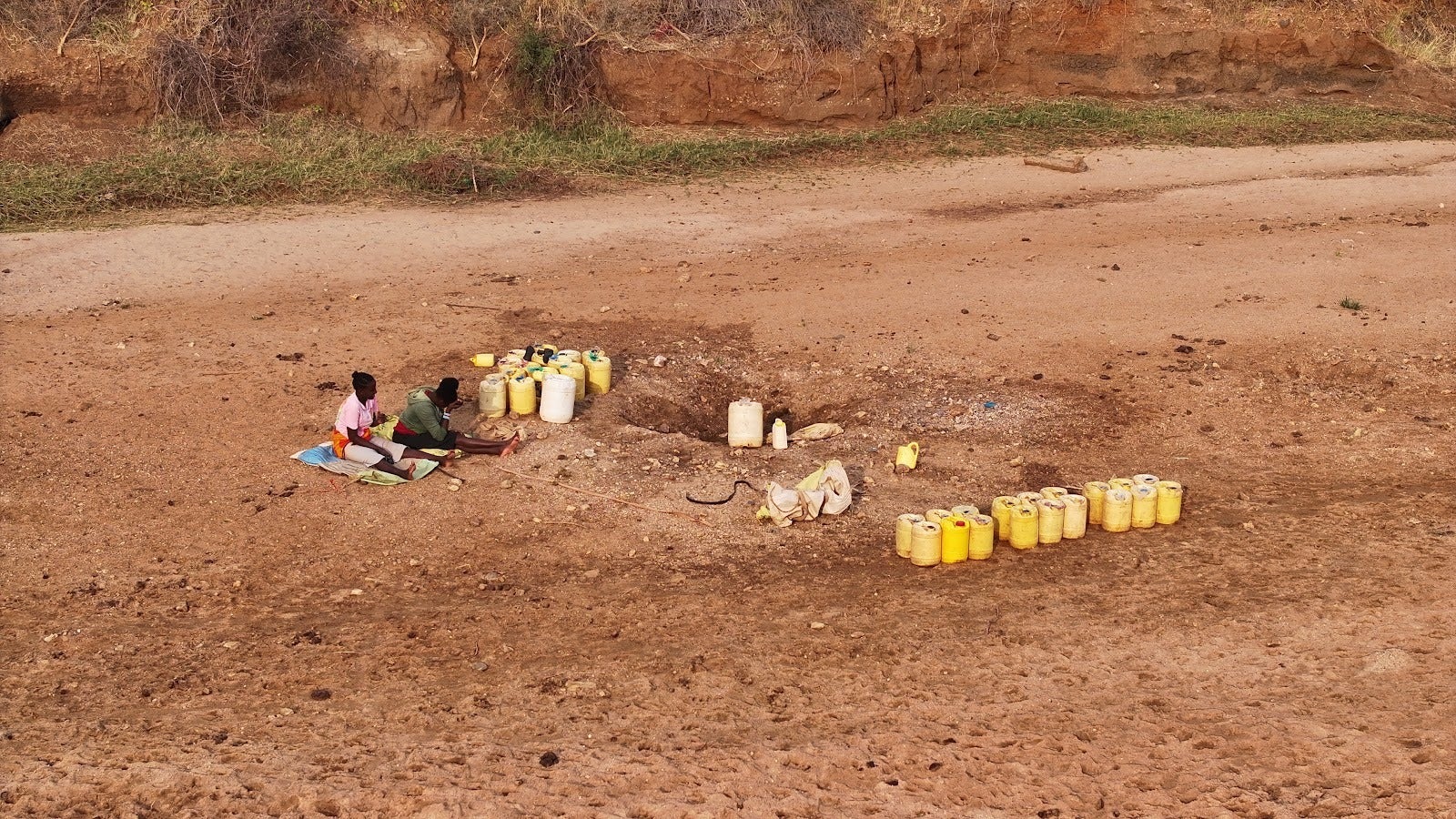
Women sit beside a shallow water hole in the Olkeriai Riverbed, waiting for water to seep through the sand.
The gendered injustice deepens when Peter describes who benefits from the trade. “The men are the ones harvesting sand and receiving the payment. Women have little say,” she says.
The riverbed becomes a divided economy: men shovel sand for cash; women dig for water for life. The same material is both livelihood and deprivation, depending on where you stand in the household and the market.
The tension is not easily resolved because sand harvesting is also survival for many young men. John Lampa (Maasai), a sand harvester, speaks with the honesty of someone trapped in a system he did not design. “This work helps us send our children to school. We are not employed, so this is the job we have,” he says.
Historically Maasai livelihoods revolved around livestock herding, but Lampa explains that pastoralism has been squeezed by land subdivision and privatization, making traditional livelihoods harder for younger generations to sustain. “Maasai were originally livestock keepers, but land has become smaller and smaller because of privatization. That is why we are looking for other ways to survive,” he says.
Yet even as he defends the need for income, Lampa acknowledges the river’s collapse. “The sand is getting finished,” he says. “Even the lorries now pass inside the river because there is nothing left on the sides.”
The contradiction is evident in his own words: sand pays school fees, but sand removal destroys the water that makes the community viable. “If we prioritize sand and the water finishes, then both sand and water will be lost,” he says.
Ecological Damage Written in Numbers and Lived Reality
Scientific studies in the Olkeriai riverine environment are beginning to quantify what residents have been describing for years. A regional environmental study on sand harvesting impacts in the Olkeriai found statistically significant links between sand extraction and environmental degradation, including biodiversity loss, soil erosion, landslides, and contamination of air, water, and soil.
In surveys conducted among local residents, more than 92% reported worsening soil erosion and air pollution, while 84% said groundwater levels had dropped, leaving many traditional wells along the riverbanks dry. These statistics mirror daily life in Olkeriai; eroded banks, exposed stones, and deep pits now mark sections of the riverbed that once held thick layers of sand capable of storing groundwater.
Hydrologists say the environmental damage extends beyond visible erosion. Seasonal rivers in drylands depend on thick layers of sand to act as natural underground reservoirs. When rains fall, water percolates through the sand and is stored beneath the riverbed, slowly releasing over months through shallow wells and natural seepage. But when large volumes of sand are removed faster than rivers can replenish them, that storage system collapses. Scientists warn that excessive sand extraction effectively drains these underground aquifers, leaving communities without the natural water reserves they rely on during dry seasons.
Heavy vehicle traffic has intensified the damage. Beyond compacting the land, trucks generate large clouds of dust that blanket nearby homes and schools. Local health workers in Mashuuru subcounty say cases of respiratory irritation, persistent coughs, and eye infections have become more common in villages near sand harvesting sites, where dust from gravel roads and excavation areas lingers in the air for hours.
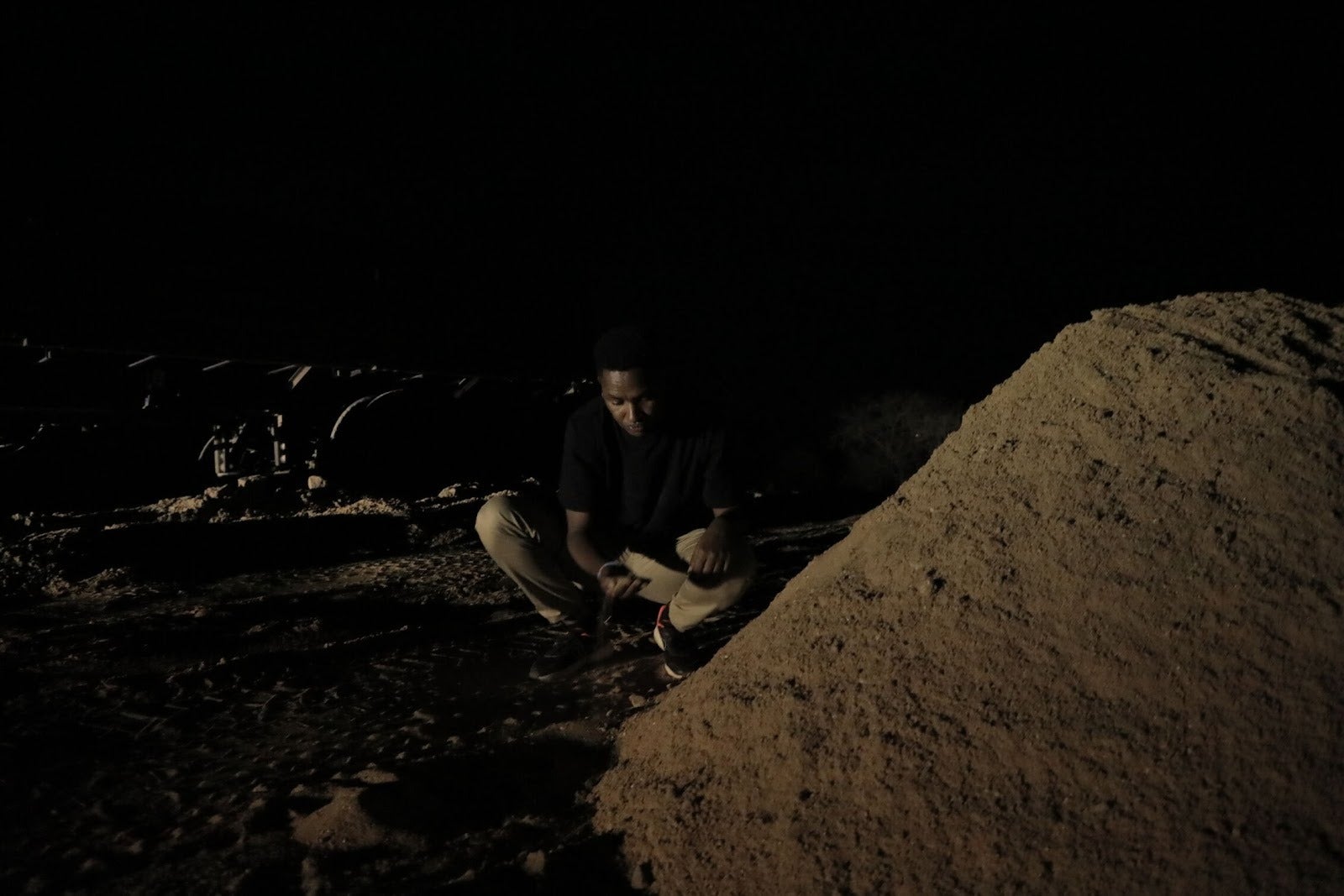
Lucas Kasosi at a sand loading site in the Olkeriai riverbed at night, where trailers are left awaiting transport.
Local administrators say the booming sand trade has also created social tensions. Chiefs and community Elders in parts of Kajiado report increasing disputes between loaders, transporters, and landowners competing for access to lucrative riverbeds, while local leaders warn that the sudden cash economy around sand harvesting has been linked to rising alcohol and drug abuse among unemployed youth.
Education is also suffering. Studies in parts of Kajiado indicate that as many as 30% of pupils in some communities participate in sand harvesting, contributing to absenteeism and declining school performance. Data from Kenya’s National Bureau of Statistics shows child labor levels in Kajiado significantly exceeding the national average in areas where sand mining is common.
When children carry sand instead of books, the extraction economy becomes generational. It not only removes sediment from rivers; it removes children from classrooms—and their futures.
Corruption, Cartels, and the Missing Revenue
On paper, Kenya has a comprehensive legal framework governing sand harvesting. The Environmental Management and Coordination Act requires Environmental Impact Assessments before extraction can begin, while the National Sand Harvesting Guidelines of 2007 establish safeguards such as designated harvesting zones, protection of riverbanks, controlled extraction levels, and rehabilitation of degraded sites.
Under Kenya’s decentralized governance system, county governments are responsible for regulating sand harvesting within their jurisdictions. Environmental experts say this has created uneven enforcement across the country, with some counties introducing strict regulatory systems while others struggle to control powerful transport networks and brokers who dominate the trade. The result is a patchwork of regulations that often allows illegal sand extraction to shift from stricter counties to those with weaker enforcement.
But along the Olkeriai River, the gap between law and reality is wide. Residents describe a system where regulations exist largely on paper while the actual trade operates through informal networks that bypass environmental safeguards and siphon away public revenue.
In theory, every truck leaving a riverbed should be licensed, taxed, and recorded by county authorities. In practice, residents say many trucks move without proper documentation, particularly during early morning or late-night operations when enforcement officers are absent.
“The trucks come at all hours. They take sand day and night,” says Nkaadu. But when we ask who is responsible, nobody seems to know.”

Gideon Toimasin (Maasai), a climate advocate who petitioned the Kajiado County Assembly to strengthen the regulation of sand harvesting.
Across Kajiado County, the sand trade has evolved into a multimillion-shilling industry dominated by transport cartels and brokers known locally as “batteries.” These intermediaries coordinate loaders, truck drivers, and landowners while negotiating directly with construction companies supplying sand to Nairobi’s booming building sector.
Of the KSh 126 million projected revenue from sand, gravel, and ballast extraction, activists and community leaders say only a fraction of that potential income is actually collected. “Hundreds of trucks leave these rivers every day, yet the communities remain poor,” says climate advocate Gideon Toimasi (Maasai). “That tells you something is wrong in the system.”
Environmental activists and local officials say revenue losses occur through underreporting of truckloads, illegal night harvesting, fake or reused transport permits, and informal payments made along the supply chain. Some trucks reportedly bypass official checkpoints entirely, while others pay small, unofficial fees rather than the full county levy.
Meanwhile, the economic imbalance remains stark. A truckload of sand may sell locally for around KSh 3,000, often shared among several villagers or loaders. Yet the same load can fetch up to KSh 30,000 ($230 USD) in Nairobi’s construction markets, generating enormous profits for transport companies and brokers.
County officials acknowledge that regulation remains a challenge. “Sand harvesting is a major economic activity in this region,” says George Rianto Kimiti, Director of Natural Resources in Kajiado County. “But without proper control, it can easily lead to environmental degradation and loss of critical water resources.”
The result, residents say, is a system where rivers are stripped of sand while communities are left with collapsing riverbanks, degraded land, and shrinking water sources.
Climate Change Tightens the Crisis
Environmental pressure on rivers like Olkeriai is being intensified by climate change.
County climate records show rainfall in parts of Kajiado dropping sharply in recent years, from nearly 80 millimeters in 2020 to just about 5 millimeters in 2023, one of the lowest levels recorded in the area. At the same time, average temperatures have risen above 38°C, accelerating evaporation in already fragile river systems.
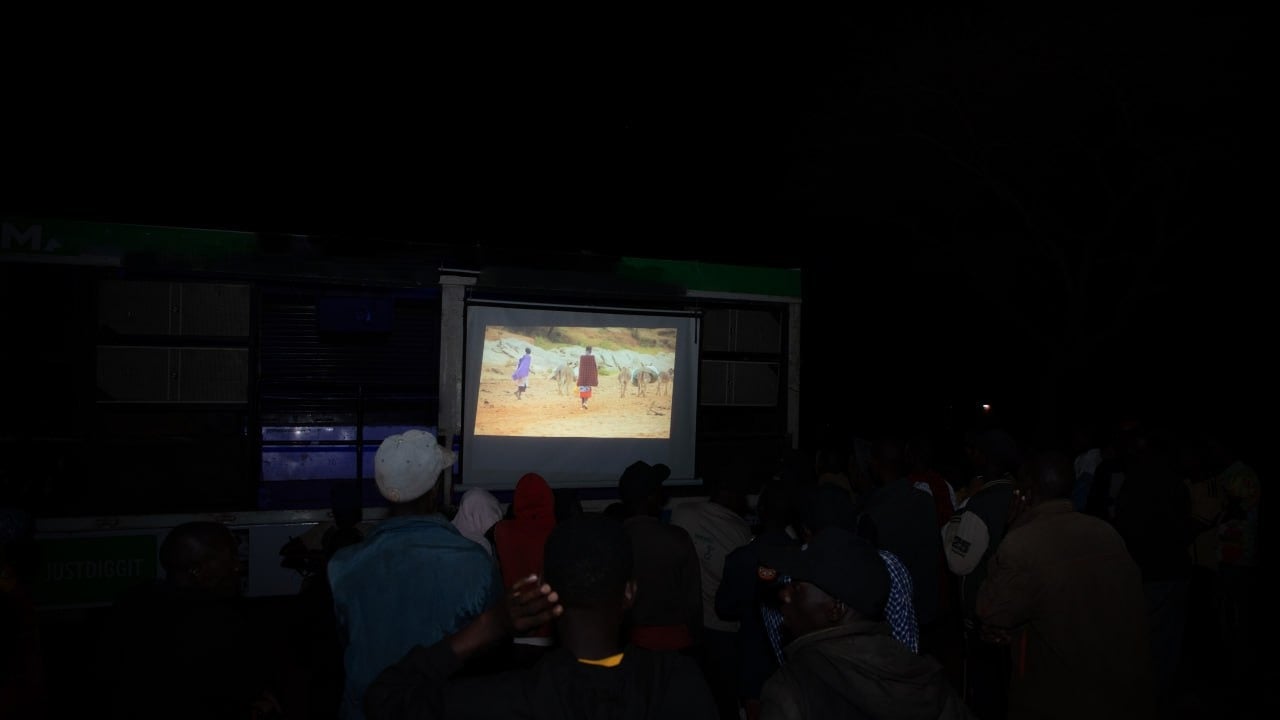
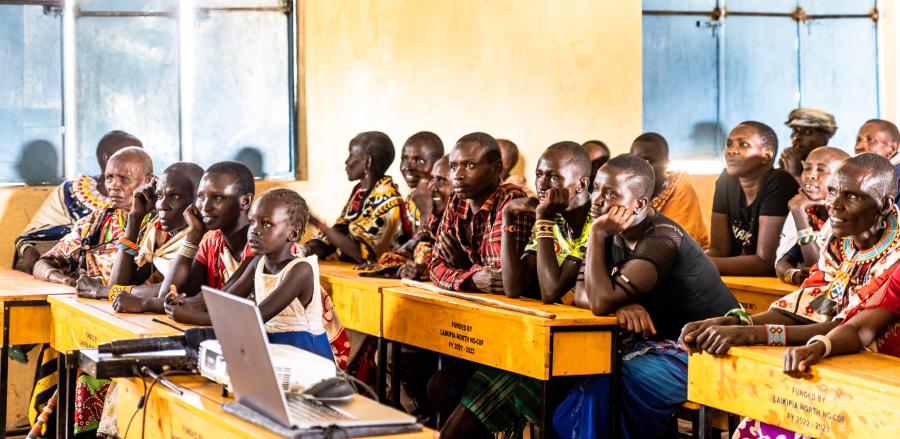
A community screening of a documentary produced through Cultural Survival’s Investigative Journalism Fellowship.
These climatic changes mean seasonal rivers replenish their sand deposits less frequently. When large volumes of sand are removed during prolonged dry periods, the river loses its ability to store water underground. Wells dry faster, livestock must travel further to drink, and communities become increasingly vulnerable to drought.
“What climate change begins, unregulated sand harvesting finishes,” says a local environmental activist involved in monitoring river ecosystems in Kajiado. For pastoral communities whose survival depends on the delicate balance between land, water, and livestock, the combined impact is devastating.
Maasai Stewardship and Pastoralist Governance Systems Under Pressure
Long before modern licensing frameworks, Maasai communities maintained governance systems for land, pasture, and water: systems designed to sustain life in unpredictable climates.
Pastoralist governance has often worked through councils of Elders, communal agreements, and seasonal planning. Practices like conserving pasture areas for drought periods, coordinating access to water points, and regulating livestock movement are part of a deeper ethic that land is held in trust for generations. The landscape is not simply a resource, it is a relationship.

George Rianto Kimiti, Director of Natural Resources for Kajiado County.
Kimiti describes this ethic as deeply rooted in the communal nature of water itself: “In Maasai culture, rivers are believed to belong to everyone. You cannot stop someone from fetching water. Water was shared by all.”
Such shared governance makes ecological sense in a dryland; if one household monopolizes water, the entire community’s resilience breaks. But market economies do not recognize water as a relationship, and they see sand as a commodity. Commercial extraction, driven by urban demand and controlled by transporters and brokers, often bypasses community stewardship norms and weakens customary governance.
In Olkeriai, residents describe how lorries now treat the river as infrastructure; a road, a loading zone, a corridor. This is more than environmental degradation. It is a cultural disruption turning a communal lifeline into a privatized revenue stream.
The transformation of rivers into commercial extraction sites undermines Indigenous stewardship. For communities along the Olkeriai, the question remains whether their voices are truly shaping decisions about the river’s future.
Indigenous Rights and the Issue of Consent
The story of Olkeriai sits directly within a global Indigenous rights framework. The United Nations Declaration on the Rights of Indigenous Peoples affirms that Indigenous Peoples have the right to maintain and strengthen their distinctive spiritual relationship with lands, territories, waters, and coastal seas traditionally owned or otherwise occupied. It also affirms Indigenous Peoples’ right to the conservation and protection of the environment and the productive capacity of their lands and resources.
The Declaration emphasizes that states should obtain Free, Prior and Informed Consent before approving projects affecting Indigenous lands or resources. Kenya’s Community Land Act of 2016 similarly recognizes the rights of Indigenous communities to manage and protect their ancestral territories.
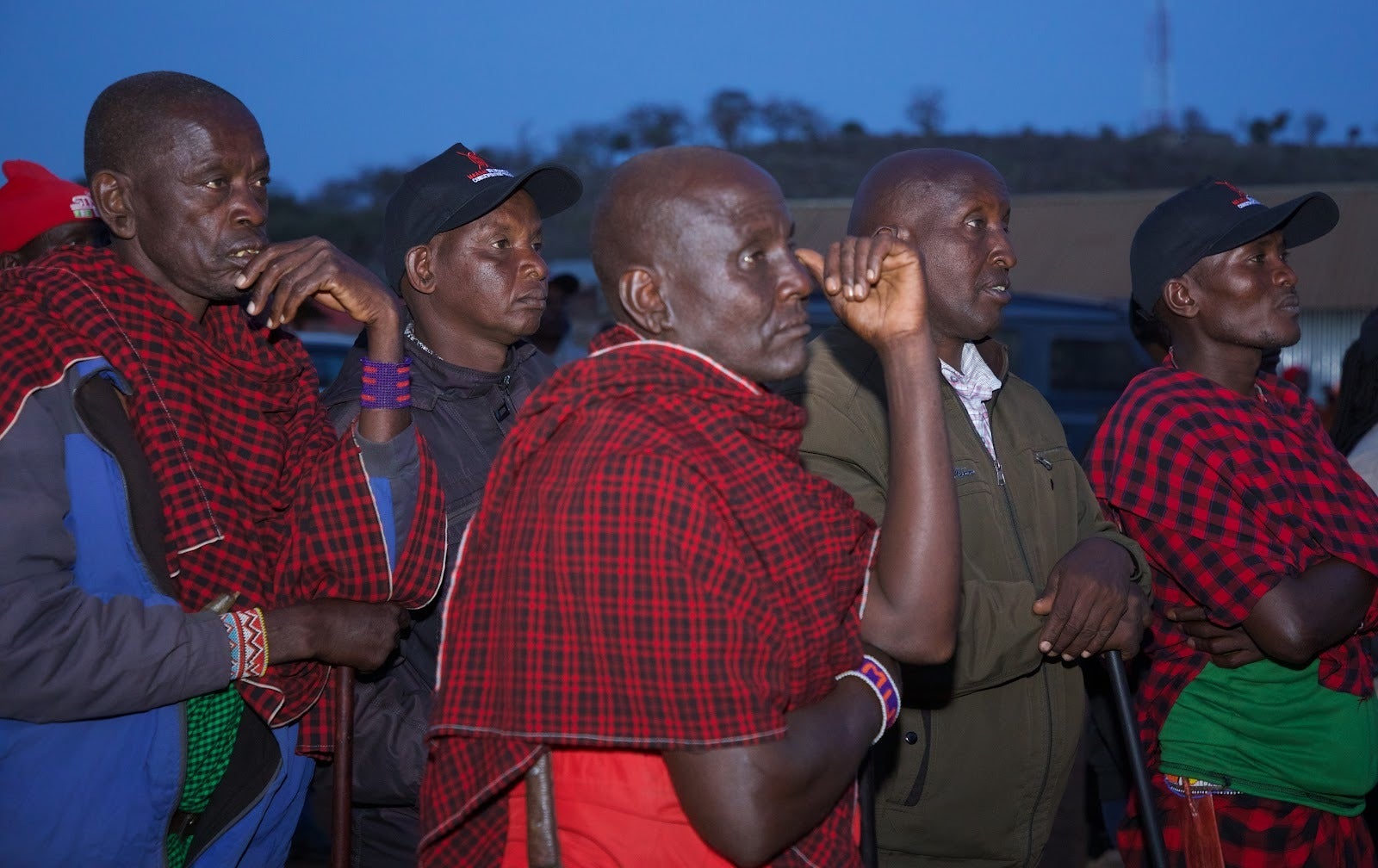
Local residents watch a documentary on sand harvesting produced through Cultural Survival’s Investigative Journalism Fellowship.
For Maasai communities along Olkeriai, the critical question is whether meaningful consent and participation exist, not only in theory, but in practice. When sand extraction alters the river’s hydrology and forces women to dig for salty water, the change is not simply economic. It reaches into the right to water, the right to health, the right to culture, and the right of Indigenous communities to sustain their livelihoods on their own territories.
When the environment that sustains pastoralism is degraded, cultural survival itself is put at risk. Livestock are not just assets; they are identity. Rivers are not just channels; they are communal heritage.
Naimeso Somari (Maasai), born and married in the area, speaks the language of that heritage. “Water is the most important thing in the world,” she says. “Every living being—birds, cattle, people—depends on water for life.”
Community Awareness and Resistance: Voices Refusing Silence
Despite the scale of extraction, Olkeriai is not a community without agency. Community leaders and members have been mobilizing through local forums, civic discussions, and local radio talk shows such as programs on Paran FM, where environmental protection is discussed and residents continue lobbying authorities to safeguard shared resources.
Youth advocates have also pushed the debate into formal governance spaces. Gideon Toimasi (Maasai), a climate advocate and youth leader, describes sand harvesting as a policy failure with human rights consequences. “We saw a policy gap when it comes to sand harvesting,” he says. “When the sector is not regulated, it worsens the effects of climate change because water becomes scarce due to over-exploitation of sand.”

Kimiti during a radio discussion on sand harvesting at Paran FM.
Toimasi links the crisis to education, arguing that children pulled into sand harvesting are being denied their right to learn. “We have seen children dropping out of school to join sand harvesting. That denies them their right to education,” he says.
For Toimasi, the struggle is not against livelihoods. It is against exploitation without safeguards. “Climate justice means human rights. We need policies that protect both the environment and the people,” he says.
Governance and the Battle Over Regulation
County leaders say the scale of the crisis has forced the government to reconsider how the sand trade is regulated.
The Kajiado County Sand Conservation and Quarrying Management Bill (2024), currently under consideration in the County Assembly, proposes sweeping reforms to control the industry. The proposed law would introduce licensed harvesting zones, restrict extraction near riverbanks, regulate transportation routes, and impose penalties of up to KSh 4 million ($31,000 USD) or 4 years in prison for illegal operators.
The bill also proposes that a portion of sand revenues be reinvested in environmental rehabilitation and community development projects.
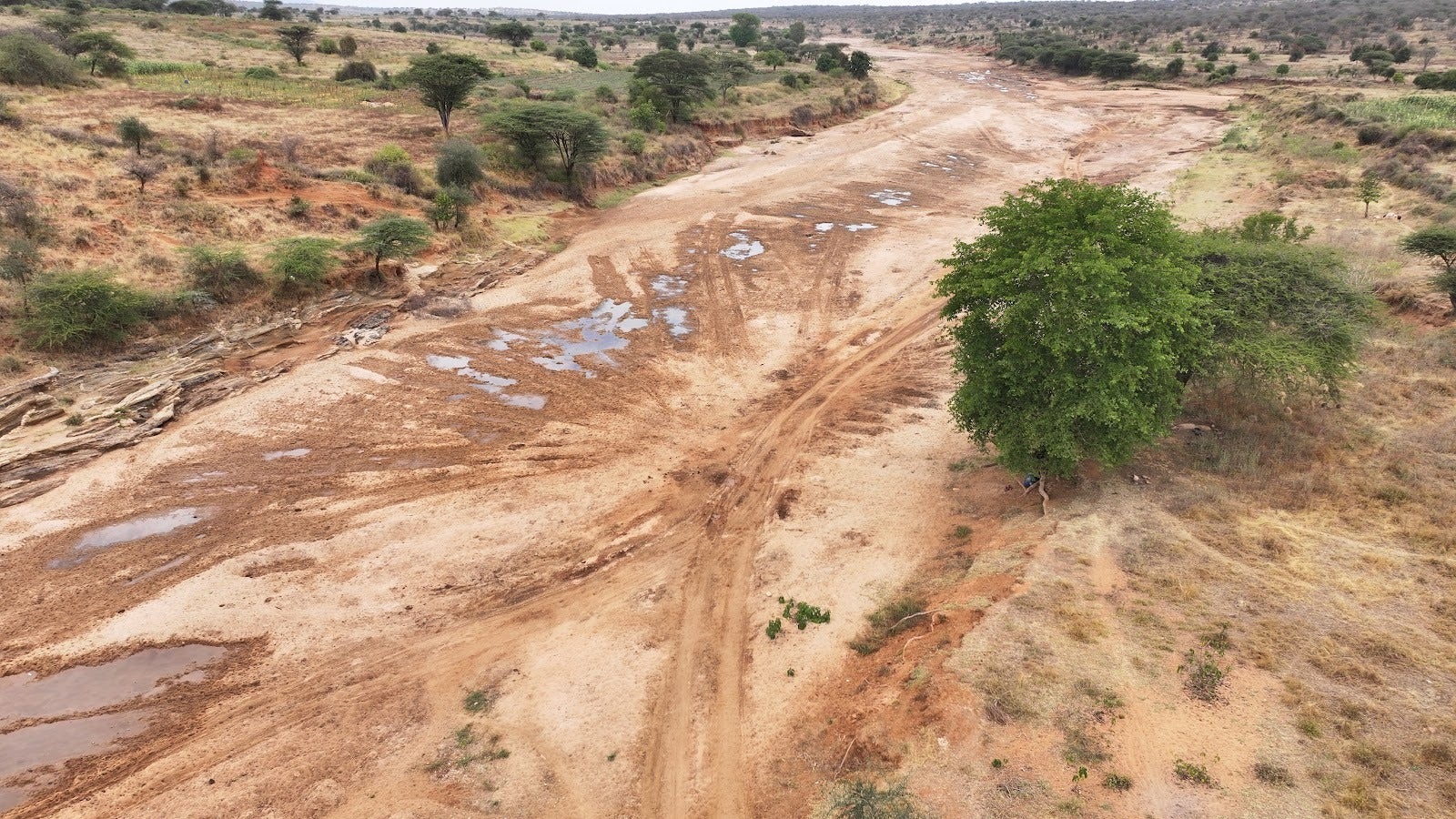
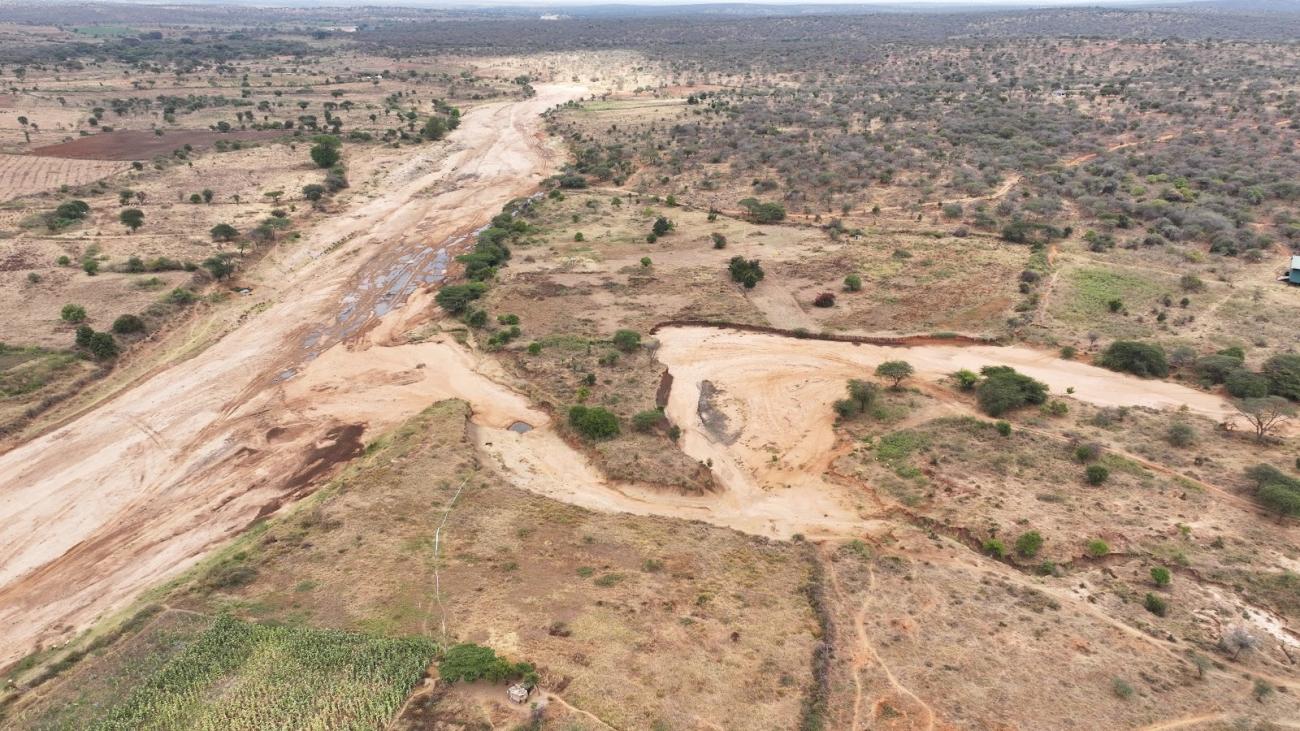
An aerial view of the Olkeriai riverbed showing tire marks left by sand harvesting trucks.
But residents say legislation alone will not solve the problem. “Policies are good,” says Toimasi. “But without enforcement and transparency, they remain words on paper.”
For communities living along the Olkeriai River, the real test will be whether political leaders are willing to confront the powerful interests that benefit from the current system. Other counties facing similar crises have already begun experimenting with stricter regulation of sand harvesting.
In neighboring Makueni County, authorities introduced a sand conservation law that created cooperative harvesting systems, designated extraction sites, and banned trucks from entering riverbeds. Revenues from sand sales are now shared between the county government and community cooperatives, while sand dams are constructed to help restore river ecosystems.
In Kitui County, a similar law introduced fines and jail terms for illegal sand harvesting while establishing designated aggregation yards where sand is collected and sold through licensed community groups.
Environmentalists say these models show that sand harvesting can be regulated in ways that protect rivers while still providing income for local communities. “Kajiado does not need to reinvent the wheel. The solutions already exist in neighboring counties,” Toimasi says.
The Price of a Skyline and the Future of a River
As evening settles over the Olkeriai River, the trucks begin to leave one by one, carrying tonnes of sand toward construction sites hundreds of kilometers away. Their engines fade along the Nairobi–Namanga Highway, hauling away the foundations of another apartment block, another highway, another piece of Nairobi’s expanding skyline.
The riverbed grows quiet again, except for the sound of hands scraping against sand. A few meters from the tire tracks, women kneel in the same pits they dug at dawn. They wait patiently for water to seep slowly through the sand. The pools are shallow and cloudy, but they are enough to fill a few jerrycans before nightfall.
For residents of Olkeriai, this daily ritual has become the measure of how much their river has changed.
What was once a seasonal river sustaining livestock, farms, and households has become an extraction site feeding Kenya’s booming construction industry. The sand economy powering urban growth is quietly transferring ecological wealth from Indigenous drylands to expanding cities. Profits move outward along the supply chain, to transport companies, brokers, and construction firms, while the environmental costs remain behind in collapsing riverbanks, shrinking water sources, and communities digging deeper into the sand for survival.
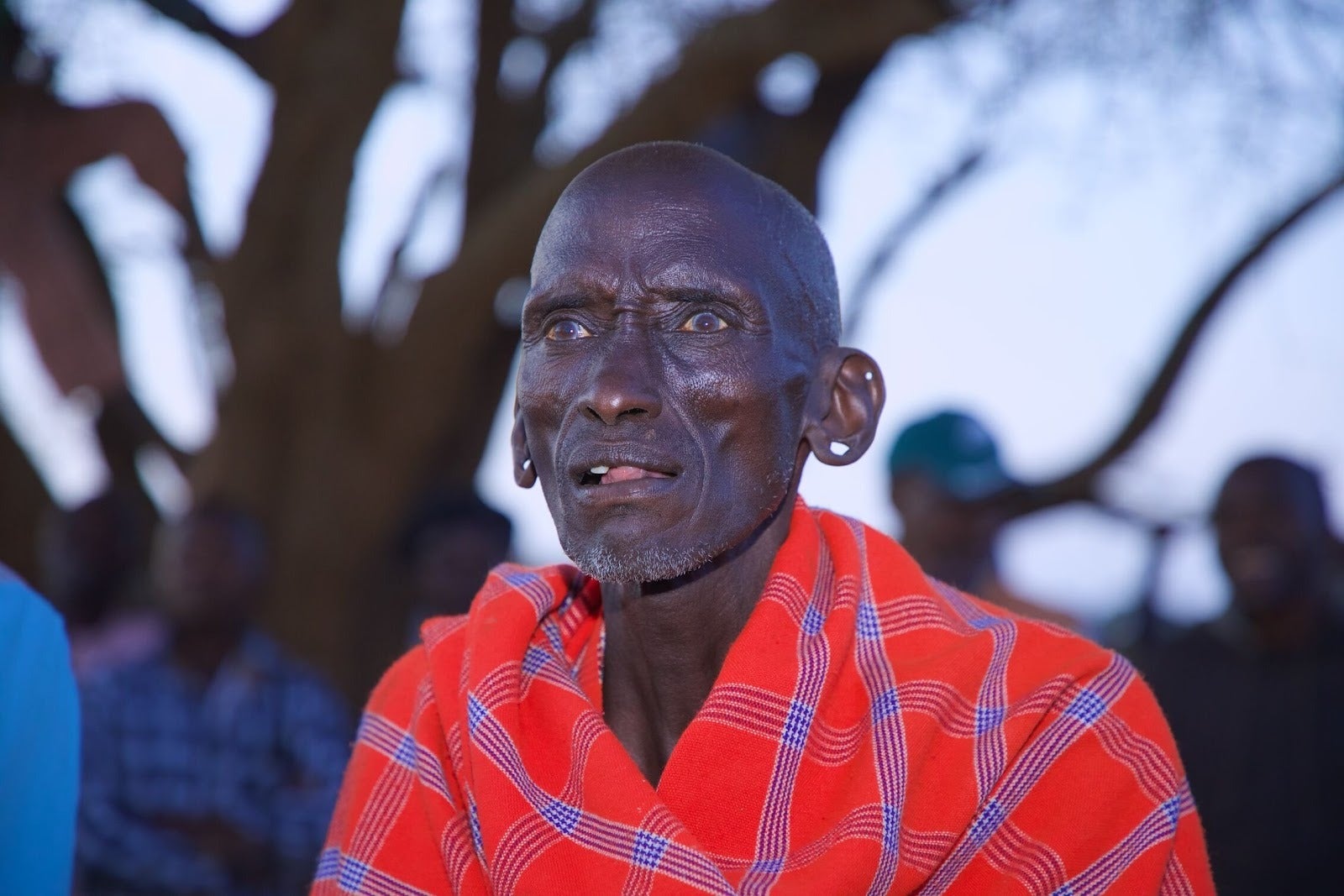
An Elder watches a documentary on sand harvesting during a community screening, produced through Cultural Survival’s Investigative Journalism Fellowship
For Maasai pastoralists whose identity is tied to land, livestock, and water, the loss is not only economic. It is cultural. Livestock cannot survive without water. Communities cannot sustain pastoral life if rivers disappear.
And yet the trucks continue to come.
Whether Olkeriai survives now depends less on nature than on governance; on whether laws regulating sand harvesting will be enforced, whether cartels dominating the trade will be confronted, and whether Indigenous communities will finally have a meaningful voice in decisions affecting their lands.
As darkness approaches, Peter lifts a jerrycan filled with the salty water she has dug from the riverbed. In the morning, she and the other women will return again. They will dig deeper.
Olkeriai is not just a river on the brink. It is a warning about what happens when development outpaces regulation, and when wealth extracted from Indigenous lands flows outward while the costs remain behind.
This investigation was produced through Cultural Survival’s Investigative Journalism Fellowship.
--Lucas Kasosi is a journalist, development communicator, and digital storyteller from Kenya. Currently he serves as the head of Digital Media and Communications at Paran Africa, a Maasai community media house dedicated to amplifying Indigenous voices through visual storytelling, advocacy, and community-driven narratives. Lucas Kasosi is a 2025 Cultural Survival Investigative Journalism Fellow.
Top Photo: An aerial view of the Olkeriai River in Kajiado County, where sand harvesting is taking place.
All photos bt Lucas Kasosi.