
By CS Staff
In the arena of climate change, Indigenous women are defenders, adaptors, activists, and change makers. Their work carries grave risks of backlash from State and corporate actors, as the world witnessed with the high-profile murder of Berta Cáceres (Lenca) in 2016 in Honduras. At least 146 land and environmental defenders were killed or disappeared around the world in 2024 defending their land, communities, or the environment, according to the latest Global Witness report. Indigenous people were victims of around one-third of lethal attacks, despite making up around 6% of the global population.
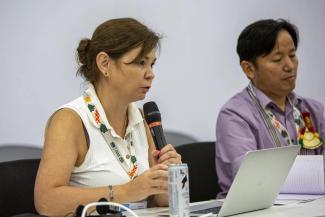
Daria Egereva (Selkup), a mother of two sons, a wife, and a citizen of the Russian Federation, has dedicated her life to the causes of climate justice and the rights of Indigenous Peoples. As a respected representative of the Selkup Peoples and co-chair of the International Indigenous Peoples Forum on Climate Change (IIPFCC), she is a powerful voice on the international stage, including at the UNFCCC COP30 in Brazil. On December 17, 2025, Egereva was arrested by Russian authorities in Moscow and accused of participating in a terrorist organization.
Born in 1977 in Tomsk, Siberia, Egereva has been deeply engaged in upholding Indigenous Peoples’ rights, with a particular focus on Indigenous languages, cultures, traditional territories, and self-determination. She holds a degree from Tomsk State Pedagogical University, where she qualified as a teacher of German, English, and the Selkup language. During her studies, she became actively involved in Indigenous cultural and rights-based initiatives in Tomsk Oblast, participating in international and interregional Indigenous projects, ethnographic fieldwork in Indigenous communities, and the development of Indigenous cultural institutions. She was a member of the Association of Indigenous Small-Numbered Peoples of the North of Tomsk Oblast and contributed to the establishment of the Ural–Altaic Ethno-Cultural Center at the university.
Egereva’s work has evolved into full-time engagement in Indigenous rights advocacy at the national and international level. She has completed numerous international professional exchanges aimed at strengthening Indigenous rights advocacy and international cooperation, including internships at the Indigenous Peoples Information Centre in Moscow, a training program organized by the government of Nunavut (Canada), as well as courses and workshops conducted by the UN Development Programme, the Council of Europe, and other international organizations focusing on organizational development, project management, advocacy strategies, and intercultural dialogue. In 1999, she joined the Russian Association of Indigenous Peoples of the North, Siberia, and the Far East (RAIPON), where she coordinated youth-focused programs.
After a temporary pause, Egereva returned to public and human rights work due to increasing State pressure on Indigenous organizations in the Russian Federation. From the early 2010s, RAIPON has experienced growing governmental interference. In 2013, under intense administrative pressure, RAIPON’s leadership was taken over by individuals closely affiliated with State authorities, resulting in a significant curtailment of its independent human rights work and the exclusion of many independent Indigenous leaders and experts. In response, Indigenous leaders and human rights defenders established alternative, independent platforms. One such initiative was the Aborigen Forum, an informal network of Indigenous experts, human rights defenders, and community leaders from across the Russian Federation. The network has served as a key platform for the preparation of alternative reports on the situation of Indigenous Peoples in Russia and for continued engagement with United Nations human rights mechanisms and international environmental and climate processes.
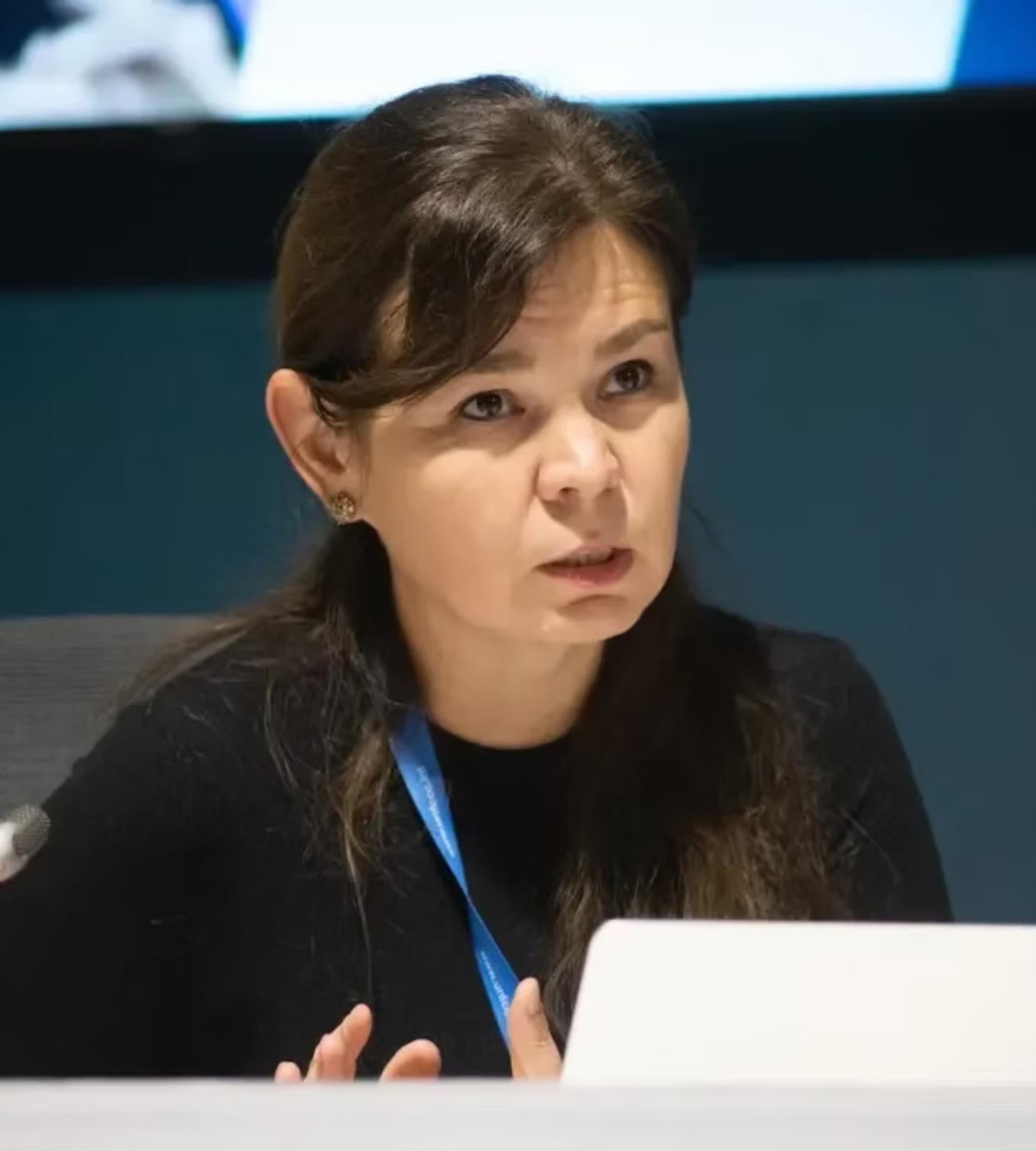
Daria Egereva. Photo courtesy of daria-egereva.org.
From 2020-22, Egereva coordinated initiatives to strengthen Indigenous women’s participation in public and social life and participated in international dialogues on climate change and sustainable development. She is a member of the Facilitative Working Group of the Local Communities and Indigenous Peoples Platform (FWG) under the UN Framework Convention on Climate Change. She serves as a regional representative of the Facilitative Working Group for Central and Eastern Europe, the Russian Federation, Central Asia, and the Caucasus, and as co-chair of the International Indigenous Peoples’ Forum on Climate Change. She has coordinated Indigenous Peoples’ participation in the last three UN climate negotiations (COP28, 29, and 30) and has regularly participated in sessions of the UN Permanent Forum on Indigenous Issues (UNPFII) and the UN Expert Mechanism on the Rights of Indigenous Peoples.
The Selkups number only about 3,500, a tiny community that, like many other Indigenous Peoples in the Russian Arctic and Siberia, represents one of the country's most impoverished segments, lacking political influence and effective mechanisms to protect their rights. Yet Egereva and leaders like her stand firm in their mission to peacefully safeguard traditional activities such as hunting and herding, protect their traditional lands and natural resources from large extractive industries, and maintain their language and culture for future generations.
This peaceful advocacy has come at a devastating cost. In December 2025, Egereva was arrested by Russian authorities in Moscow and charged under laws related to terrorism and extremism, offenses that carry sentences of up to 20 years imprisonment. Indigenous Peoples’ organizations and international human rights actors regard her prosecution as politically motivated and as retaliation for her long-standing, peaceful human rights work and Indigenous rights advocacy. Her detention was part of a large-scale, coordinated wave of repressive actions against Indigenous Peoples and human rights defenders across Russia. Another female Indigenous activist was also arrested, and at least 17 others were subjected to searches and interrogations.
“Daria Egereva is a representative of Indigenous Peoples whose lives are inextricably linked to nature, its conservation, and responsible stewardship for the benefit of future generations. The protection of ancestral territories is a form of peaceful human rights activism aimed at dialogue, mutual understanding, and sustainable development. Daria’s love for her native land and responsibility for its preservation have always been and remain a key priority for her work. We are convinced of her innocence and respectfully call for her immediate release.” -- Valentina Sovkina (Saami), UN Permanent Forum on Indigenous Issues Expert Member
The wave of repression affected representatives of many Indigenous Peoples of Russian Siberia and the Arctic, in addition to the Selkups, including the Tubalar, Chulym, Shor, Kumandin, Dolgan, Yukaghir, Evenk, Sami, and Nganasan Peoples. These Peoples often number in the thousands, and sometimes in the hundreds, which is why leaders like Egereva are an integral part of the peaceful work to promote traditional activities, languages, cultures, and the very survival of their Nations.
A key focus of the charges against Egereva was her ties to the Aborigen Forum, a network of human rights defenders that had openly discussed Indigenous issues at UN forums before being declared an extremist organization by Russian authorities. For those who know Egereva and her work, the accusations of terrorism or extremism are unfounded. Her activities, and those of her colleagues, were public, peaceful, and legal, focused on monitoring violations, raising awareness, and cooperating with UN mechanisms like the United Nations Permanent Forum on Indigenous Issues. The repression is widely seen not as a domestic criminal matter, but as direct retaliation for peaceful cooperation with the United Nations.
Egereva's arrest also highlights the gender dimension, in which Indigenous women, who often serve as the primary guardians of Traditional Knowledge and culture, are suffering disproportionately. Egereva and other women who were arrested or subjected to repression have played leading roles in human rights and environmental work for many years. When the land is threatened, they are often the first to stand up—and the first to be silenced.
In this ongoing campaign of systemic repression, international visibility and sustained attention are critical. For Egereva, the co-chair of an international climate body who is now imprisoned under charges of terrorism, international outcry is not just about justice—it is about improving her safety and defending the fundamental right of all Indigenous Peoples to peacefully protect their communities and the planet.
“Across the world, when land is harmed by fossil fuel extraction and climate destruction, Indigenous women are among the first to rise in its defense. The punishment of peaceful women who protect their peoples, lands, and ways of life is unjust and must end. Daria Egereva acted in defense of her people by standing for the land, water, and life that sustain Indigenous communities. In solidarity with Indigenous defenders everywhere, we call for the immediate and unconditional release of Daria Egereva.” --Luda Kinok (Yupik), an Indigenous activist in exile
On February 12, 2026, the Basmanny Court in Moscow decided to keep Egereva in detention until a hearing on March 15, 2026. Get involved in the Campaign for Daria’s release: www.daria-egereva.org
Top photo: Daria Egereva, Co-chair of the International Indigenous Peoples’ Forum on Climate Change speaking at COP30 in Belém, Brazil. Photo courtesy of iisd.org.