Fred Nahwooksy (Comanche), a national leader in the movement to save endangered Native American languages died suddenly on Friday October 2nd in Johnson City, Tennessee. [link to obiturary]

Fred Nahwooksy (Comanche), a national leader in the movement to save endangered Native American languages died suddenly on Friday October 2nd in Johnson City, Tennessee. [link to obiturary]
Thanks in part to Cultural Survival's efforts, both appropriations committees of the U.S. Senate and the House of Representatives have recommended a fourfold increase for endangered Native American languages funding.
 For the past few months Cultural Survival has been in merger discussions with a Colorado-based international nonprofit organization called Global Response. We are very pleased to announce that this month Global Response becomes a new program of Cultural Survival.
Cultural Survival will attend the grand opening of the Eastern Band of Cherokee's language immersion school, New Kituwah Academy, on October 7 near Cherokee, North Carolina. New Kituwah Academy will house Cherokee language preschool and kindergarten classrooms, serving 2 - 5 year olds. The students, who already speak English as their first language, will study English as a discrete subject area, but will be taught all other curriculum content in Cherokee. Eastern Cherokee is an endangered language, with 300 remaining speakers, most over age 50.
Summer is a great time for grants and fundraising research and planning! Our Native Language Revitalization Campaign works closely with our partners supporting grantwriting activities which strengthen local community efforts to create new fluent speakers of Indigenous languages. Major federal funding
The National Native Language Revitalization Summit that Cultural Survival co-organized this May was by almost any measure, a great success. Nearly 300 people from across Indian Country gathered for three days of eduction, advocacy, and celebration. Read more.
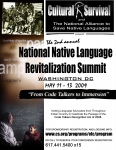 Cultural Survival and the National Alliance to Save Native Languages are facilitating the National Native Language Revitalization Summit in Washington D.C. this May 11th-13th.
Working with top officials at the Bureau of Indian Affairs (BIA), members of Congress, and leading Washington DC-based tribal advocacy groups, Cultural Survival's endangered language campaign director Ryan Wilson has been pushing for $5 million in federal funds for "shovel-ready" projects to support repairs and renovations at American Indian language immersion schools throughout the U.S. Watch for more news next week as the economic stimulus package moves through Congress to President Obama.

Reconocimiento de tierra
Reconocemos que nuestra sede está en la tierra de Massachusetts, en Cambridge, MA, y agradecemos a los administradores Indígenas pasados, actuales y futuros de este territorio.
