
By Bobbie Chew Bigby (Cherokee)
At the outset of researching and writing this article, I had thought this piece would begin and end in many of the same ways as previous articles in which I have examined the impacts of transition metal mining on Indigenous communities. Like the stories from numerous other corners of the globe, ranging from Indigenous Australia to Bolivia, Panama, and U.S. Indian Country, what I had expected to write about was the ongoing exploitation of Indigenous lands and communities by industries in search of new, so-called ‘green’ energy resources. Through these previous writing journeys, I had also become a witness to familiar yet always remarkable patterns of Indigenous resilience in the face of today’s mining pressures—forms of extraction now cloaked in the language of "green" energy transitions.
But the journey of this specific story, examining the experiences of copper mining on the island of Bougainville in the Pacific Ocean, has illustrated to me more than any other example that these stories are never simple, straightforward, or truly one-sided. General assumptions often made by the media or environmental movements that the majority of Indigenous Peoples worldwide stand firmly against extraction in all forms actually obscure realities that are much more complex, nuanced, and often challenging. These stereotypes also overlook the underlying reality that no being on this planet can escape—namely, that the dominant economic model upon which the current global order is based is profit-driven capitalistic consumption and resource extraction that demands growth, and does not tolerate moderation.
As an Indigenous citizen and mixed-race woman approaching this topic of Indigenous Peoples and mining, my own understandings, values, and assumptions have been thoroughly tested, shaken up, and transformed by learning about these different contexts in which mining has occurred historically and continues into the present. I have come to see that for some Indigenous communities across the globe, refusing and opposing transition mineral mining, or extraction in any form, is a luxury that they simply do not have and cannot afford or fathom. Moreover, in certain cases, resisting against extraction can potentially undermine what local communities understand as viable pathways to Indigenous political, economic, and even cultural sovereignty.
For certain communities in Bolivia, for instance, where Indigenous Quechua and Aymara Peoples have been the backbone of mining labor since the Spanish conquest in the early 1500s, some families do not know of a livelihood that exists apart from the silver mines. Even though the silver mined from the Cerro Rico of Potosí was exported to Europe and enriched the Spanish monarchy, many Indigenous Bolivian livelihoods—including access to food and daily necessities—have also been forced to rely on this industry for nearly 500 years. Thus, for some communities, the question of engaging with transition mineral extraction remains challenging and even painful, but it must be addressed in degrees rather than flat-out rejection. Further, these questions of mining are usually deeply interconnected with a complex web of geopolitical, economic, and cultural considerations, in which notions of Indigenous sovereignty can become extremely complicated.
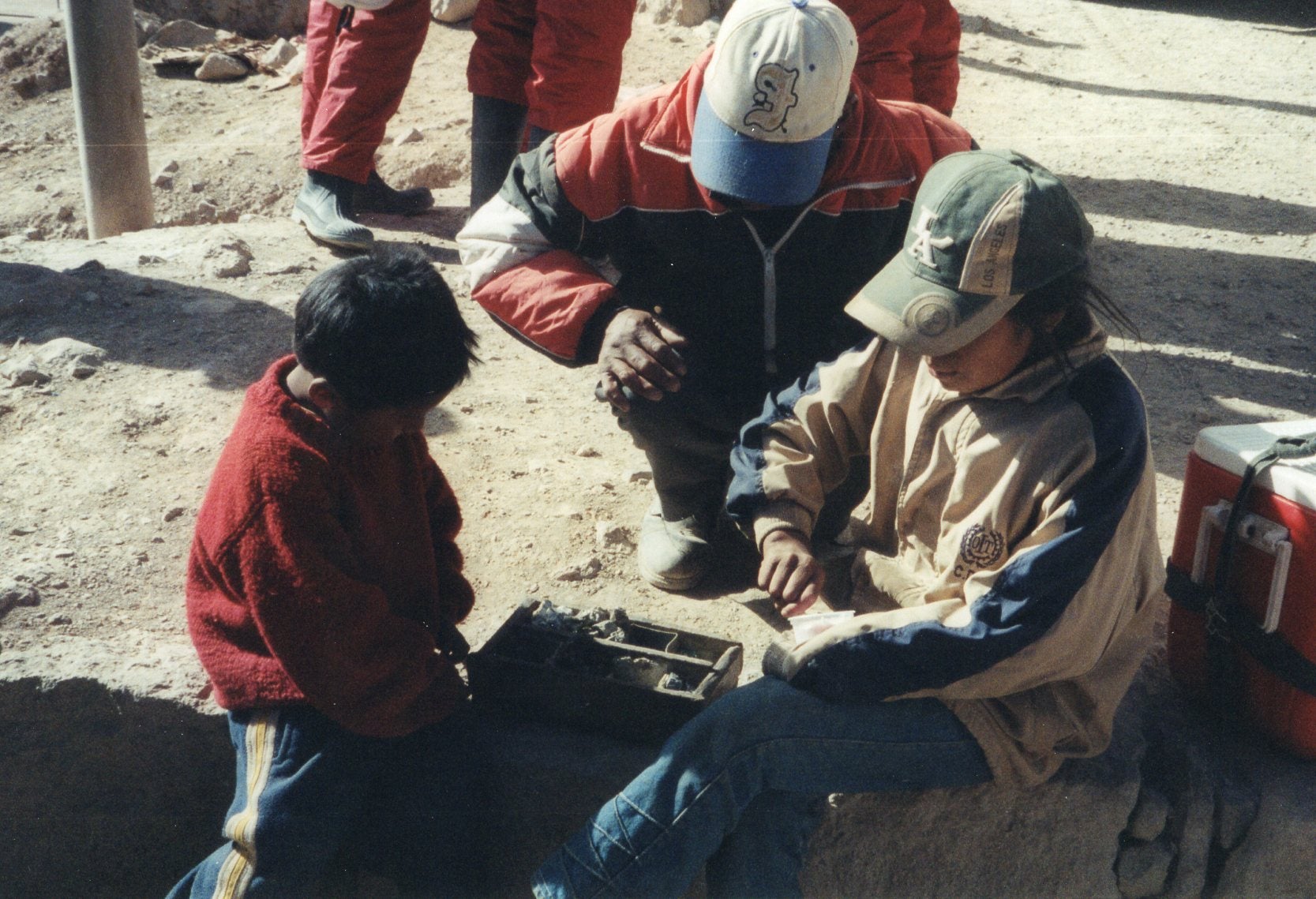
An image from 2003, taken by the author while she was a visiting high school student during a ‘mine tour’ in Potosí, Bolivia. This image shows the children of miners who work outside the mine selling colorful stones while their family members labor inside the silver mine. Photo by Bobbie Chew Bigby
Similarly, across the globe, the scramble for "transition" and "critical" metals is becoming an issue that not only involves the problematic dynamics of mining and extraction. These minerals are becoming ever more deeply embedded into nearly all geopolitical considerations at local and global scales—whether involving trade and technology, or regional warfare and fights for sovereignty. From the Ukraine-U.S. Mineral Resources Agreement and Ukraine’s struggle to maintain its political sovereignty to the rapid growth of Artificial Intelligence and its insatiable hunger for energy and microchips, almost every issue we are now grappling with in some way involves these minerals as a key component. Even the pursuit of supposedly ‘green’ technologies that aim to electrify energy sources as a solution to decarbonization and to minimize climate change is, paradoxically, built upon these very metals. Yet in the loud debates over who can mine, extract, develop, and ultimately benefit from these mineral assets, all too often the communities and living environments from which these metals are sourced are overlooked, if not completely forgotten. While the Strait of Hormuz and Ukraine may currently be at the top of our minds when thinking about violent conflicts and energy resources, we must remember that such conflicts are playing out across the world. And many of them date back decades, including the conflict over copper on an island known as Bougainville.
A set of islands and atolls located north of Australia and categorized as an autonomous region of Papua New Guinea, Bougainville is home to culturally-rich communities, a tropical rainforest climate, mountainous terrain, and stunning biodiversity. Culturally and geographically, Bougainville aligns itself much more closely with the nearby Solomon Islands archipelago. In terms of metals, Bougainville is also home to one of the world’s richest sources of copper. And sadly, it is this vein of copper-rich deposits that has brought massive suffering to the people, lands, and waters of the island, while providing much of the world with the copper it demands.
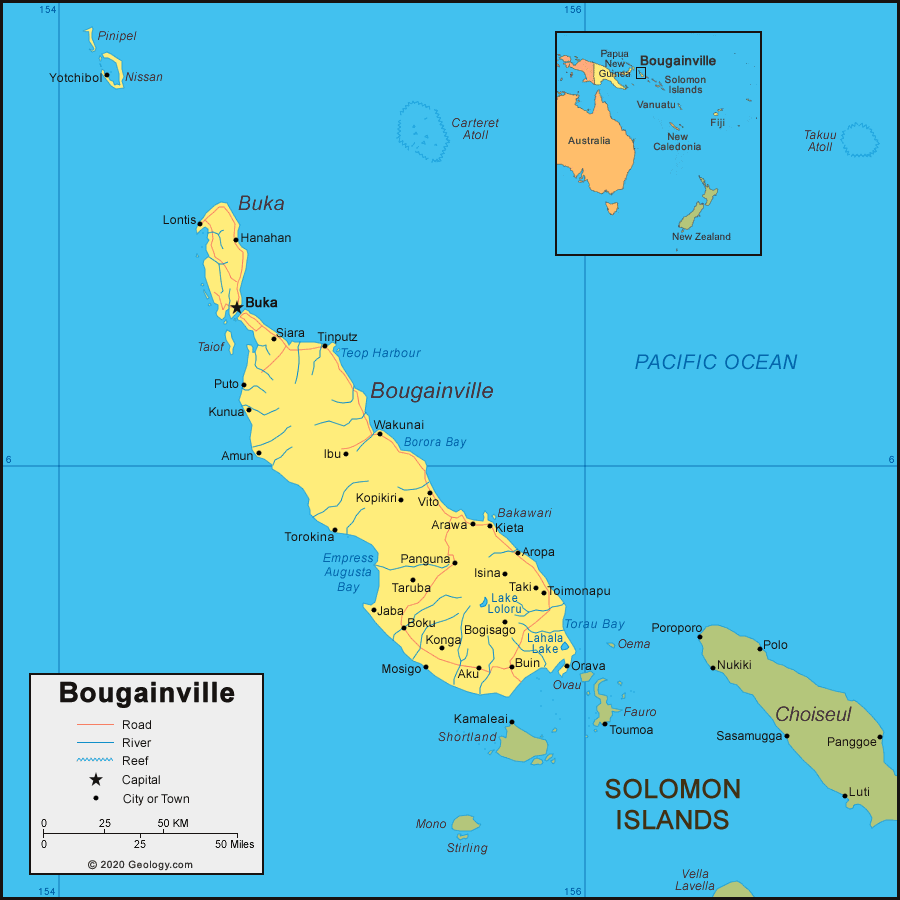
A map of Bougainville in relation to other nations in the Oceania region. Credit: Geology.com
Upon Papua New Guinea’s (PNG) independence from Australia in 1975, the island of Bougainville was subsumed into the new, larger nation of PNG. Beginning in the early 1970s, Bougainville Copper Limited (BCL), a subsidiary of the major mining company Rio Tinto, established one of the world’s most prolific copper mines in an area known as Panguna, located deep in the heart of Bougainville Island. Producing copper, gold, and silver, the Panguna mine ran non-stop from 1972 until 1989 and was one of PNG’s primary economic activities (Read: Rio Tinto And Bougainville – A Fatal Connection. A Mine, A War, And An Uncertain Future - Boege - 2022 - Australian Journal of Politics & History - Wiley Online Library). As a very young nation comprised of between 800 and 1,000 different Indigenous cultural and language communities, PNG’s own economic and political sovereignty was supported through the revenues from the copper mining.
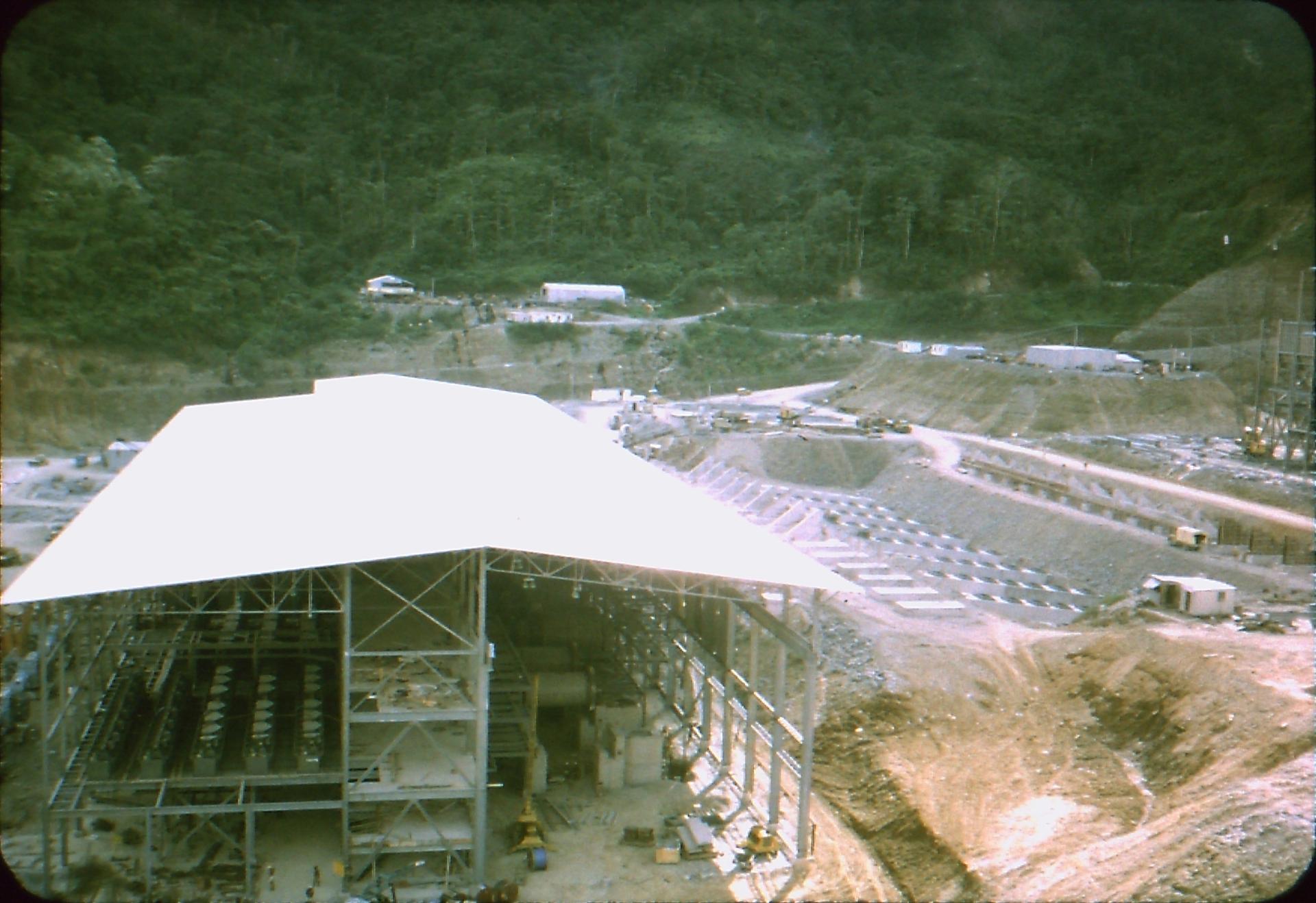
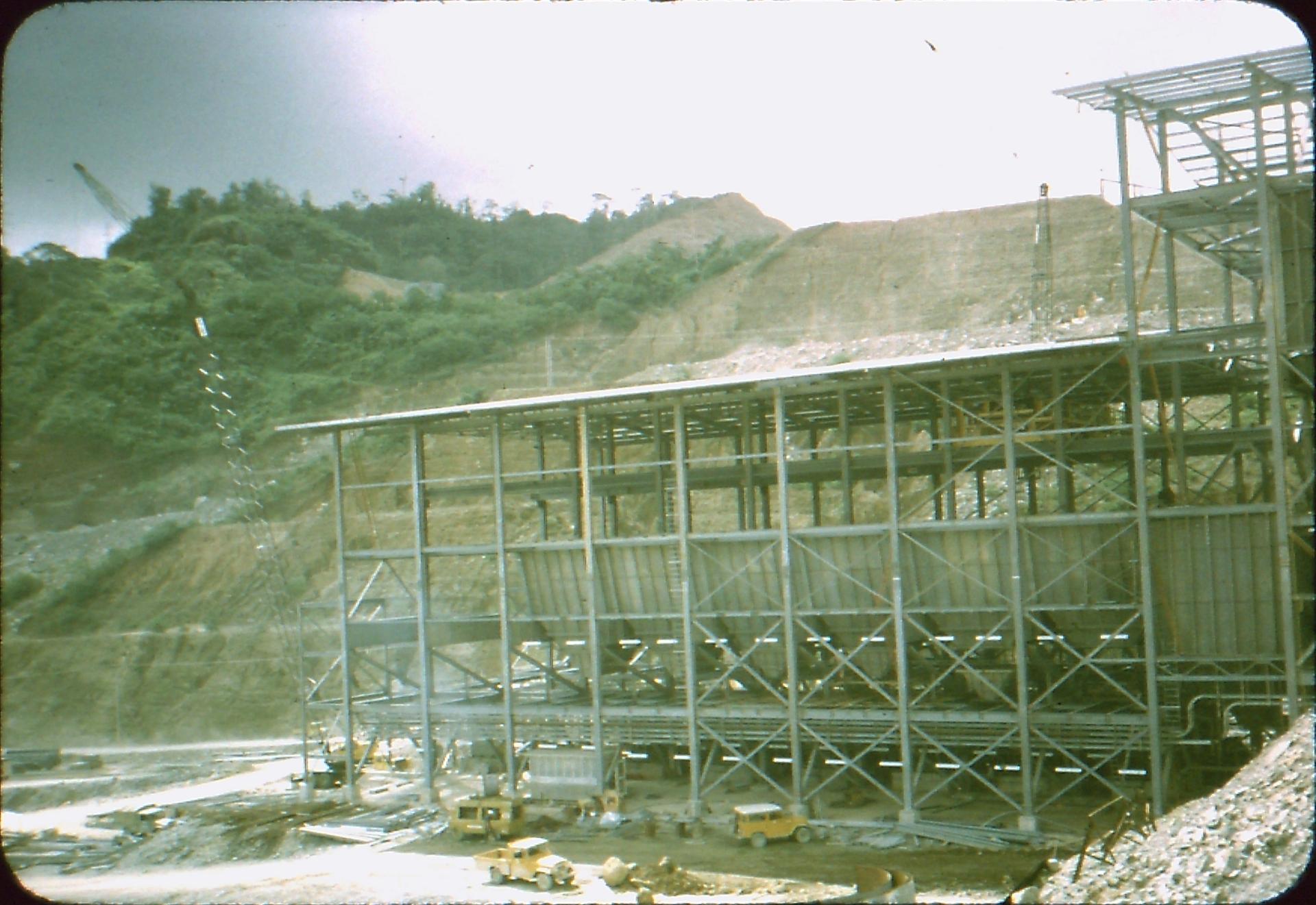
Historic photographs from 1971 documenting the construction of the copper ore concentrator used in the Panguna mine in Bougainville. Credit: Wikimedia images.
As locals in Bougainville began to witness firsthand the mine’s scale of environmental destruction and the lack of equitable revenue sharing, anger turned into armed rebellion against PNG, with some locals forming the Bougainville Revolutionary Army (BRA). This armed rebellion closed the mine, but also tragically led to a ten-year-long civil war in Bougainville, resulting in a blockade of the island and the deaths of an estimated 15,000 to 20,000 local people (Read: Bougainville's gold mine sparked a war that killed 20,000 - now it could be reopened | SBS News). A peace agreement between Bougainville and PNG was reached in 2001, but this did little to ease the scars of the war on the people and land.
While Bougainvillean people have tried to recover from the destruction of the civil war and the massive environmental toll that the mine had brought, movements for political sovereignty of Bougainville and separation from PNG continued, undaunted. In 2019, a referendum on independence was held in Bougainville, with approximately 98% of voters supporting independence from PNG (Read: Bougainville referendum: region votes overwhelmingly for independence from Papua New Guinea | Pacific islands | The Guardian). The proposed name for Bougainville’s future status as a sovereign state is the Republic of the North Solomons, reflecting the island’s cultural and geographical alignment with its Solomon Islands neighbors. Yet to this day, PNG has not ratified the outcome of the Bougainville independence referendum.
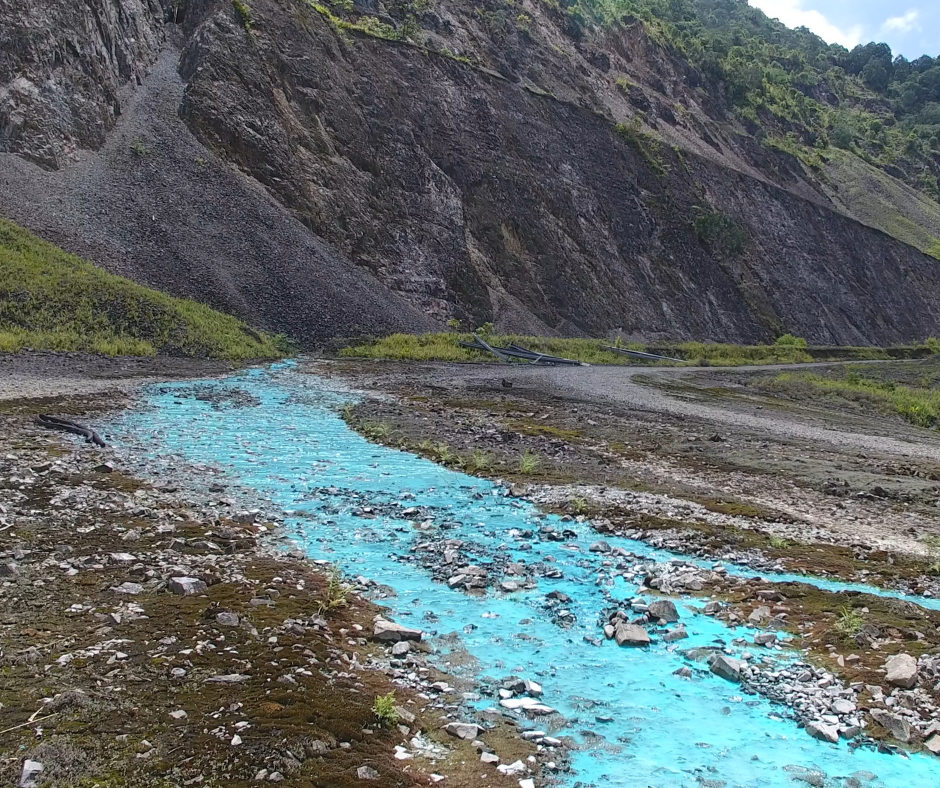
These questions of independence, post-conflict reconciliation, and economic livelihoods for local Bougainvilleans intersect with the issue of the Panguna copper mine in complex, painful, and even paradoxical ways. The Panguna copper mine highlights the challenging reality that even for Indigenous people who are deeply connected to their lands and waters, opposition to a mine is not a simple choice. Many Bougainvilleans are opposed to the mine’s horrendous environmental and health impacts, as the unremediated areas around the mine have caused copper and other heavy metals to contaminate the waters, turning parts of the river a teal color from oxidized copper. This contamination of water sources not only leads to the death of marine life, including fish that locals depend on, but also exposes local people to sores and skin ailments when they come into contact with the water.
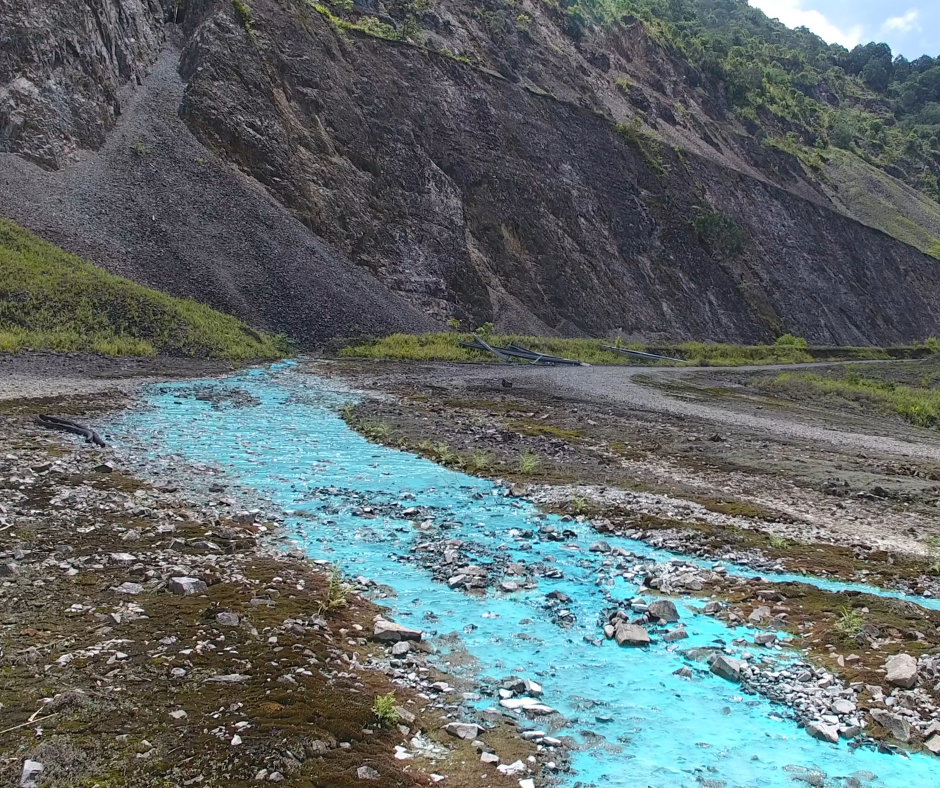
An image of mine waste from the Panguna mine that has contaminated local waterways, turning the water an unnatural tea color. Credit: HRLC Discover Documentary / Film makers & Film Production projects Online. | IPS NEWS
In spite of this natural destruction, however, many local people—particularly those living around the Panguna mine site—rely on unregulated, alluvial mining of remaining gold deposits for their basic survival. For many of these local villagers, alluvial mining is the only livelihood that can actually support their families, since many areas of contaminated land and water no longer support subsistence agriculture or aquaculture. Additionally, many of the local people who are veterans of the civil conflict never had a chance to go to school or receive any type of vocational training or education, leaving them unable to realistically pursue any other type of job that will provide an income source for purchasing basic necessities, including food. Understood in this light, this engagement with mining is out of desperation, as there are no other viable alternatives within the dominance of a cash economy, and when subsistence is no longer environmentally feasible.
Apart from the opportunities presented by alluvial mining for those villagers on a smaller scale, many Bougainvilleans have also not closed the door to officially reopening the Panguna mine and the copper industry. At a broader level, many Bougainvilleans do not believe independence is possible or economically viable without mining as a revenue source. Understanding that PNG relied on revenue from the Panguna copper mine to establish its independence and sovereignty as a new nation in 1975, people in Bougainville recognize that legitimate sovereignty requires a financial base that provides leverage to participate in the global economy. Over the years, Bougainville has recognized how heavily reliant it is for PNG for providing and funding many of its public services. Thus, denying or avoiding that reality of the need for an economic base does not allow any entity—whether an autonomous region or nation-state—to survive for very long.
With an estimated 90 million Australian dollars' worth of gold and copper left in the mine if it were reopened, the Panguna mine represents an important economic asset for whichever party ultimately controls its reopening. Because of this, it has recently been reported that the Bougainville Autonomous Government has been in talks with Lloyds Metals, an Indian mining company seeking to partner with the island to reopen the mining industry (Read: Transparency concerns as Bougainville's Panguna mine that sparked civil war on path to reopen - ABC News). While mining is not the only economic activity that the island has to offer, as shown by the activity in the fishing and aviation sectors, as well as a recent surge in cocoa production given problems with cocoa crops globally, the mine represents the industry that has the potential to offer the largest and quickest turnaround with revenue. Thus, at both the micro and macro levels, Bougainvillean people find themselves in a quagmire and in a deeply challenging relationship with the copper mine. The reality is that mining engagement cannot be avoided, as it is already occurring among alluvial miners, who face the choice between mining and starving.
Bougainville is not alone in this situation, where Indigenous Peoples with deep connections to their lands and waters must reconcile with mining as one of the only viable pathways for providing economic and political sovereignty. In the complicated and fraught geopolitical environment surrounding Greenland in the last year and a half, local Greenlanders have been challenged to think about their sovereignty and rights not only in their historical relationship with Denmark as a territory, but now also in relation to possible political ambitions voiced by the current United States administration. Greenland’s autonomous government is not only wary of granting rights for oil pumping to foreign companies because of the plans for the drilling activities to occur in protected conservation areas, but also because they are not clear of the political consequences if they refuse this drilling (Read: Greenland issues ‘strong warning’ as Trump-linked oil firm prepares to drill | Greenland | The Guardian). Further, given Greenland’s massive reserves of rare earth minerals that are in high demand for current technologies, many Indigenous Greenlanders are divided on their openness to this kind of mining and its impacts on their lands, while nearly all stand in agreement about the importance of economic sovereignty for Greenland (Read: What does the global mineral rush mean for Greenland's future?).
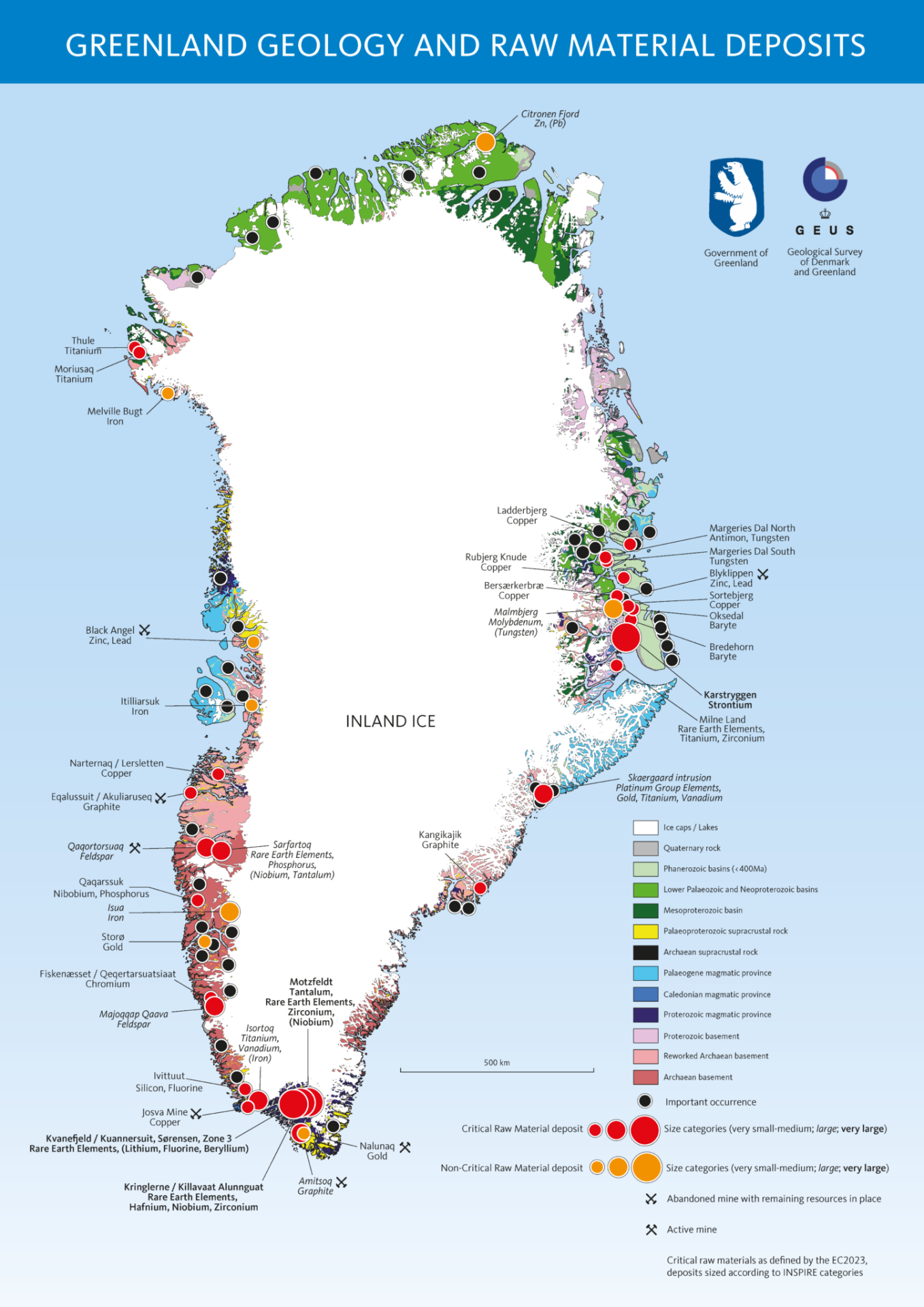
A detailed map showing Greenland’s geology and diversity of mineral deposits. Credit: Greenmin.gl.
In the South Pacific, the Cook Islands are also a place where leadership and locals are trying to navigate what sovereignty can look like amid the global scramble for transition metals. As an island country with an Exclusive Economic Zone that encompasses nearly 2 million square kilometers of ocean floor, the Cook Islands is weighing the costs and benefits of engaging in deep-sea mining. This type of extraction from the seabed yields metal-rich rocks known as ‘polymetallic nodules’ that contain high levels of different desired minerals, including nickel and cobalt, among others. Under the leadership of Prime Minister Mark Brown, a leader who has been open to engage with mining exploration and partnerships, the Sovereign Wealth Fund Act 2026 was recently passed in order to structure the ways that future deep seabed mining royalties can be used to support the Cook Islanders (Read: Sovereign Wealth Fund to secure future from seabed mineral revenues - Cook Islands News). Under this Act, future mining funds are directed towards social and economic services, as well as disaster preparedness and response for events such as cyclones, which are increasingly impacting the islands due to climate change. While this act has already passed and the fund has come into being, this does not diminish the fact that not all Cook Islanders agree with the plans for deep-sea mining, particularly given strong traditional relationships that these Indigenous communities have with the ocean (Read: Deep-sea mining: How the Cook Islands is opening its seabed for exploration | AFP).
While every generation of people on Earth has faced challenges in their own times, it feels as though the crises, challenges, and intensely difficult decisions in how we respond to what is happening around us are extremely heavy. Perhaps there is no better set of issues than the intersection between mining, Indigenous communities, and struggles for sovereignty to illustrate the ways in which decisions are not always straightforward and completely clear-cut, particularly when we are all navigating larger global political and economic orders that were not built with Indigenous and ancestral wisdoms at their core. In this sentiment, I look upon the communities and individuals with whom I have engaged on this topic with profound respect and an open heart, whether they are Bolivian miners, Bougainvillean community leaders, Panamanians trying to develop community tourism plans, or North American colleagues trying to make responsible choices in shopping. I hold the faith that in these really extraordinary and challenging times, we are all trying to do our best in circumstances that are increasingly taking on an energy of their own. And I stand in solidarity with those trying to ensure that our connection to and stewardship of Mother Earth remains strong in perpetuity.
--Bobbie Chew Bigby (Cherokee) is a Postdoctoral Research Fellow at the University of Waterloo, Ontario, Canada, where she researches the intersections between Indigenous-led tourism and resurgence. This article is part of a series that elevates the stories and voices of the Indigenous communities and land defenders impacted by mining for transition minerals.