By Phoebe Farris (Powhatan-Pamunkey)
Raven Halfmoon (Caddo Nation), Anna Tsouhlarakis (Navajo), Nani Chacon (Navajo and Cree), and Teresa Baker (Mandan/Hidatsa) are some of the Indigenous women artists featured in this year’s Whitney Biennial held at the Whitney Museum of American Art in New York City. This year’s exhibition focuses on how artists use their creativity to test forms of so-called “rationality” between people and their surroundings across multiple generations, within ecological systems via new and evolving technologies, alongside infrastructures that sometimes support daily life and sometimes are used to destroy it.
These four select Indigenous women artists traverse these themes in varying forms of artistic expression, media, and disciplines that reference their unique heritages as well as how they perceive the world at large and their places within it and beyond it.
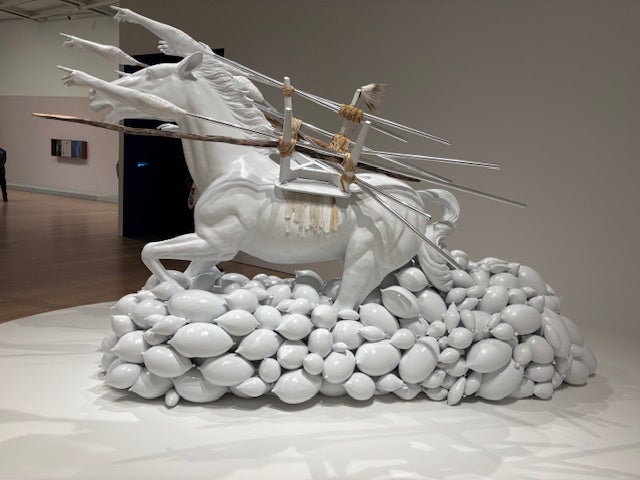
“She Must Be A Matriarch" (2023) by Anna Tsouhlarakis.
Tsouhlarkis’s 2023 sculpture, “She Must Be A Matriarch,” has generated significant attention and buzz in mainstream art publications. Its large size and placement on the sixth floor draw viewers' attention, most of whom stare at it in amazement. It is made of fiberglass, paint, adhesive, resin, plaster, wood, foam, metal, IKEA remnants, leather, deer hair, menstrual cups, prophylactics (condoms), and found objects. Tsouhlarkis is using feminist satire to humorously critique the 1919 sculpture, “End of the Trail” by James Earle Fraser, in which a Native American man is slumped over a horse, exhausted and defeated. Tsouhlarkis substitutes a female Indian warrior armed with realistic weapons, such as spears, and domestic items such as IKEA furniture and objects dealing with sexuality and reproduction.
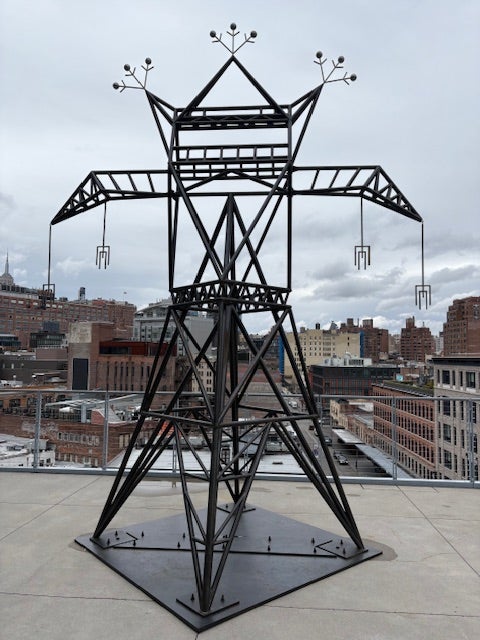
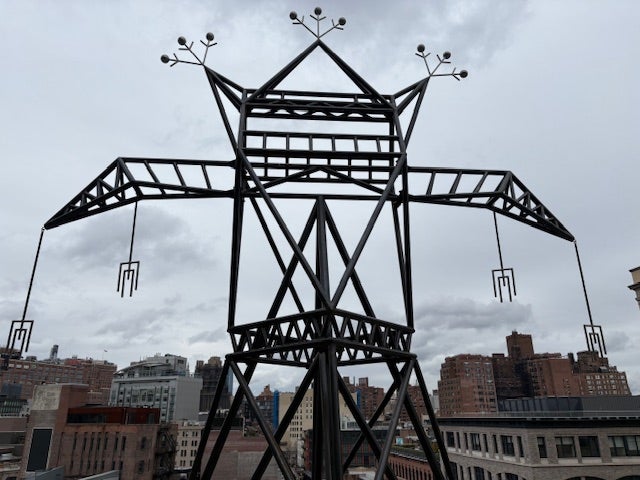
“Our Gods Are Above Us” (2026) by Nani Chaco.
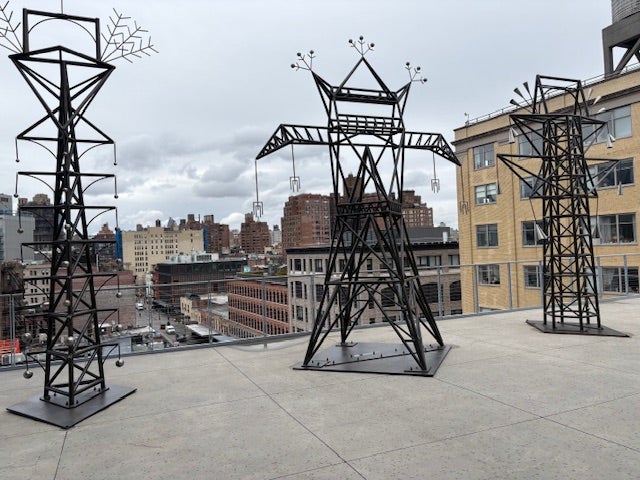
L-R: “Our Gods Are Above Us”, “Our Gods Walk Among Us” , “Our Gods Are Below Us” (2026) by Nani Chaco.
Chacón’s towering iron and steel sculptures are displayed on the 6th-floor outdoor terrace, with views of the city as a backdrop. Titled Our Gods Are Above Us”, “Our Gods Are Below Us”, and “Our Gods Walk Among Us”, they were all constructed in 2026. Chacon uses her sculptures to reveal visual similarities between sand paintings of Dine/Navajo gods and electrical towers used by coal refineries on the Navajo Nation. After the Biennial closes, one of the sculptures will be installed on the land of the Navajo Nation. Chacon views her work as seeking to transform environmental blight into new narratives.
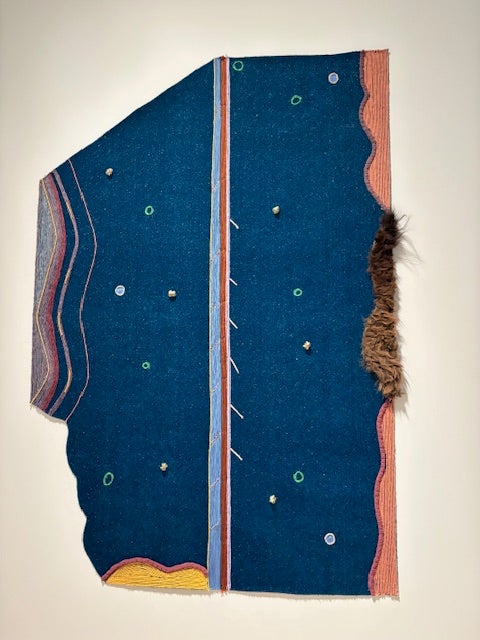
“Voluminous Day” (2025) by Teresa Baker.
Baker’s work transcends the boundaries of painting and weaving. “Voluminous Day” and “The Harvest Melting On Our Tongue”, both created in 2025,are made from yarn, parfleche, buffalo hide, and artificial sinew on synthetic turf. Her paintings are created by placing yarn, buckskin, and other materials on top of synthetic turf. Baker states that she was “ drawn to the material because it suggests the land and the space between natural and artificial”.The bold shades of blue could represent skies or waterways, and the small fragments of yarn placed on them could be seen as sea life, birds, or flying insects.
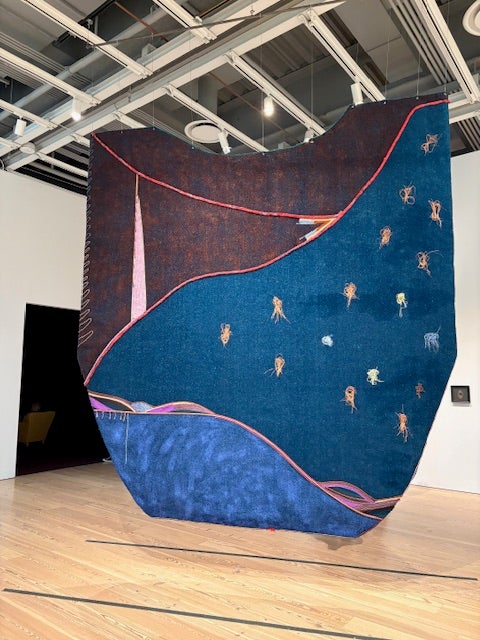
"The Harvest Melting On Our Tongue” (2025) by Teresa Baker.
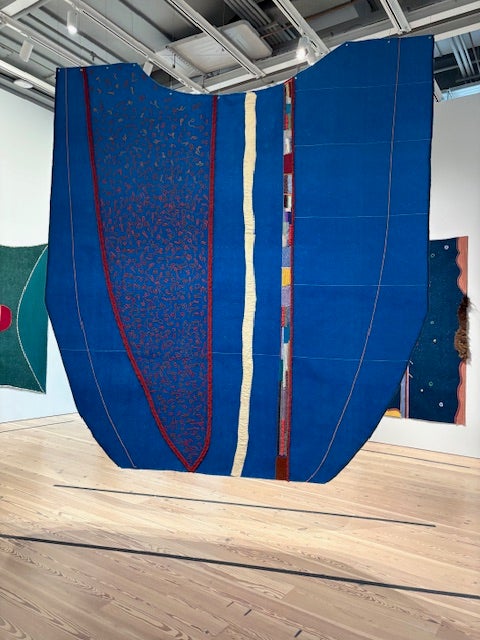
"The Harvest Melting On Our Tongue” (2025) by Teresa Baker.
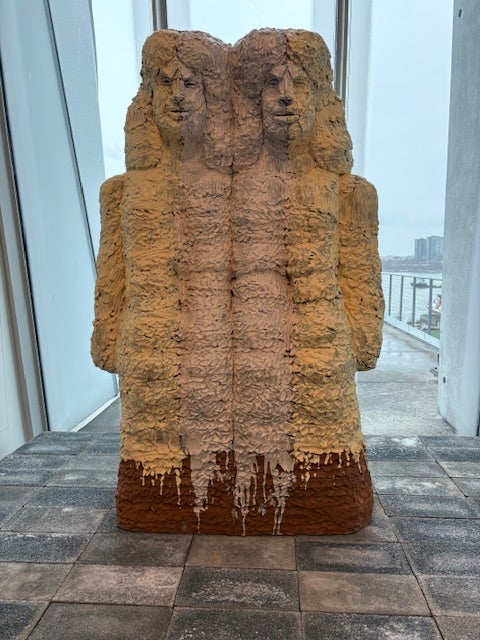
“Sun Twins” (2023) by Raven Halfmoon.
Halfmoon has a sculpture inside the museum and one outside on the street where people casually walking by can come upon one of her large figurative works. “Sun Twins” (2023), made from stoneware and glaze, is placed inside in front of one of the 6th-floor doors leading to the outside terrace where Chacón’s sculptures stand. Halfmoon creates her sculptures using a Caddo ancestral coil technique. Halfmoon likes creating twinned figures in most of her sculptures because she prefers making art with her family nearby rather than in isolation. Her twinned figures displayed outside are painted white and black with black and blue stars and crosses. Viewers can walk around them from the front, back, and in profile. The curvy, full-figured women appear sensual and powerful.
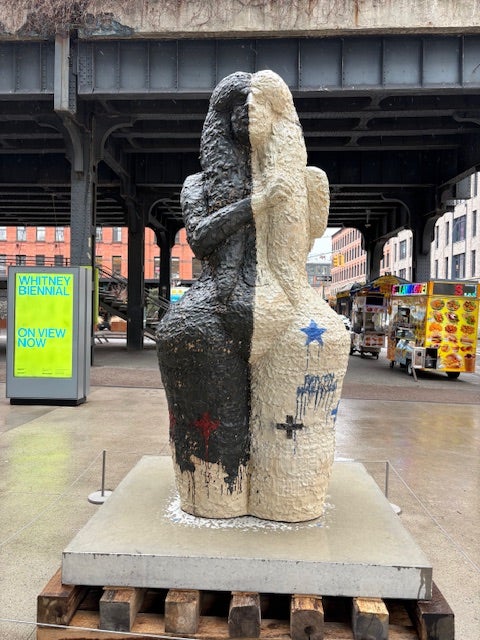
“Sun Twins” (2023) by Raven Halfmoon.
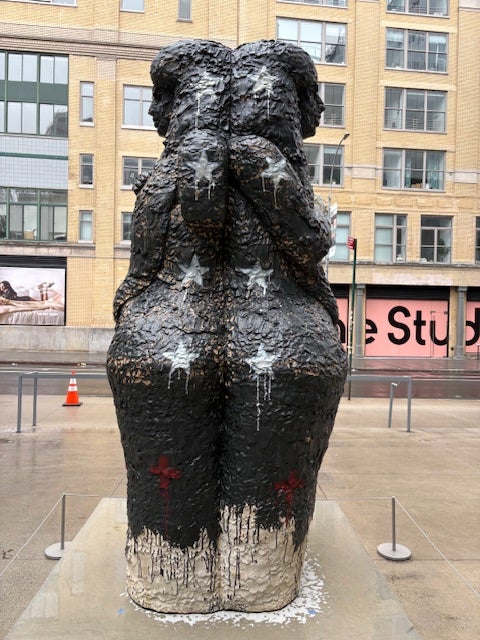
“Sun Twins” (2023) by Raven Halfmoon.
This year’s Whitney Biennial featured the most diverse group of artists I have seen in years. It showcases American artists of all backgrounds, those born here and those who are immigrants but now call the U.S./Canada/Turtle Island home. And I estimate about equal representation of female, male, and 2SLGBTQ+ artists. The Whitney brochure states that, “The Whitney Biennial showcases the most relevant art and ideas of our time and is often at the center of dynamic conversations that spark cultural shifts.” One of its goals is also to use painting, photography, film, sculpture, and the written word to capture the complexity of the present and suggest new creative ways to coexist. To see if you think this year’s Whitney Biennial lived up to its purposes and goals, check it out from now until closing on August 23, 2026.
--Phoebe Farris (Powhatan-Pamunkey descent) is Contributing Arts Editor for the Cultural Survival Quarterly magazine. An art critic, curator, author, and photographer, she has written extensively on Indigenous visual, literary, and performing arts for over two decades. Farris is also a Professor Emerita of Art and Design at Purdue University and has curated and contributed to exhibitions highlighting Native and global Indigenous artists. Her work bridges scholarship, creative practice, and advocacy, amplifying Indigenous voices in contemporary art and media.