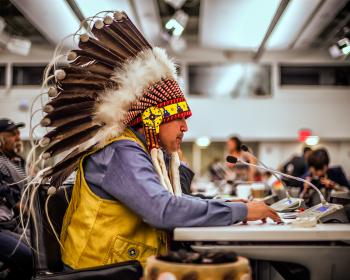
On October 12th, Tsilhqot’in People gathered at Fish Lake in British Colombia to inaugurate a totem pole at a new conservation area covering 800,000 acres to be managed by the Tsilhqot’in First Nation of Canada. The park, whose official name is Dasiqox Tribal Park, is known as ‘Nexwagwez?an’ , meaning “it is there for us” in the Tsilhoqot’in language.
On October 4th, the Tsilhqot’in First Nation of British Columbia will hold a totem pole-raising ceremony to inaugurate 3,000 square kilometers of land as a tribal park, just a few months after a historic Supreme Court decision granted them title to 1,750 square kilometers of disputed land.
24 September 2014
PUBLIC STATEMENT
In a decision delivered on Thursday, June 26, 2014, Canada’s Supreme Court has granted aboriginal title to the Tsilhqot’in Nation of British Colombia for 1,700 square kilometers of land that they can prove they have traditionally occupied or used for hunting, fishing, or spiritual ceremonies.
By Elliot Setzer, Intercontinental Cry
Taseko Mines Ltd. applied to the Federal Government for a second judicial review on March 26, 2014 after their proposal for the New Prosperity gold and copper mine in Tsilhqot’in territory was yet again rejected.
Known by the Tsilhqot’in people of the area as Teztan Biny, Fish Lake is a small lake located on the Chilcotin plateau in the Cariboo region of British Columbia on the Fish Creek Watershed, 125 kilometers southwest of the town of Williams Lake. Fish Lake lies within the picturesque lakes and forests of the Tsilhqot’in territory and is of great significance culturally and spiritually to the Tsilhqtot’in people. Throughout the last decade this land has been the subject of a battle between First Nations people and their supporters and Taseko Mines, Ltd.
By Jenna Winton
On February 14, 2014, the 23rd annual Women’s Memorial March (WMM) was held I in Vancouver, Canada. While some celebrated Valentine’s Day with their sweethearts eating chocolate and swapping Hallmarks, thousands of Indigenous people and supporters joined the March to honor their murdered and missing loved ones.
By Idle No More
The February 14th Annual Women’s Memorial March is held on Valentine’s Day each year to honour the memory of Indigenous women, including trans and two-spirit women, who have died as a result of physical, mental, emotional, and spiritual violence. Now in its 23rd year, the March remembers and honours murdered and missing women, and seeks to organize against ongoing gendered violence that women face.