By Cristina Verán
The word Moogahlin, in the Yuin and Bundjalung languages, means “to play” or “to fool around”. This spirited term—and the living philosophy behind it—expands through the work of the renowned Moogahlin Performing Arts, one of the most vital and culturally grounding forces in contemporary Australian performance today. Indigenous theatre veterans Lily Shearer (Murrawarri), Fred Copperwaite (Bunuba), and Dr. Liza-Mare Syron (Biripi) co-founded the company in the deeply entrenched Aboriginal community of Sydney’s Redfern district, deliberately rejecting the standard western structures and strictures of theatre to instead honor millennia of First Nations storytelling.
Over the past decade and a half, Moogahlin has evolved from a grassroots, artist-run setup into a major force on the international stage—one that maintains a deep commitment to the community from which it sprang. Through landmark productions like Jane Harrison’s “The Visitors”—a touring work that inverts the colonial gaze to depict the arrival of the British First Fleet through the eyes of the land’s Original Peoples—and flagship platforms like the Yellamundie Festival, the company continuously champions independent First Nations creators and reclaims historical narratives. Beyond decolonizing performance spaces and redefining what theatre can be, Moogahlin broadens its mission to include environmental and cultural advocacy through its biennial Baiame's Ngunnhu Festival, held alongside the ancient Brewarrina Fish Traps.
Cristina Verán spoke with Moogahlin Performing Arts Co-founder and Artistic Director Lily Shearer about the political and social histories that shape their work, and how Indigenous storytelling remains essential to the larger projects of community healing and cultural survival.
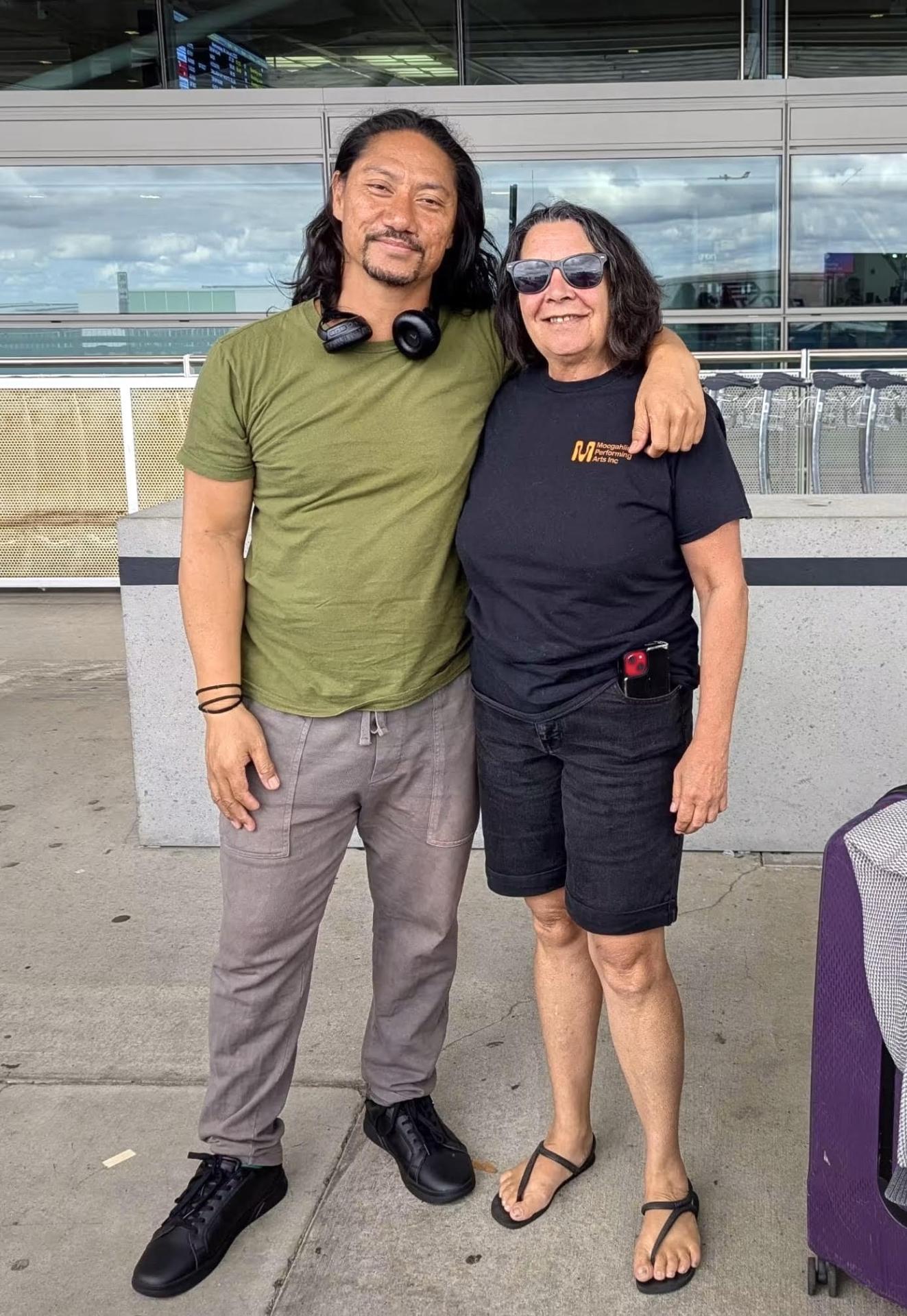
Lily Shearer and Natano Fa'anana (Samoan), Moogahlin's Executive Producer, en route to pitch a new play at the 2025 ISPA Conference (International Society for the Performing Arts) in New York.
Cristina Verán: Tell us a bit about the beginnings of Moogahlin Performing Arts and the community it calls home.
Lily Shearer: We, the company’s co-founders, started talking about forming something like this back in November 2007, following the passing of Uncle Kevin Smith (Walbung-Murramarang), a deeply respected actor and Aboriginal activist from Redfern, in Sydney. He’d been trying to establish a local Indigenous theatre company, and his family asked if we’d pick up the baton and build something proper and lasting for the community. We officially incorporated on May 19, 2009.
CV: While it’s become known for performances that can be defined as “theater,” Moogahlin doesn’t refer to itself as a "theater company,” as such. Why is that?
LS: That was dead intentional. Western concepts of theater want to put artists in this box, requiring script-bound works and proscenium arches, whereas our mob has been telling stories for tens of thousands of years, across interconnected forms that combine dance, music, visual art, oral yaans, and songlines. Written scripts, in the Western sense, are a form First Peoples here have only really been using for about 50 years. Naming ourselves Moogahlin Performing Arts meant no one could lock us into a single Western performance genre, leaving us free to tell stories our way.
CV: What was it like during those early years in terms of size, scale, resources, and before Moogahlin had a permanent home?
LS: We started out as a grassroots, purely artist-run setup, working on a project-by-project basis. Each of us, the founders, kept outside jobs to pay the bills and keep roofs over our heads. For years, our office consisted of a single black filing cabinet that held all our documentation, dragged from place to place, wherever I was working. Though we lacked a fixed venue, we had strong relationships with the local Redfern community.
CV: What makes Redfern so significant, symbolically and historically?
LS: It’s universally recognized as the "Black Capital" of Australia as well as the geographic and political beating heart of the modern First Peoples movement—where everything from the Aboriginal Legal Services to Koori Radio to the original National Black Theatre were born. Back in the late 1960s and ‘70s, our Indigenous civil rights activists here were exchanging ideas directly with members of the Black Panther movement in the United States. The central block of the neighborhood—known simply as "The Block"—is Aboriginal-owned land handed over under the Gough Whitlam-led federal government in 1972 after community members squatted in tents, right there on country, to demand land rights. This history also ties directly to the closing down of state and church-run missions from the late 1930s to the late 1960s.
CV: What were the social dynamics like at the time, in terms of where people came from and what they were facing?
LS: Those missions I noted were run like reservations, or residential schools, with the aim of total control, strict assimilation, and the cultural erasure of our People. When they eventually shut down, generations of displaced mob—many of whom had been stripped from their families under the country’s shameful Stolen Generation policies—had nowhere to go. They started coming to Redfern and setting up camp on The Block because nearby factories offered manual-labor jobs to people who’d been trained on the missions. Sadly, by the early 2000s, the accumulation of intergenerational trauma, poverty, and forced displacement led to serious issues for many residents with drug misuse, domestic violence, alcoholism, and crime. It also became a highly policed neighborhood.
CV: Did these folks come primarily from Indigenous communities around Sydney, or did they arrive from further afield as well?
LS: Our people came from all over the nation after the missions were closed. First Peoples from as far as the Northern Territory were taken to Milleewas Half-caste home, Mulgoa NSW, in Western Sydney. Our people on the Mission in my hometown of Brewarrina came from QLD, VIC, and communities close by, but it was a handful of those communities all mixed up on the Mission, so they didn’t speak the same language and have the same ceremonies, they didn’t even have the same diets.
When the missions closed, they came to Redfern looking for work, as they were trained as domestic servants and/or laborers. However, most importantly, they came in search of their families, to find out where they belonged. I was involved in a door-to-door survey taken in Western Sydney during the 1990s. There were mobs representing 63 different First Nations tribes and/or language groups living in the Blacktown LGA. Most of our people living in Western Sydney were relocated from Redfern as they were redeveloping The Block in Redfern.
CV: What were you engaged in at that time, and how did it relate to the movements you’ve mentioned?
LS: Between 2005 and 2007, while working in Redfern for a mainstream company, Performance Space, I got involved at the Redfern Community Centre (RCC), and I helped launch “Gathering Ground,” a Community Cultural Development project, alongside Pact Youth Theatre. I then became the Cultural Development Officer at RCC, and Frederick Copperwaite stepped in to direct “Gathering Ground”(2008, 2010), while I acted as cultural advisor, to ensure 100% Indigenous creative leadership. Our focus was telling authentic stories through our own lens, as well as using that storytelling to process intergenerational trauma, which we did while also bringing in over 3,000 audience members a night.
CV: How did urban development pressures in Sydney begin to impact this community?
LS: Gentrification was forced upon it by the state government’s Redfern Waterloo Authority. Homes on The Block were knocked down, and families who’d lived there were forcibly relocated, again. The Aboriginal Housing Company was staunch in holding onto The Block, and began fundraising and working with University of Sydney design students to reimagine The Block’s future.
CV: The advent of new arts spaces, and arts programming in general, seems to too-often herald and further encourage more gentrification, serving its newly anointed beneficiaries rather than the People already living there in community. How has that played out in Redfern?
LS: Well, when Carriageworks Performing Arts Centre opened down the road in 2007, community mistrust around it was huge. People reckoned it’d be yet another elitist venue—like, for example, the Sydney Opera House—that would basically lock locals out. It took years of deliberate, unrushed relationship-building to bridge the Centre’s divide between itself and the local Aboriginal community, ensuring the People would be empowered to tell their own stories through its space and resources.
CV: How did Moogahlin transition into a fully funded resident company there?
LS: The major shift came in 2014 when the CEO of Carriageworks formally invited us to apply for residency, despite our lack of capital at the time. This provided our first actual office space, and partnering with them on grant applications gave us the organizational weight needed for multi-year operational funding. We secured our first four-year grant from the Australia Council for the Arts (now Creative Australia) for 2017–2021, and are currently in our third consecutive cycle with them, through 2028, matched by multi-year operational funding from Arts New South Wales (now Create NSW) since 2021. That baseline financial stability allowed us to stop surviving hand-to-mouth on project grants and actually engage in long-term strategic planning.
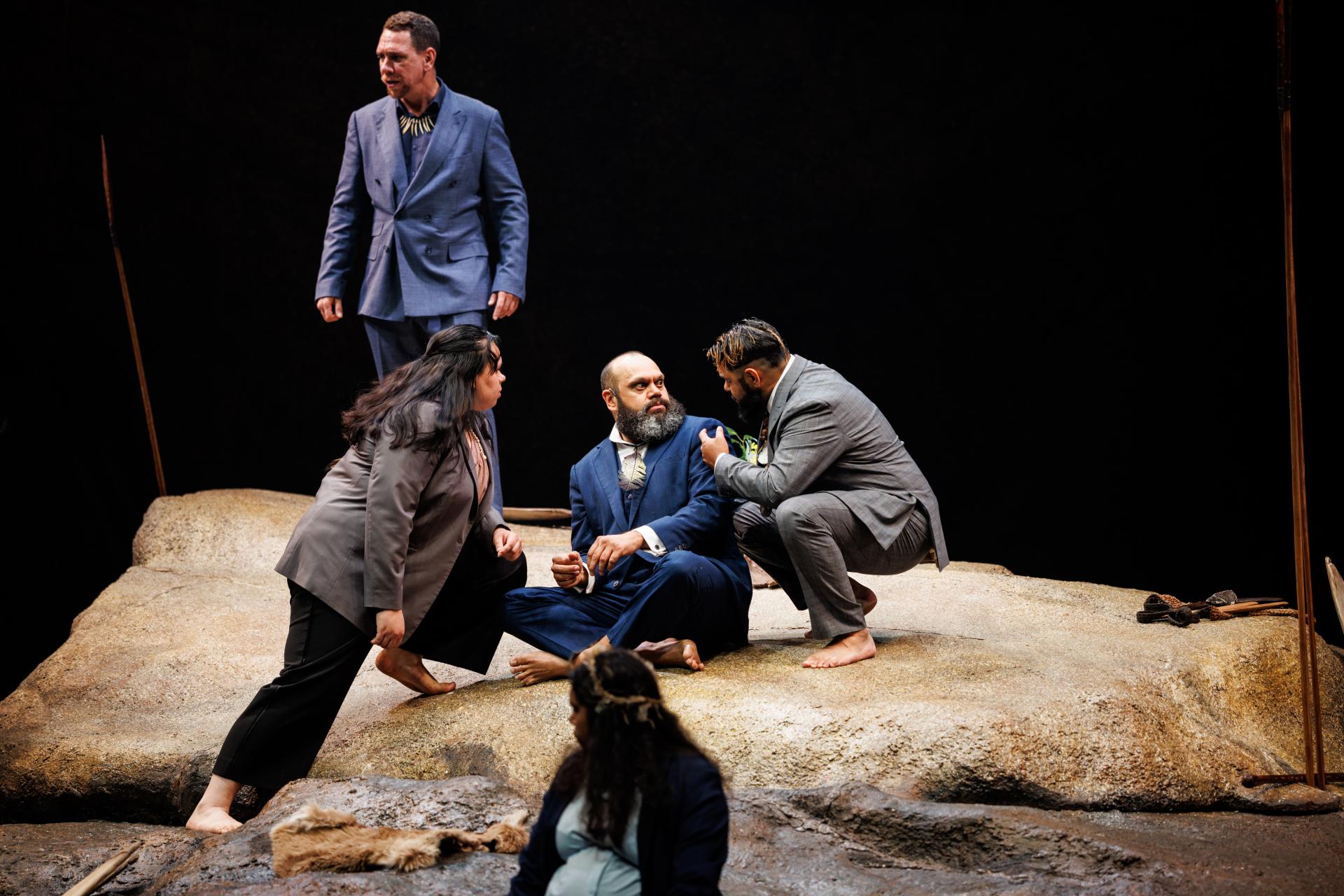
Scene from "The Visitors" at the Perelman Arts Center in New York City. Photo by Maria Baranova.
CV: Now let’s get to “The Visitors,” which has been touring across Australia and internationally in the past couple of years—including here at New York’s prestigious Perelman Arts Center (PACNYC). Tell us how this work came to Moogahlin and what its mission has become now that it is part of it.
LS: It was written by playwright Jane Harrison (Muruwari), the author of Stolen, who had pitched the script originally under the title “First Contact” at Moogahlin’s National flagship platform, Yellamundie Festival, in our inaugural year (2013). Following seven years of dramaturgical development and community consultation around it, to ensure authenticity, it premiered at Carriageworks (directed by Frederick Copperwaite and produced by Liza-Mare Syron) during the 2020 Sydney Festival.
In 2023, “The Visitors” was re-staged under the directorship of Quandamooka man, Wesley Enoch, and in partnership with Sydney Theatre Company, premiering at Sydney Opera House as part of their 50th Anniversary program.
“The Visitors” employs a kind of symbolic inversion of all the histories Australians are taught in school that are, in fact, contrary to our own Indigenous stories. Those British colonizers who recorded meticulous entries in their logs about us had operated under the assumption that First Peoples would never read them. But Jane went and found these documents, including many wherein British officers described Aboriginal People as, for example, "brutes" with "narrow heads, stocky bodies, short limbs, fish-like lips, and protruding eyes." Non-Indigenous audiences are often shocked to learn that some offensive language used in the play is, in fact, quoted verbatim from the official British records. She wanted to invert that colonial gaze.
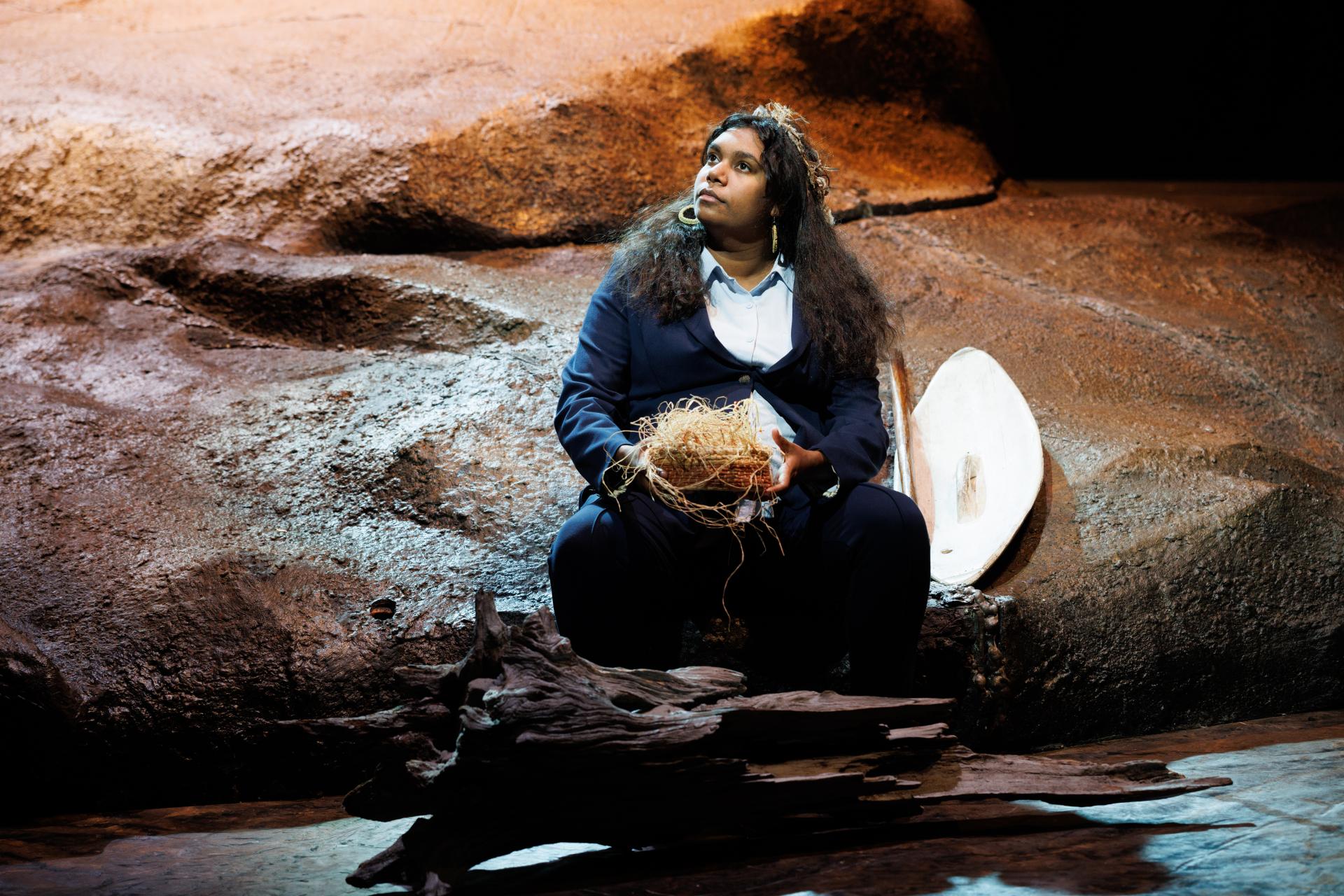
Scene from "The Visitors" at the Perelman Arts Center in New York City. Photo by Maria Baranova.
CV: What should we know about the historical event around which the story is centered?
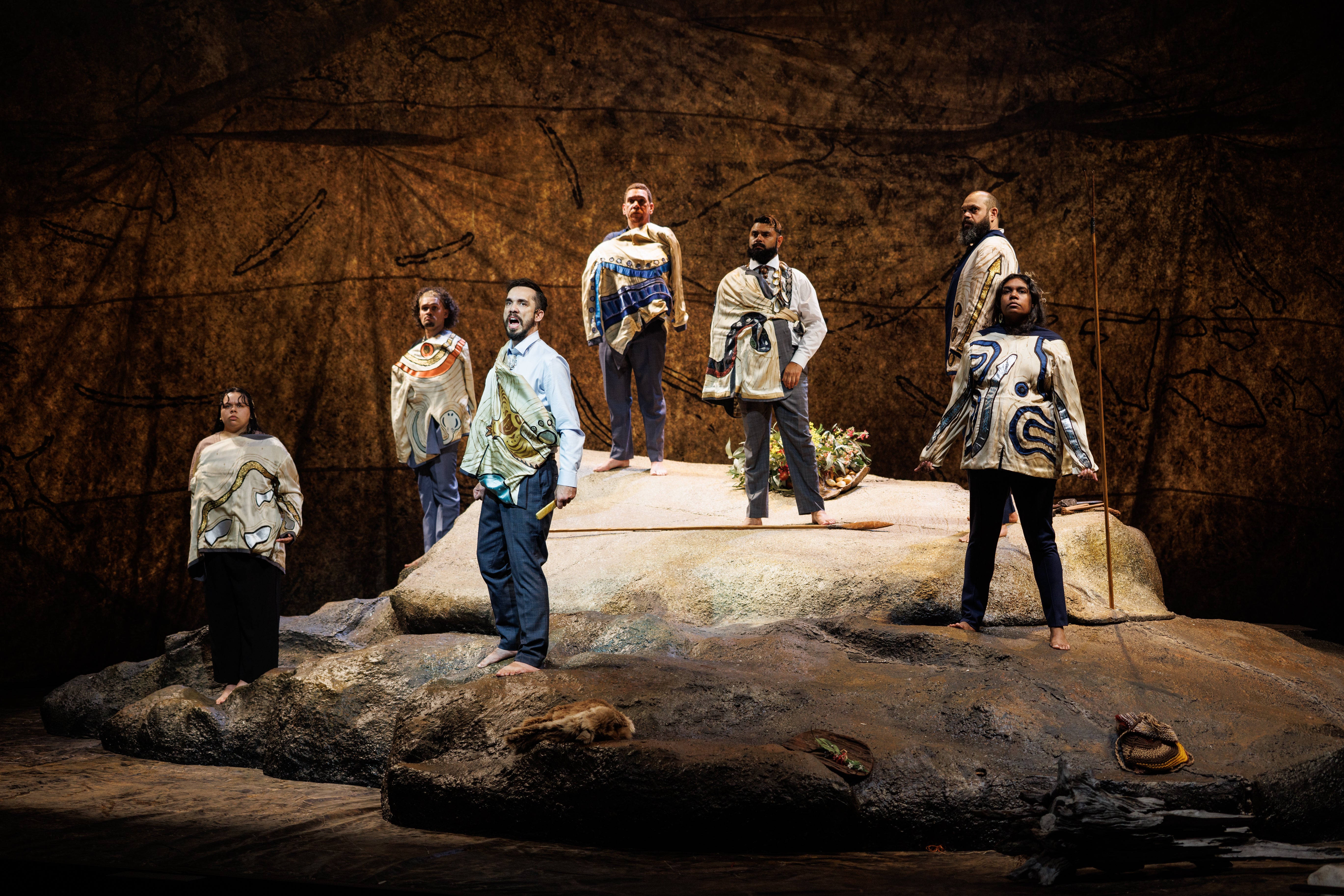
LS: Set in 1788, “The Visitors” depicts six senior [Aboriginal] Law Men & Women, and one new initiate, from surrounding clans, convening in council at what is now known as Sydney Cove to discuss what they saw making its way toward them on the horizon: the British fleet. They begin to debate, per their own diplomatic protocols, whether to welcome, ignore, or resist the newcomers. Events in the play [such as a public hanging witnessed offshore] are drawn directly from colonial logs now reinterpreted through an Indigenous lens.
CV: How has Moogahlin managed to design and adapt the staging for “The Visitors,” thus enabling the play to travel beyond major mainstage theatres and work well in different and smaller spaces?
LS: We created three distinct production models. Version A is our mainstage configuration, built for major venues like the Sydney Opera House or the Public Theater in New York, and featuring a massive sandstone set piece we’ve nicknamed “Bertha.” Version B is a much more compact, flexible touring setup for use in regional theatres across Australia. And Version C, still being developed, will be further stripped back, ideal for performances on missions, reservations, and in community halls. It requires just the seven actors in business suits around a boardroom table, under basic lighting. When we were in New York earlier this year, to perform this at the Perelman Arts Center (PACNYC) in Manhattan, the cast even considered taking this version to a rock in Central Park to perform it right there.
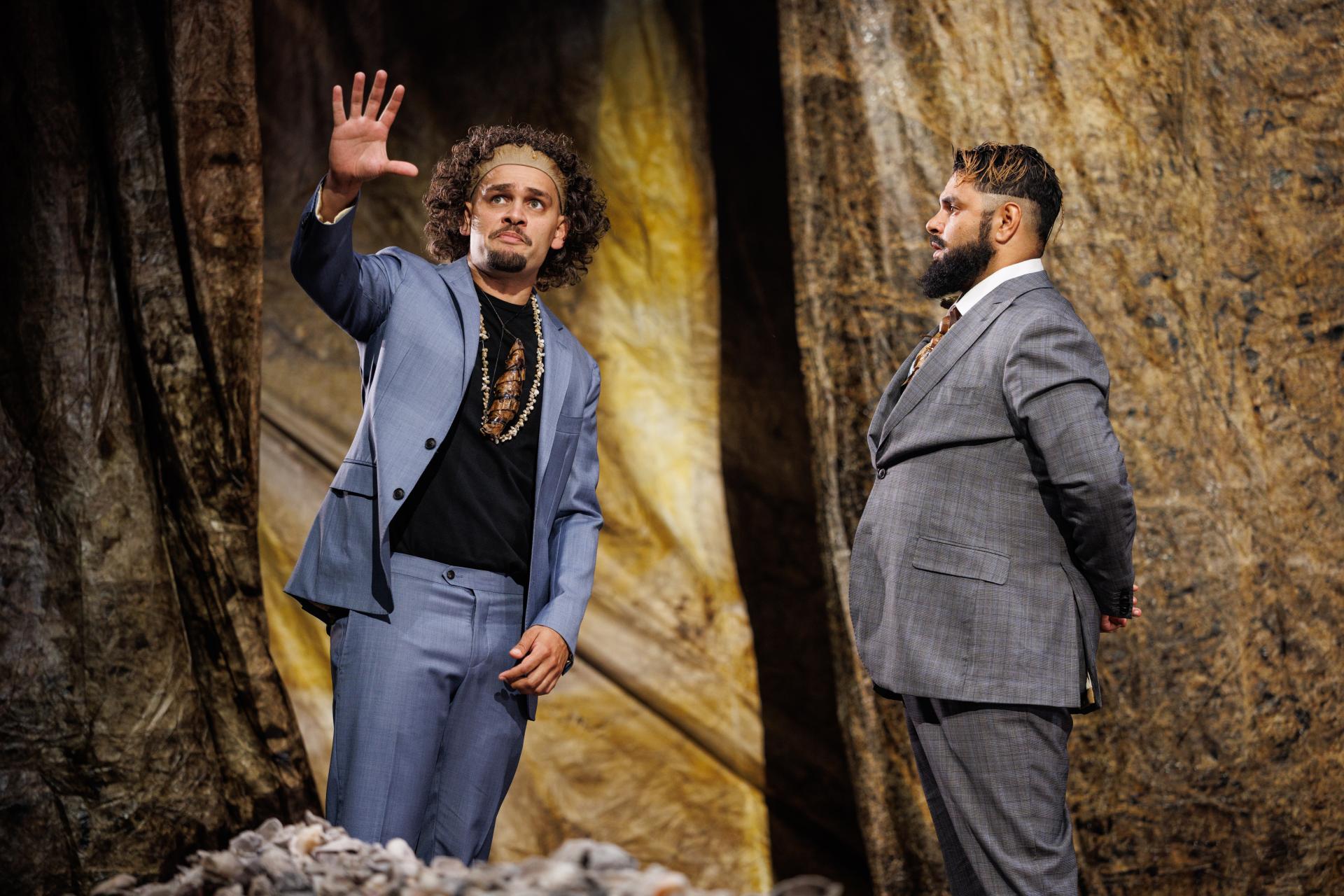
Scene from "The Visitors" at the Perelman Arts Center in New York City. Photo by Maria Baranova.
CV: How have Indigenous Australian audiences been responding to it?
LS: Mainstage venues often feel alienating to our mob, due to historical barriers we’ve experienced from such spaces. But during our 2024 national tour, regional venues reported record attendance for local First Nations community members—some venues, in fact, saying it brought out the most Blackfullas they’d ever hosted! They come to “The Visitors” because we’ve built real relationships with local communities, presenting a powerful narrative that had never been presented on stage through an Indigenous lens before.
CV: I understand that some conversations that came out of the 2010 National Indigenous Theatre Forum led to the launch of your flagship platform, Yellamundie Festival.
LS: Between 2008 and 2010, Wesley Enoch (Quandamooka), now chairperson of Creative Australia, had been in discussions with federal Arts Minister Peter Garrett about allocating $2 million toward a new National Black Theatre for Australia. We argued that funds should go directly to artists, script development, and commissions—not more “bricks and mortar.” In response, Wesley and Lea-Anne Buckskin (Narungga, Kaurna, Wirangu, and Wotjobaluk) convened the inaugural National Indigenous Theatre Forum you mentioned, in Cairns, so that First Nations practitioners from across the country could gather to map out sector priorities.
When the number one of these policies was identified by a vote: reviving the National Aboriginal Playwrights Conference (which had been defunct for 17 years due to both drops in funding and a generational gap in the sector), Wesley looked out at all the attendees and asked: “Who will take on the responsibility?” The room went dead silent, because no company had either spare cash or extra staff to offer.
Liza-Mare Syron and I looked at each other, though, and thought, “OK, we will!”—and thus committed Moogahlin to leading it (despite having bugger-all in our bank account). Creative Australia then backed us with $50,000 in seed funding and paired us with producer Wendy Blacklock at Performing Lines to help build and strengthen our own producing capacity.
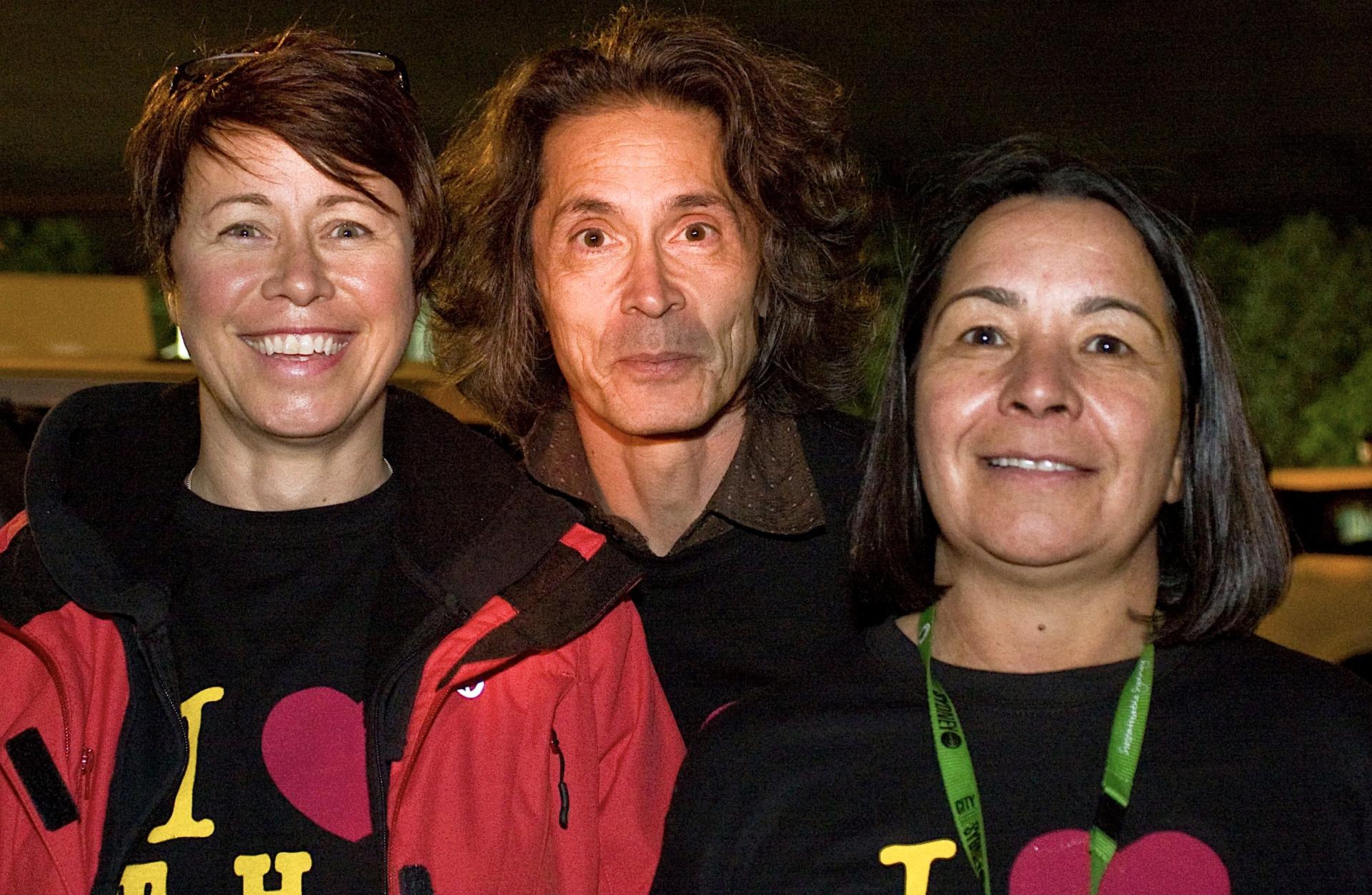
Moogahlin Performing Arts co-founders Dr. Liza-Mare Syron, Frederick Copperwhite, and Lily Shearer.
CV: How did that commitment lead to producing festivals as part of its work of decolonizing performance spaces, and how has Moogahlin’s vision evolved over time?
LS: We launched Yellamundie Festival—from the Dharug word for "storyteller"—in 2013, as a biennial national showcase dedicated exclusively to independent First Nations artists (We do not accept proposals for this from established companies). From the 50 to 60 applications we receive from around the country each time, we select six works for intensive workshop development, and showcase the works to the public and sector over 3 nights and 2 days.
Under Frederick Copperwaite’s direction from 2013 to 2019, the festival focused on script-based plays. When I became Artistic Director in 2020, I expanded the format to include two play scripts, two dance/movement works, and two music/composition pieces, returning us to traditional storytelling methods that treated movement and composition as equal to texts. Across its seven editions so far, Yellamundie Festival has developed 51 original works—21 of which have gone on to full mainstage productions with major companies nationwide. Moogahlin itself also commits to fully producing at least one work from each cohort.
CV: Please describe what the broader landscape of Indigenous theatre in Australia, especially Indigenous-led theater companies, looks like today, and what particular challenges are still being faced.
LS: The sector remains relatively tiny, with just three dedicated Black companies nationwide: Ilbijerri Theatre Company in Melbourne, Yirra Yaakin Theatre Company in Perth, and Moogahlin in Sydney (a fourth company, Kooemba Jdarra in Brisbane, closed around 2008 due to funding and operational pressures). We do have several specialized dance and physical theatre organizations to add to the list, including Bangarra Dance Theatre, Marrugeku, and BlakDance. Recognizing also our only national First Peoples-led training institution, the National Aboriginal & Islander Skills Development Association (NAISDA) Dance College.
As to the challenges, we as First Peoples entities have to respond to demands that mainstream organizations rarely face, with our teams constantly balancing creative development with support for community needs—including the ongoing work of reconnecting families split by the country’s Stolen Generations policies. We’re also navigating the dynamics around what’s being called a “lost generation”—people who’d previously hidden their Indigenous identity due to systemic racism and discrimination, but now, without having grown up in community, proudly claim this heritage.
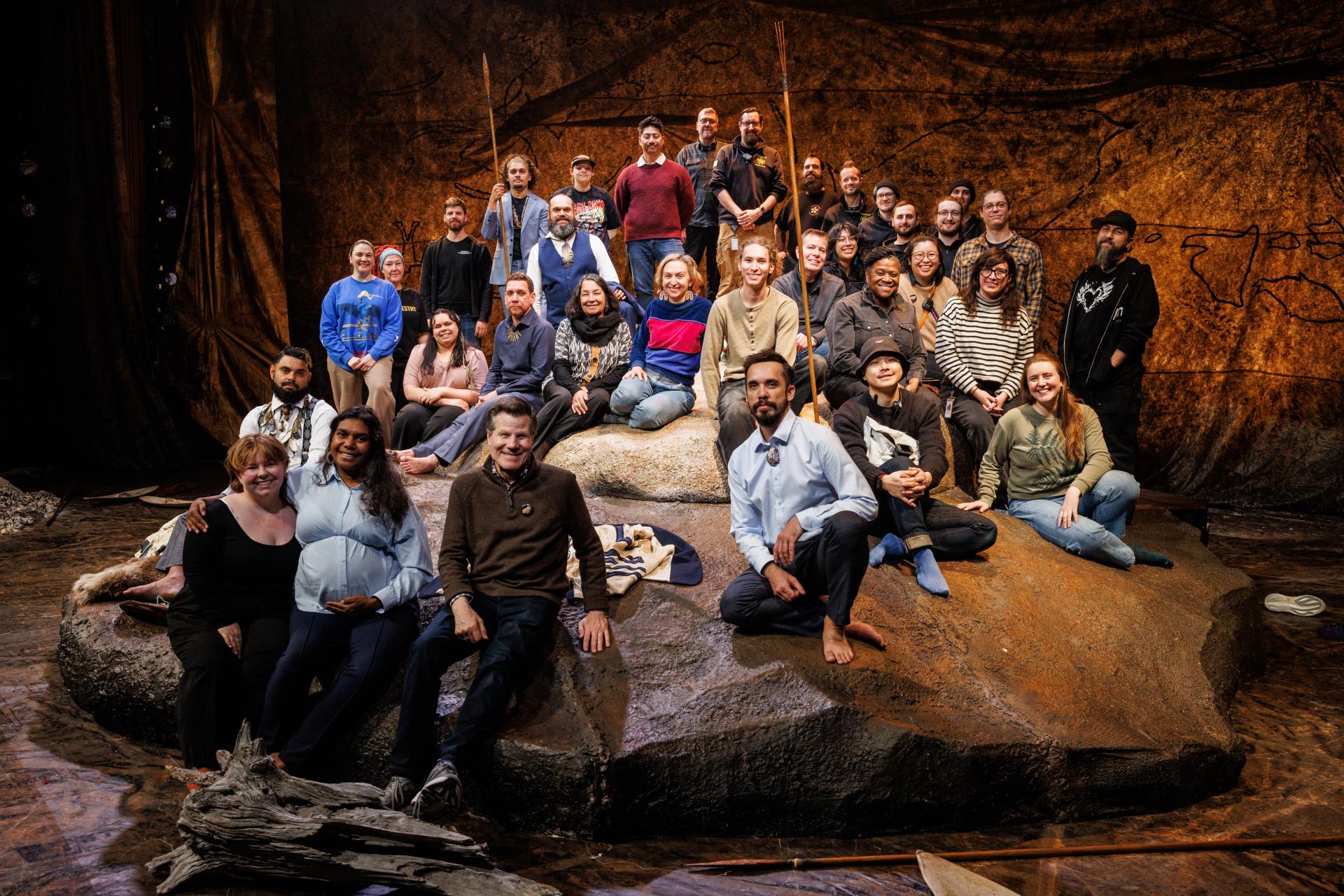
Cast and crew of "The Visitors." Photo by Maria Baranova.
CV: How did the familial and perhaps generational experiences of yourself and your Moogahlin counterparts shape your respective interests in and commitment to reclaiming historical narratives?
LS: My generation grew up under Australia’s assimilation policies. First Peoples here were not granted full voting rights until 1967, and our equal access to education was only mandated around 1972. I remember well that, as a student in the mid-1970s, in a Catholic secondary school run by Good Samaritan nuns, we were taught that Captain Cook "discovered" Australia (and therefore us). I dared to challenge my history teacher on this point, insisting that, according to my father and grandfather, that man didn't discover us—our people discovered him when he arrived on our shores. For this, the teacher called me a "brazen toad" and threw me out of her class—permanently. My co-founders, who are also Indigenous, had quite different upbringings. Meanwhile, Liza-Mare Syron grew up away from community in the Sydney suburb of Balmain, while Fred Copperwaite grew up on the other side of the country in Fremantle, near Perth, with his white father’s family. It was at age 30 that he was finally able to connect with his (maternal side) Aboriginal family.
CV: Moogahlin now also produces another festival, which connects culturally centered storytelling with environmental advocacy. Tell us about this, especially the significance of the place for its setting.
LS: The Baiame Ngunnhu Festival, established in 2015, uses performance and community gathering to fight for environmental justice. It takes place along the Ba-Wun (Barwon) River in my home community of Brewarrina (in New South Wales). The site features our traditional Fish Traps—called Ngunnhu—which comprise an ancient stone-pen system and represent the oldest human-made structures on Earth, predating the Egyptian Pyramids and Stonehenge. Despite its immense historical significance, unfortunately, the Australian government provides bugger-all protection or funding compared to those places it sees as global heritage sites.
CV: And for the record, what are the most pressing issues for this community right now?
LS: The river system has been severely degraded by imported cattle breaking down its banks, invasive European carp displacing native fish, and introduced weeds choking the water channels. Most damaging of all are commercial cotton farms—many owned by foreign corporate interests in America and China—that extract massive volumes of water from our river network, on the driest inhabited continent on Earth. The core message at Baiame’s Ngunnhu Festival is straightforward: if the natural country provided by the Creator is unhealthy, the people who rely on that land cannot be healthy either. Thus, we are able to link our cultural survival directly to environmental survival and, ultimately, to the survival of all our First Nations Peoples.
--Cristina Verán is an international Indigenous Peoples-focused researcher, educator, advocacy strategist, network weaver, curator, and mediamaker. She was a founding member of the United Nations Indigenous Media Network and the UN Indigenous Language Caucus. As Adjunct Faculty at New York University’s Tisch School of the Arts, she brings emphasis to the global histories, expressions, and socio-political impacts of Indigenous contemporary visual and performing arts, design, tech, media, and popular culture(s).
Cast members featured in these images from "The Visitors" America Season, at PAC NYC in New York, include: Najwa Adams-Ebel, Beau Dean, Riley Smith, Sean Dow, Kyle Morrison, Guy Simons, James Slee, and Zoe Walters. (Additional members feature in the Australian and New Zealand Season productions.)