By Cristina Verán
Amidst the polyphonic plurality of contemporary art in India today, a young Indigenous artist named Dhiraj Rabha (Rabha) from the country’s far northeast emerges as a compelling observer, cultural critic, and storyteller. Assam may be a state best known for its lush tea plantations, formidable one-horned rhinoceroses, and the mighty Brahmaputra River, but its Rabha People, as with dozens of other Tribal communities there—comprising an estimated 3.88 million people—have long lived surrounded by political volatility and echoes of armed conflicts past that impact their lives to this day. As a result, Rabha grew up not on his ancestral lands, but in a high-security facility of the state, surrounded by high-perimeter walls and the perpetual surveillance of looming watchtowers meant to corral and control the onetime insurgent groups from the region.
Despite the restrictions such a place imposed on his life, from an early age, Rabha began looking to his immediate environment as both a site of artistic inquiry and a living archive, within which the collective memory of his People lived. After earning his fine art degree from the prestigious Kala Bhavana (Institute of Fine Arts) at Visva-Bharati University of Santiniketan, West Bengal, Rabha returned to his community as an artist with a mission: to gather its fragile and fragmented oral histories and transform them into interactive works of embodied memory.
During this year’s Kochi-Muziris Biennale (held in the southern port city of Kochi, in India’s Kerala state), Rabha’s ambitious opus—a three-part installation called "The Quiet Weight of Shadows", exhibited at the historic Aspinwall House—was a true high point. In this, he wove together interactive soundscapes with experimental videos, audio testimonies, and archival remnants to tell a story—indeed, many stories—of the world he grew up in and the struggles that often consumed it, challenging standard Indian narratives about the Northeast and its Peoples.
Dhiraj Rabha spoke with Cristina Verán about his roots, practice, and mission.
*Note: In India, the terms Adivasi and Tribal are typically preferred over Indigenous. The artist, however, often chooses the latter term.
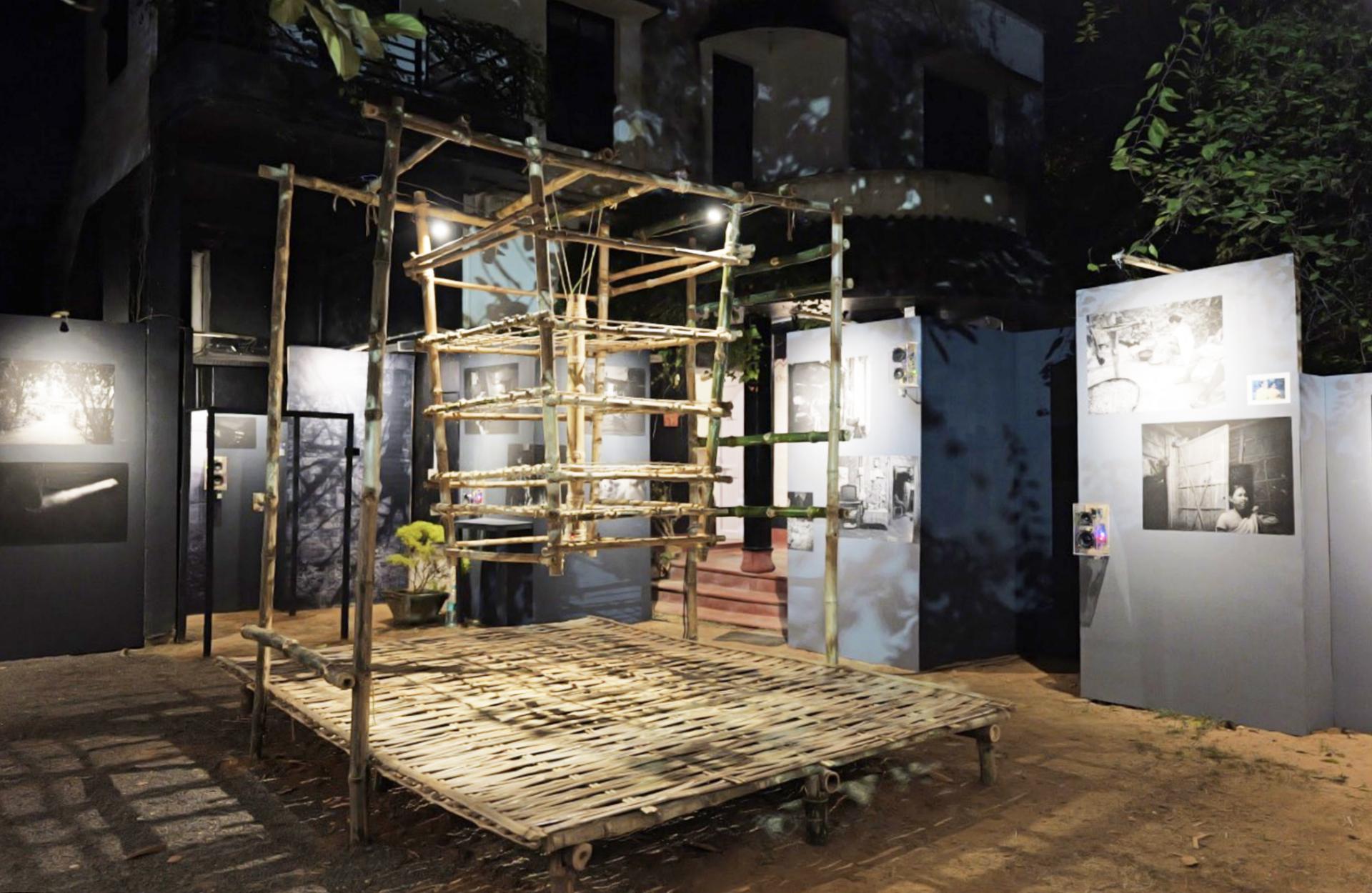 A view of the installation "Ongari," featured at the 2024 Bengal Biennale. Its name refers to a traditional bamboo structure featured in the Tribal Community kitchens of th Rabha People. The artist centered this, much as it had been thus throughout his childhood; a place where stories from his mother and others were passed down to him.
Cristina Veran: How did being selected for and your participation in the Kochi-Muziris Biennale make you feel at the time, as an artist whose work so movingly represents and brings his own People and Community into its spaces?
Dhiraj Rabha: The Biennale brought such sudden attention to me, which was so overwhelming, as it would be for anyone coming from my background. I belong to an Indigenous Tribe called the Rabha, and was born in a pristine and beautiful village called Borali Gaon, along Assam’s border with the neighboring Indian state of Meghalaya. Around 1999, though, when I was only about four years old, my family was forced to leave our land behind and move from there to a militarized detention camp
CV: What led to this displacement, and how would you describe that environment?
DR: To understand this place, known as Ex-ULFA Camp—where I still live, by the way—you have to also understand what was happening in this part of India during the 1990s: a time extraordinarily disturbing and tense, when extrajudicial killings and political assassinations were rampant across the whole Northeast of the country. This gave rise to an armed rebel force known as the ULFA (United Liberation Front of Asom)—a group my father was part of—that battled the government and its occupying forces, looking to secure and protect the sovereign lands and rights of our people. In 1999, they chose to surrender after taking part in peace talks with the Indian government, which then decided it would put us all in a detention camp "for our safety.” But the reality is this: it was designed as a surveillance camp, where the military and its intelligence officers watch its residents 24 hours a day, to make sure they won’t rise up, revolt, and return to the jungle again.
*Note: “Ex-ULFA, in the camp name, refers to the ex-cadres of ULFA who live there.
CV: You still live there?
DR: Yes, but I’m not a prisoner. I can leave, but I return because my family and community otherwise remain here. Since the political situation in Assam today is much more controlled these days, the camp is no longer as crowded or intensely active as it once had been. Many others who once lived here have been able to move out and move on.
CV: What made your own family stay for so long?
DR: My father initially believed that being here would give my siblings and me the opportunity to study in the nearby town. Where we’d come from, which is quite remote, there was no quality education. My parents believed that after we completed our schooling, we would all move back to our native village together as a family. But over the years, though we still have our land, our homes are no longer there, unfortunately. We’ll have to rebuild them before we can move back. For now, we remain stuck in the camp—but I’m holding on to the dream of going back to live in my village one day.
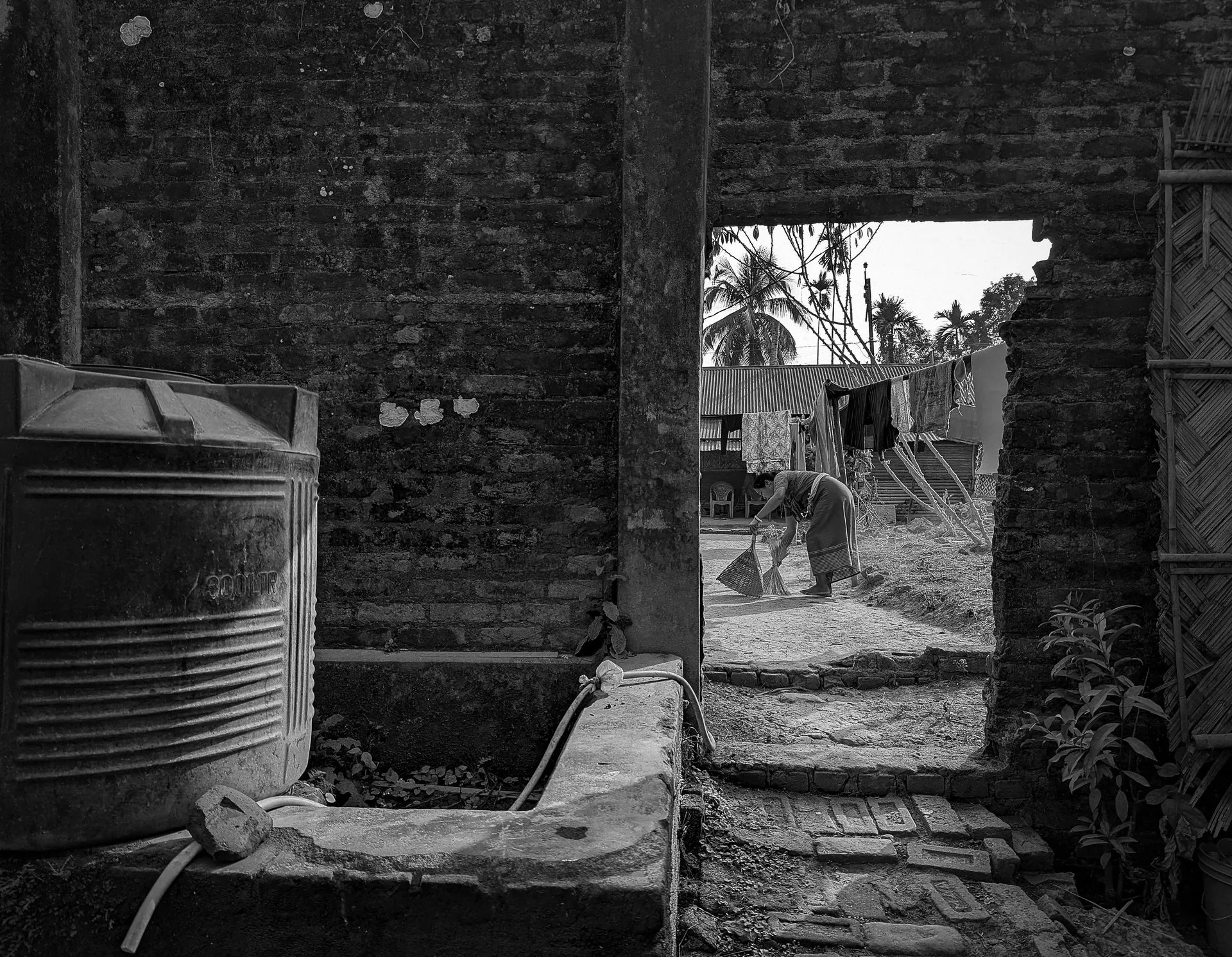 From the photo series "Echoes of Resilience", which is set in Ex-ULFA Camp and features the artist's own mother, depicting the peace in quotidian scenes that otherwise belie the ever-present clouds hanging over such scenes; memories of another time, that are yet also still now part of life lived in detention.
CV: How do you reckon with this political history, relative to your personal story and your art?
DR: Earlier in my life, I felt both afraid and ashamed to talk about where I lived and the circumstances that brought me there. I’d deliberately hide these things because, otherwise, some people in the broader society would label me as "the son of terrorists.” I did not want my entire existence defined that way.
CV: Art provided an outlet as well as a new framework to consider things another way, though.
DR: Indeed. When I left Assam for my arts studies, I started looking back at my upbringing from that distance, which gave me a fresh perspective. I realized why the struggle occurred and that what those people went through was so important to document. To be very clear: I’m not here to promote their political manifesto or glorify armed conflict. No. Rather, I became far more interested in the ordinary people in our communities and the heavy memories they carried in their bodies.
Around 400 families lived here in Ex-ULFA Camp at its peak—all of whom carry with them not only their personal stories, but also deep trauma and a great deal of psychological stress. They’ve kept their memories bottled up for decades, mostly because they did not see how their lived experiences mattered and just assumed that no one would ever care to listen. And so, I felt a deep obligation to go to them, to listen, and to collect those fragile stories before they disappeared completely.
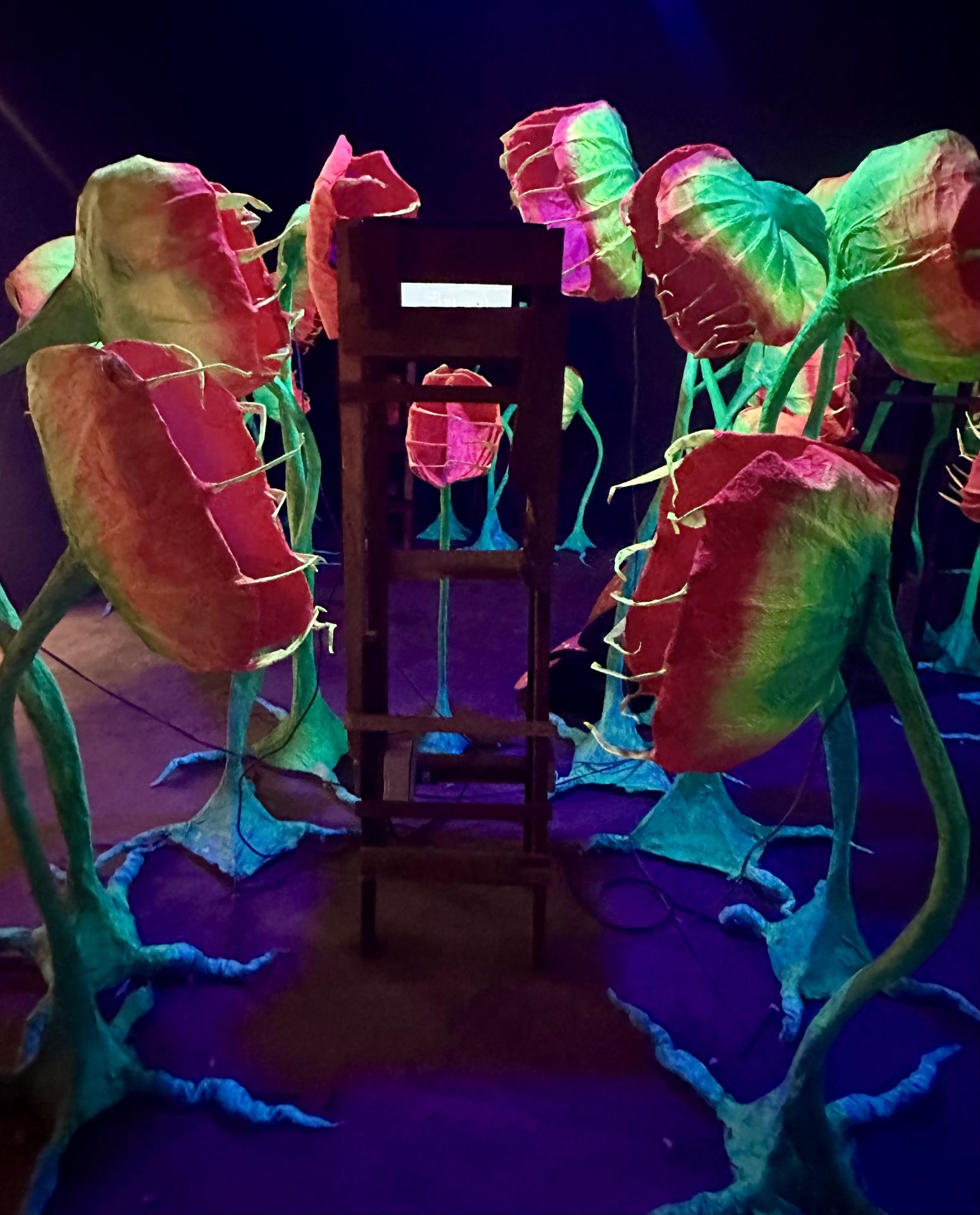
Garden of Carnivorous Flowers - a multimedia segment of "The Quiet Weight of Shadows." Photo and video (below) by Cristina Veran.
CV: Were you always making art, or at least interested in it, while growing up in the camp? How did your academic path in and through the arts develop?
DR: Since my earliest school days, I loved to create things with my hands and especially to draw, filling countless sketchbooks back then. But I had no idea back then that art could be studied formally as a practice or academic discipline. Where I come from, that’s practically unheard of. We’ve always had a great many traditional craftspeople in our communities, of course, but never "professional artists" or “fine artists” living among us. I became the very first boy from my village to choose that route, completing a Bachelor of Arts degree.
I was initially a Political Science major, and studying politics gave me a vast framework for understanding power structures and history—but it felt too purely theoretical for what I wanted to achieve. When I transitioned into fine art, I realized that my political science background could be immensely valuable to the art I wanted to make, providing the conceptual foundation that allows me to analyze society and inject real meaning into it with my work.
CV: How do you distinguish between the traditional creative practices of your Rabha community and the realm of so-called fine art?
DR: We have an abundance of master practitioners in our villages, possessing deep expertise in, for example, bamboo craftsmanship, wood carving, and weaving traditional textiles. I grew up watching my mother weave intricate patterns, learning to absorb both her technique and the patience she embodied while doing these kinds of things. It’s incredibly frustrating to me how mainstream art institutions too-often dismissively look at creative expressions from Indigenous communities and say, "Oh, that’s not real art; it’s just some traditional craft." That sparked a critical question for me: Who holds the power to draw these boundaries and categorize human creation as one thing or another?
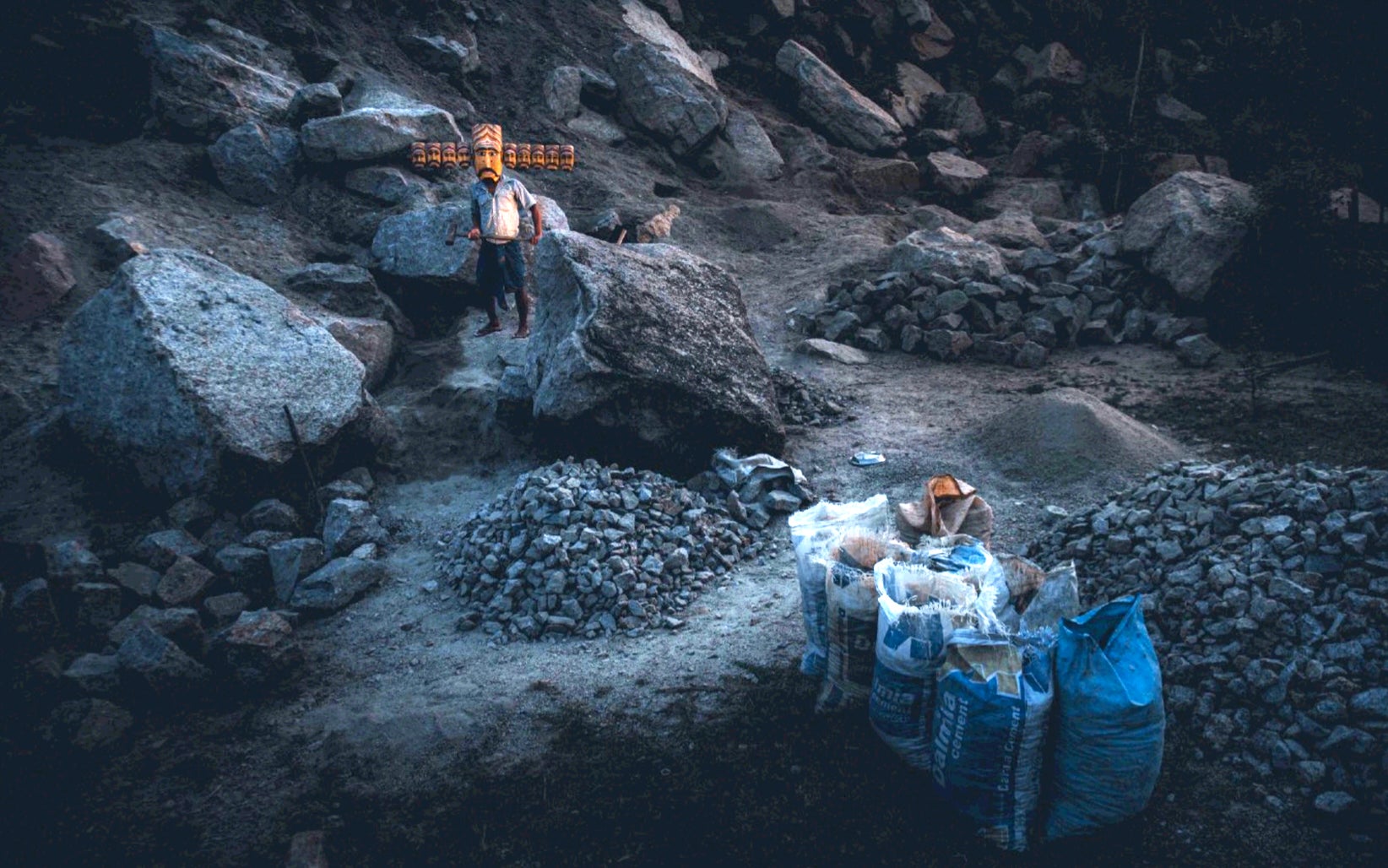
An image from the photo and video project "Blurred Hymn", which explores the deep-rooted ritual theatre of the Rabha People known as bharigan. Within this tradition, performers don carved and painted wooden masks to take on the identity of spirit beings as they enact ancestral stories honouring the natural world.
CV: Have you had to explicitly delineate how and where your own work should be situated, in terms of category and genre?
DR: Let's just say that I decided to stop worrying about institutional labels altogether. Whether my practice is categorized as fine art, traditional craft, or a hybrid should be completely irrelevant. What matters fundamentally is the deep internal need I feel to create these works, so I create them.
In our Rabha tradition, tools, textiles, and architecture are never made for some purely passive decoration—or simply for survival. Every single motif, color choice, and structural detail carries complex narratives. For my exhibitions, I adapt specific structural elements from those I have observed in my village—such as how a traditional kitchen is arranged, for example—because every design choice made there functions as a story itself. The physical structures are components of our living oral archives—in contrast with Western institutional methods of archiving that prioritize written documents and now digital records.
CV: Why did large-scale installations become your primary medium?
DR: During my formal arts training, I studied drawing, painting, and sculpture, but installation art stood out for me because it allows you to synthesize physical sculpture, architectural space, ambient audio, archival documents, and video projections into a single, immersive environment. I approach the design of an installation much like a film director approaches a movie scene, carefully considering how the viewer will physically move through the space. What will they encounter first? How will their emotions shift, and how will the climax of that experience lead them to what I hope will be lingering, critical questions at the end of it all?
CV: Describe, if you will, the planning and production of The Quiet Weight of Shadows, your installation in Kochi.
DR: The Biennale curators allocated to me a specific hall there at Aspinwall House for this. When I arrived on-site, I decided to embrace its spatial constraints to structure the narrative into three distinct zones that present a single political context, explored through different media.
At first glance, visitors are drawn toward a room filled with a garden of glowing and visually captivating carnivorous flowers. Inside that zone, I placed scaled replicas of military watchtowers [like those from the detention camp] containing video monitors playing recorded interviews from my community. I wanted visitors to realize that these beautiful flowers are there as alluring symbols that speak to something more sinister in the form of surveillance and propaganda.
After experiencing this garden, the audience would pass into a different space constructed to resemble the remnants of a burnt-out village home. There, they’d encounter a historical archive filled with physical documents and rare photographs I have salvaged from the camp; physical evidence arranged in an evocative display.
Finally, after absorbing that heavy history, they move into the final room to view the film I created for this, narrated and led onscreen by child actors, which synthesizes the installation’s entire emotional narrative.
The team that worked with me throughout the making of this project—Sarpil Nandan Deka, Himangshu Sharma, Rohitashwa Gupta, and Kapil Das—deserves special recognition for all that they contributed to it.
CV: How were you able to find all those archival materials—the photographs, documents, and even ephemera—given all the turmoil and displacement your people experienced?
DR: Collecting such items presented an extraordinary challenge, for sure. Historically, it was far too dangerous for anyone connected to the rebel movement to hold onto anything. After its former cadres surrendered, the military and the intelligence forces would conduct frequent, aggressive search raids on our homes in the camp. Because of that constant fear, community members deliberately destroyed almost everything they owned; burning photographs, letters, documents, and uniforms so no incriminating evidence would remain.
Those photos I managed to gather and display in Kochi are among the last remaining visual remnants of that movement and era. I was only able to collect them by spending months sitting with community members, building deep personal trust, and helping them to understand my intentions.
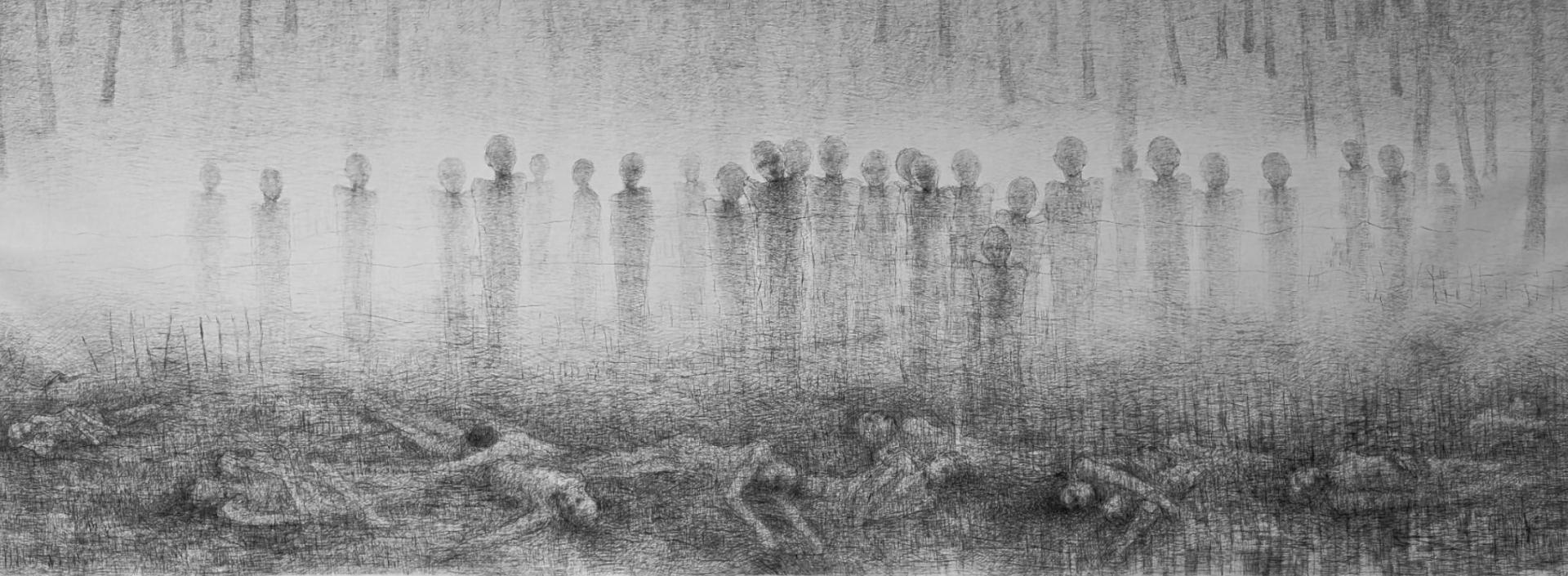
A charcoal drawing featured as part of Dhiraj Rabha's contributions to the group installation, "Anatomy of Land: …from soil to soil…brick to brick…dust to dust…", curated as part of the larger project by Vidya Sivadas called "Turning: On Field and Work," for the Serendipity Arts Festival (2023) in Goa.
CV: The very first iteration of this project was built not at the Biennale or other outside artspace, but rather in Ex-ULFA Camp itself, for your community to experience first. How did they react to it?
DR: Presenting the original installation inside the Camp is, easily, the most profound and meaningful moment of my artistic life. The physical structure, which I constructed right on the campgrounds, quickly transformed from being [just] an art display into [also] a powerful community gathering space.
I had first created a short documentary about my project to screen exclusively for camp residents as part of the process of seeking their formal consent. I asked, directly, "Are you comfortable with me sharing these stories and this history with people on the outside?" Fortunately, upon seeing how respectfully their lives were portrayed in the film, they gave me not only their consent but an enthusiastic blessing.
When camp residents stepped inside, they were overcome with emotion, pointing at displays and saying, "I remember this exact day," or "I went through this exact struggle." It triggered a massive outpouring of shared memory.
CV: You also invited non-Camp residents to attend this. Why and for what anticipated outcome did you do that?
DR: For decades, those living on the outside have looked at us in the camp with intense suspicion, as dangerous terrorists. So I made the decision [and got permission] to throw the security gates wide open and invite the general public, from surrounding towns, to come and witness the reality of camp life with their own eyes.
Exhibiting my work at international art events is so wonderful because it can educate the broader public about hidden histories. But on a personal level, creating this first as a healing space of truth and reconciliation for my own community, inside the camp, will always be the most important achievement of my career.
CV: Do you feel connected to a broader contemporary movement among other Indigenous artists in Assam or, otherwise, across Northeast India, as well?
DR: Within Northeast India specifically, there is such an active and talented community of contemporary artists, but we have not formalized ourselves into a distinct "movement" with a name. But I have built a wonderful, supportive network of close artist friends elsewhere, representing diverse regions across India, from Ladakh to Kashmir to Kerala. We come from radically different contexts, yet we share a deep mutual understanding.
Alas, working here so far removed from the Indian art capitals like Delhi or Mumbai, it can feel deeply isolating. As the only practicing fine artist in this immediate area, I do not have local peers nearby with whom I can regularly discuss contemporary art theory or share experimental work.
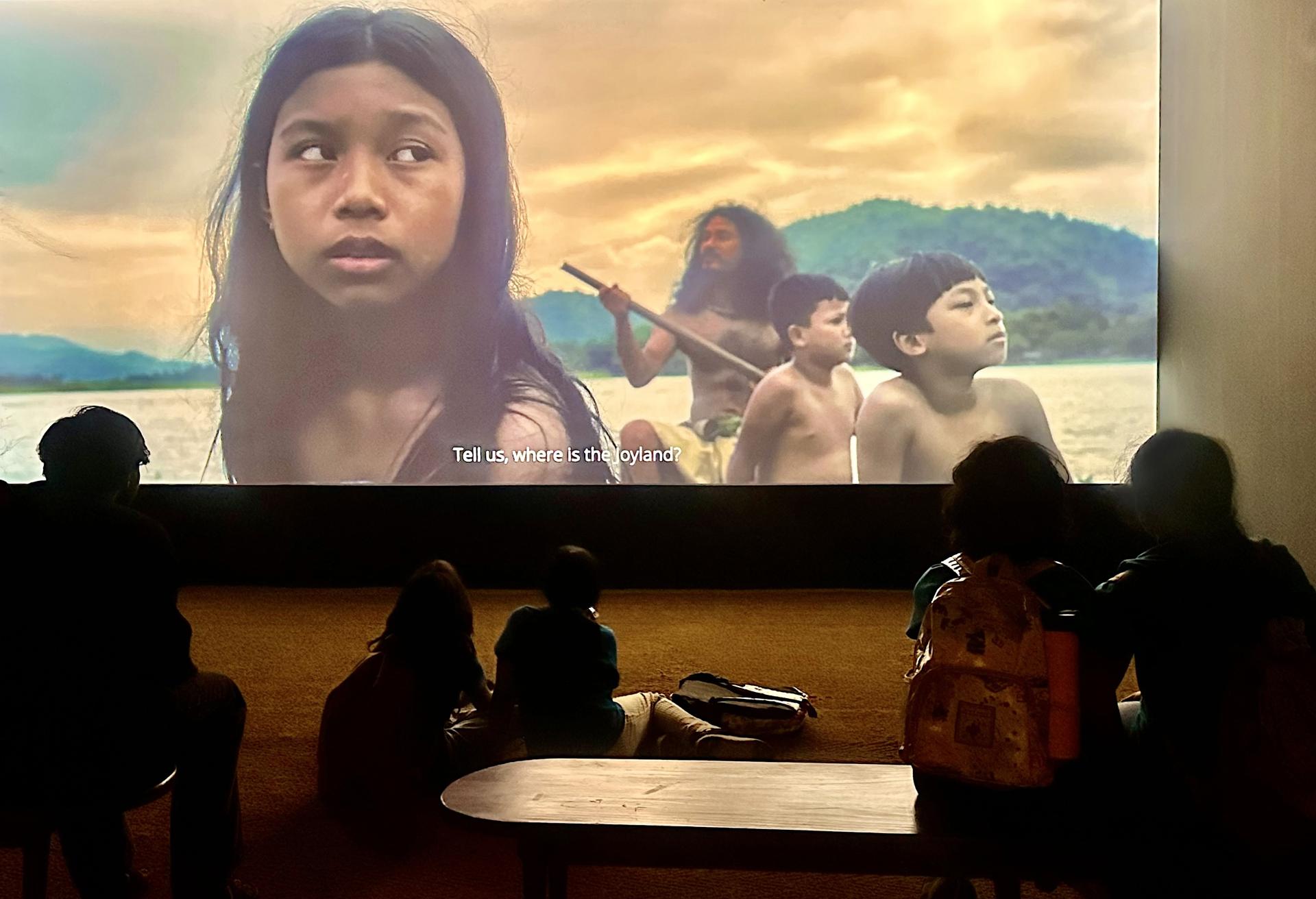
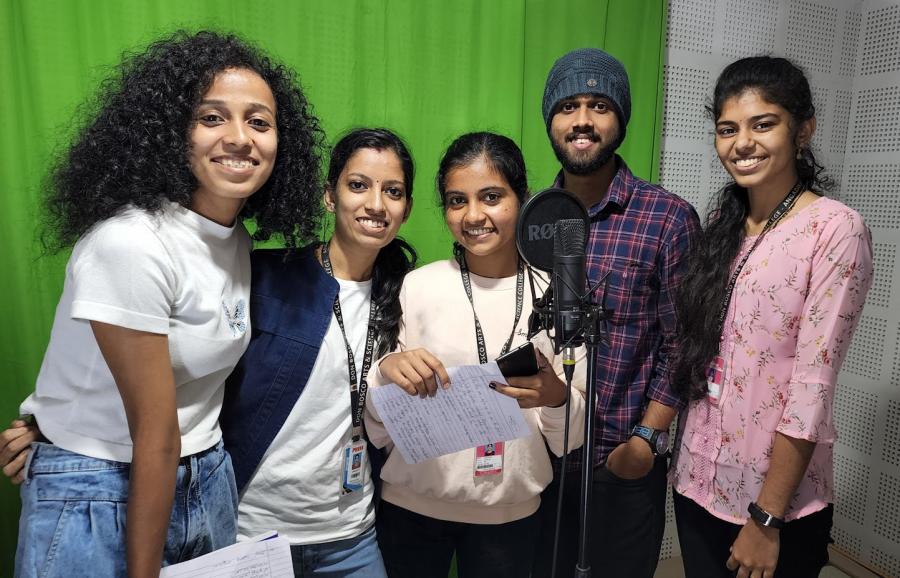
Child actors from the Rabha People's theater collective Badungduppa Kalakendra, feature in "Whispers Beneath the Ashes"—an experimental filmed component of "The Quiet Weight of Shadows" installation, screened during the Kochi Muziris Biennale. Photo by Crisitina Veran.
CV: How do you approach field research, eventually translating your findings into visual art?
DR: To be clear, I do not use standard sociological methodologies. My research style is deeply relational: I go to a place and live alongside the people. We share meals and spend meaningful time together, and I listen as they share their experiences. Beyond this, I collect the physical objects, local stories, and ambient sounds that embody and reveal the atmosphere of the location.
Once I have absorbed those realities, I ask myself critical ethical questions: What is my moral responsibility, as an artist, in representing these lives? How can I translate these heavy realities into a visual language that engages the viewer's imagination without reducing human struggle to dry statistics?
In order to counter the toxicity that India’s mainstream media outlets project about the Tribal Peoples of Assam, through sensationalized and biased stereotypes [which their audiences accept, unquestioningly, as “the truth”], I deliberately construct my installations with layers of poetic abstraction, such as through metaphors, local mythologies, and even fireflies to allow space for the viewer to reflect on our People’s human suffering without feeling lectured to.
CV: I immensely enjoyed the short film, which was a key component of your Biennale installation—especially the engaging child actors and other collaborators from your community that were part of it. How did it all come together?
DR: It was shot entirely on location in my native village of Borali Gaon. We approached it as an experimental, hands-on workshop rather than a traditional film shoot, gathering in the forest and experimenting with visual ideas. The Rabha children featured are local kids who belong to an extraordinary Indigenous theater collective, so they already possessed a natural comfort with performance and the language of the body. I have known them and their families for many years because I participated in this as well, during my own youth.
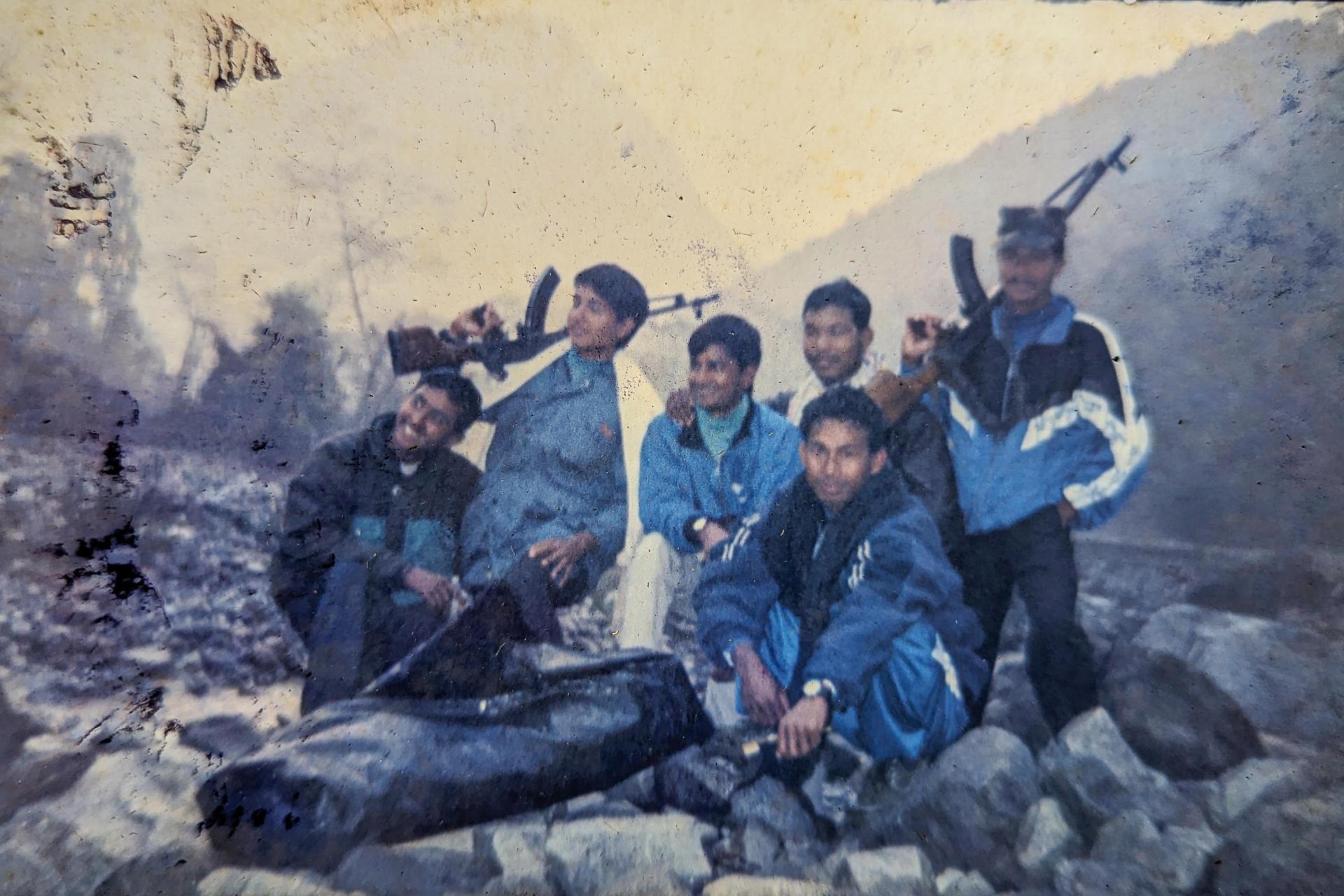
A rare image of the former UFLA insurgents of Assam; preserved by Rabha community members at the Ex-UFLA detention camp in Assam.
CV: Tell us a bit about this theater group and its significance to your community.
DR: It’s called Badungduppa Kalakendra, and they organize an immersive theater festival each year called Under the Sal Tree, which takes place deep inside Assam’s sal tree forests. The plays produced for it are performed and staged entirely without artificial lighting or microphones, exclusively in our native Rabha language. Visitors are most welcome to attend this.
CV: Given your love for centering research in your practice and examining critical issues through your lens as an artist, what other themes are you focusing on these days?
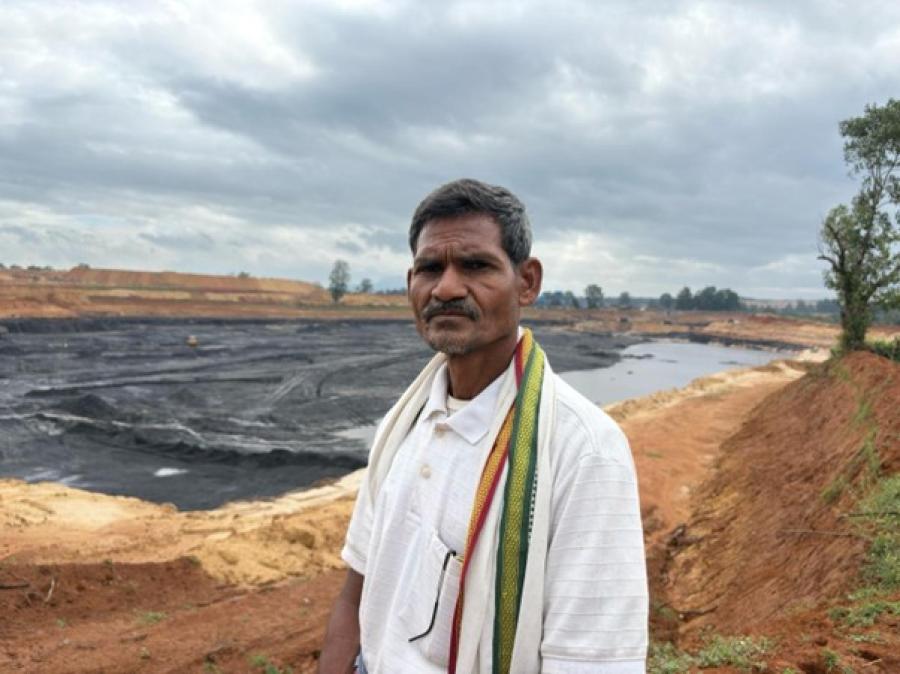
DR: I’m deep into the research phase of a major new body of work focused on environmental justice and resource extraction. Across Northeast India, major corporate entities and state-backed ventures are aggressively targeting our region’s rich natural resources — constructing mega-hydroelectric dams, expanding open-pit coal mines, and clearing pristine forests at an alarming rate. I am deeply concerned about how these destructive industrial projects permanently alter local ecosystems, displacing Indigenous communities and destroying our sacred landscapes.
CV: And beyond the above, what’s next?
DR: One conceptual project I am developing at the moment is a surrealist video installation centered on Indigenous cosmological views of the afterlife. In our Rabha Tribal tradition, for example, we believe that when a human being passes away, their soul transforms into a dove. I became fascinated by this as a central poetic question: How would this dove—a sacred bird, carrying the soul of an ancestor—perceive the industrial transformation and destruction of its ancestral homeland? For this, I am designing a multi-channel video installation wherein each screen would represent a vision of this from each of the so-called “seven sister” states comprising Northeast India: Assam, Nagaland, Manipur, Arunachal Pradesh, Meghalaya, Mizoram, and Tripura.
CV: Beyond art itself, what kinds of enduring and perhaps more tangible contributions—social, material, and otherwise—do you hope to create for your community?"
DR: I constantly ask myself: “What should my broader social role be as an artist?” One of the most important responsibilities that I believe I am here for is to help build sustainable, community-rooted spaces for creative practice and cultural gathering. I’ve conceptualized a project for a space called the Sankui Creative Hub, where my dream (once we secure funding) is to make this an independent and fully equipped creative arts center, directly in my native village. Our young people possess immense natural artistic talent, deep resilience, and a profound desire to create meaningful work. What we lack is structural support, institutional access, and educational infrastructure. I want to change that reality.
CV: Any final thoughts you’d like to add?
DR: Just to say that I will always prioritize integrity and the needs of my community above marketplace considerations and the recognition of external institutions. It’s as simple as that.
--Cristina Verán is an international Indigenous Peoples-focused researcher, educator, advocacy strategist, network weaver, curator, and mediamaker. She was a founding member of the United Nations Indigenous Media Network and the UN Indigenous Language Caucus. As Adjunct Faculty at New York University’s Tisch School of the Arts, she brings emphasis to the global histories, expressions, and socio-political impacts of Indigenous contemporary visual and performing arts, design, media, and popular culture(s).
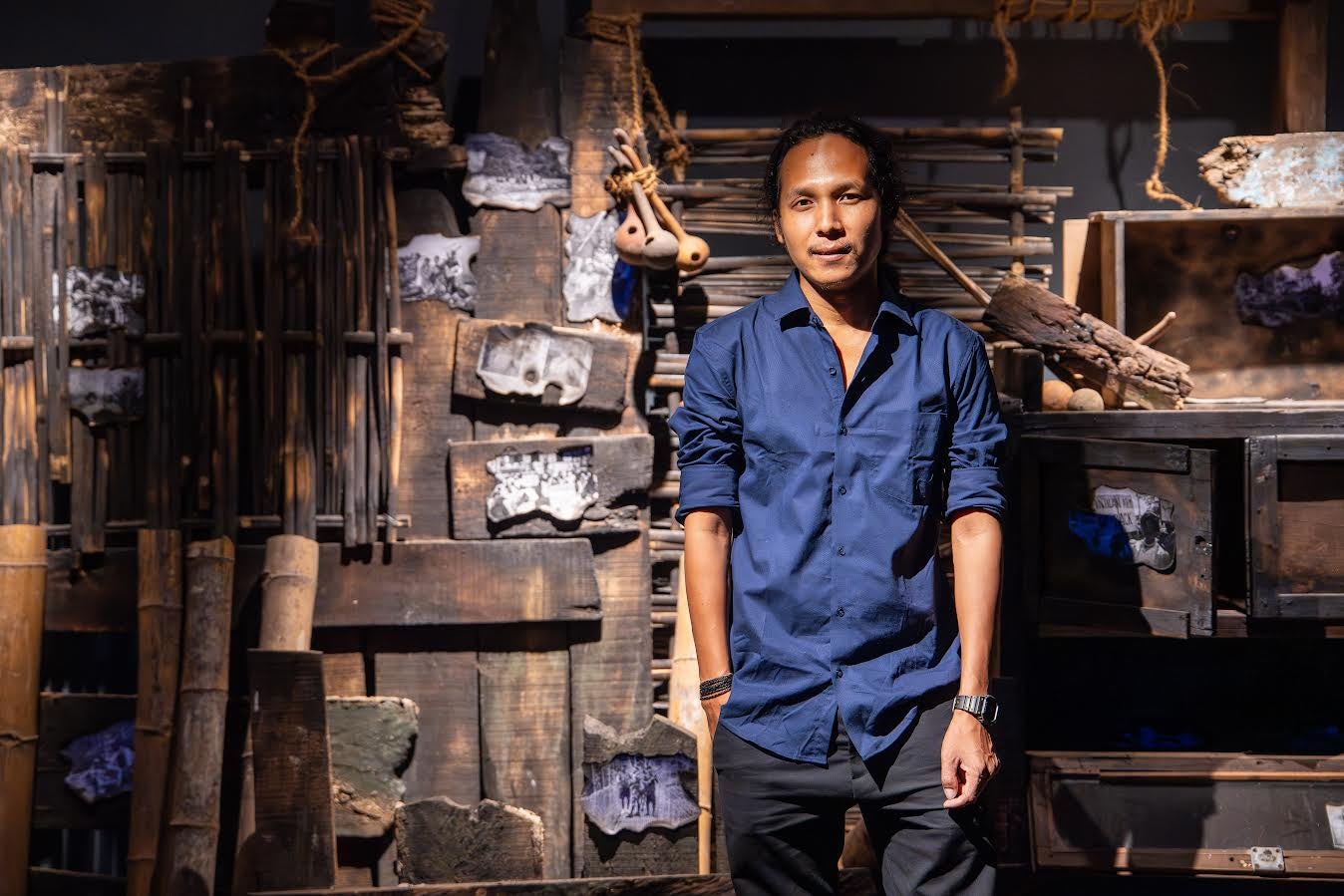
Top photo: Dhiraj Rabha stands with his installation, "The Quiet Weight of Shadows," at Aspinwall House during the Kochi-Muziris Biennale. Photo courtesy of Kochi Biennale Foundation.