Book Review by Jo Ann Zimmerman
My name is Jo Ann, and I’m a teacher. Like many of my colleagues addicted to this profession, my own teachers were a big factor in what got me hooked. There was Mr. Stouffer, the math teacher who taught us to transition from plane to solid geometry with class readings from Edwin Abbott Abbott’s “Flatland.” In ninth grade, my biology teacher put us into groups and gave each of us the job of teaching our classmates about an assigned aspect of the cell, however we wanted. My team presented mitosis using a modified version of Gloria Gaynor’s hit song “I Will Survive,” which we made into “I Will Divide.”
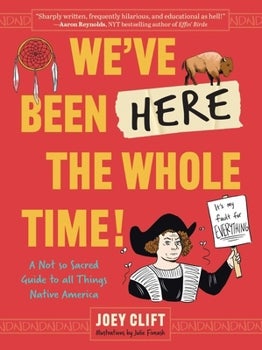
Sadly, I never had a great history teacher. I’ll bet you didn’t, either. That’s because no matter how fun or exciting their lessons might have been, they almost certainly got a core component of American history all wrong—the part about Native Americans. Joey Clift’s new book, “We've Been Here the Whole Time! A Not So Sacred Guide to All Things Native America,” sets the record straight. Clift is an enrolled member of the Cowlitz Indian Tribe, and illustrator Julie Fiveash is a Diné artist.
Those who know Clift from his many comedy writing credits may be surprised to learn of his passion for education. “I love talking about my culture. The first time I had an Indian 101 conversation in college, I was so happy to educate that person! Imagine how I felt after the thousandth time,” he writes. “We’ve Been Here the Whole Time!” was written to spread the word faster and further. And he is one helluva teacher.
Clift differentiates instruction, as we say in the classroom. The first section of his story collection, the “Remedial” chapters, presents readers with a list of “Things to Ask Natives that Are not About Thanksgiving,” such as cats, dogs, Wes Studi, pineapple on pizza, and professional wrestling. The list device reappears in the “Basic” section, in “How to Find Your Spirit Animal Using People from 'The Office.’” Spoiler alert—you don’t have a spirit animal. Once graduated to the “AP level,” readers encounter the mature menu: “A List of Things You Can Call a Work Meeting that Are not a Powwow.” My personal fave is “job jamboree.”
Pages from “We’ve Been Here the Whole Time! A Not So Sacred Guide to All Things Native America”
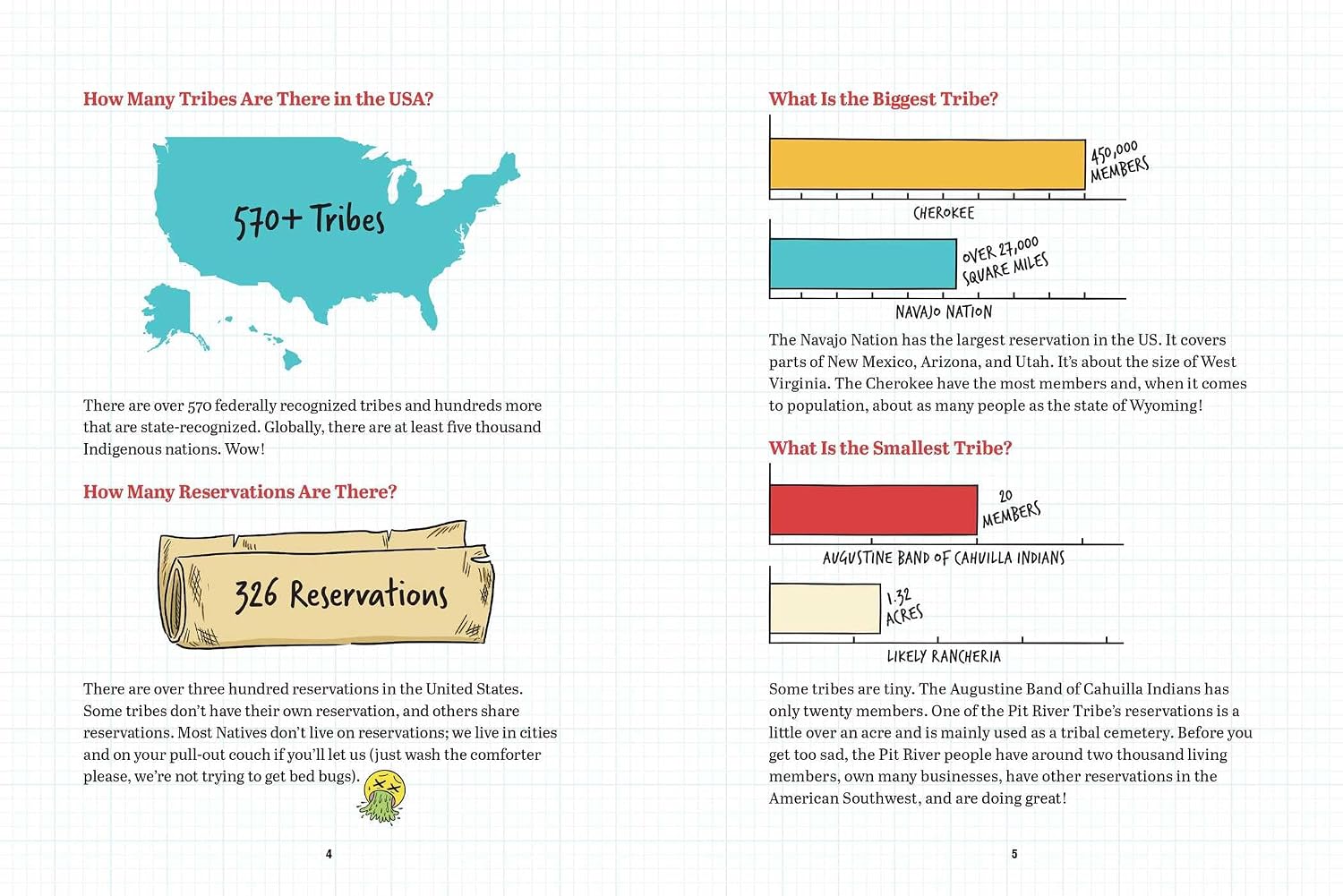
Within the context of the “Things to Ask Natives” list, Clift explains why Natives favor Native over Native American, Indigenous, or Redskin (they prefer Commander). The best option, though, is to call someone by the name of their Tribe (Clift is a Cowlitz Tribal member). In that context, we learn there are more than 575 federally recognized Tribes in the U.S. with a total of 10 million members. And one of them is Wes Studi.
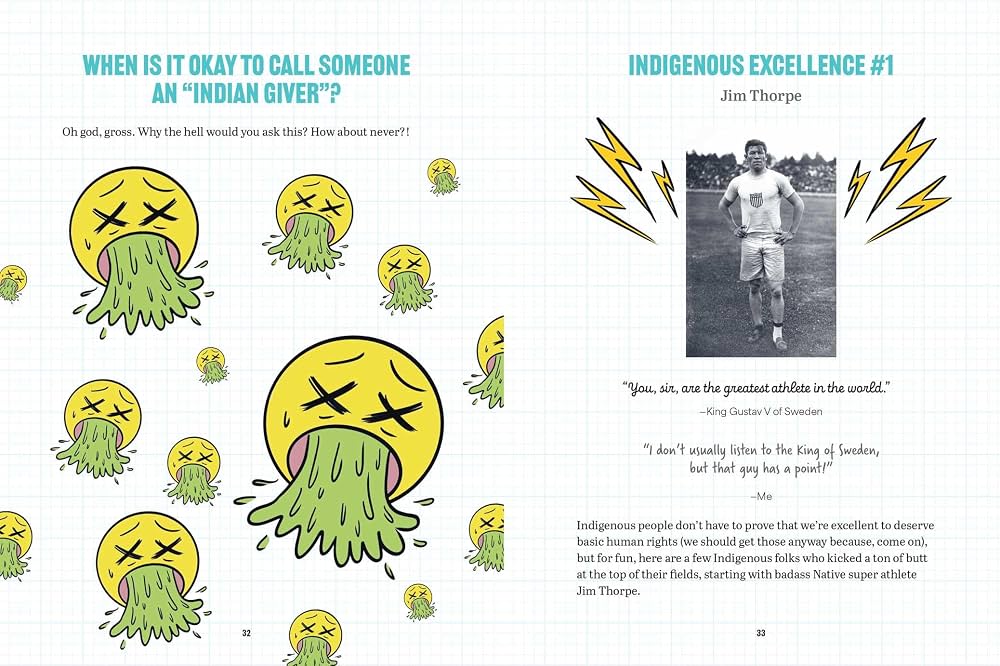
A frame titled "You’re Welcome" also appears in each section, featuring little-known contributions Natives have made to American culture. For example, we think of space exploration as an American achievement, but the Northern Athabaskan tribe in Alaska mapped the stars to navigate on land and at sea and to forecast the weather centuries ago. More recently, Cherokee Nation member Marie Golda Ross was the first woman engineer at Lockheed Martin and became a founding member of Skunk Works, the division that designed top-secret aircraft that helped win the Cold War. Later, she co-wrote NASA’s “Planetary Flight Handbook,” the guidebook still used today for flight to Mars and Venus.
Fitting the same form is New York City. Manhattan is the Lenape word for “island of many hills.” After Dutch settlers forced the Lenape People off the island (no, they didn’t buy it with beads), another Tribe, the Mohawk People from upstate, built the town we know today as New York City. They incorporated the highly dangerous job of bridge building into their rituals for entering manhood, and beginning in the late 1800s, they contributed to projects from the Empire State Building to the George Washington Bridge and the Twin Towers. On September 11, 2001, Mohawk ironworkers were among the first search and rescue teams at Ground Zero.
Pages from “We’ve Been Here the Whole Time! A Not So Sacred Guide to All Things Native America”
The final face of "You're Welcome” may be the most surprising. Despite what generations of American schoolchildren have been taught, the concept of government of the people, by the people, and for the people did not originate with the Mayflower Compact, John Locke, or even the Magna Carta. The founding fathers modeled their democratic government after a system created in the 12th century by the Haudenosaunee Confederacy, a collection of Mohawk, Oneida, Onondaga, Cayuga, and Seneca Tribes. Later joined by the Tuscarora to form the Six Nations Confederacy, it remains active today.
Ben Franklin, in a letter to James Parker dated 1751, wrote, “It would be a very strange thing if ignorant savages should be capable of forming a scheme for such a union…that has subsisted for Ages…and yet that a like Union should be impracticable for ten or a dozen English colonies…” Kind of like, “so easy even a caveman can do it,” but hey, at least he recognized the value of the Confederacy. And stole it like another parcel of Native land.
Beyond that, President John Adams lauded the Confederacy’s system of government frequently in “The Defense of the Constitution.” Fellow presidents James Madison and James Monroe went so far as to meet with a Haudenosaunee Chief to learn about the structure of their Confederacy and to incorporate their wisdom into the Federalist Papers.
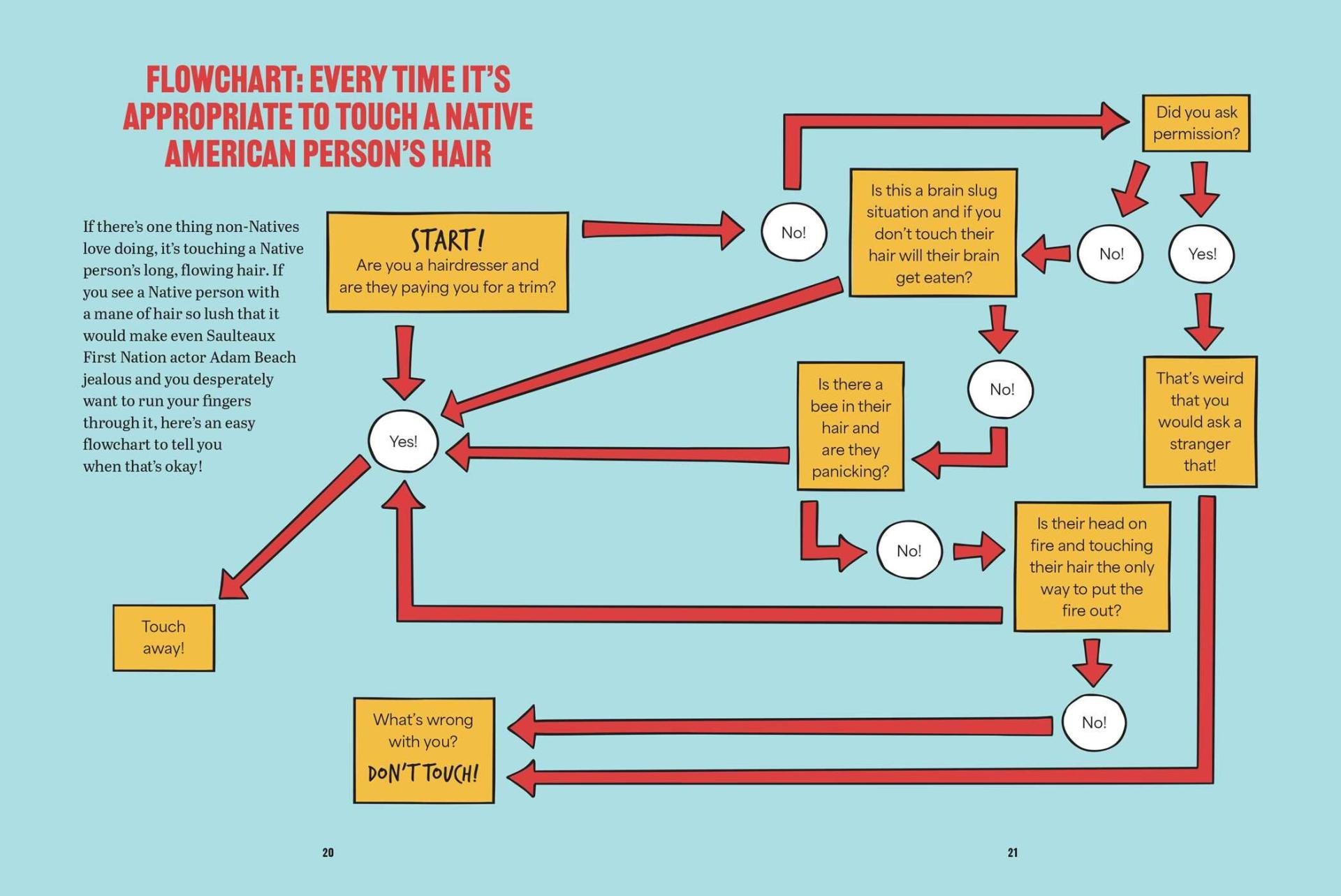
A great many other characters ripple through Clift’s richly told stories of Native culture, past and present. Chunks of text are interspersed with clever sketches of historical figures such as Christopher Columbus, Richard Henry Pratt (“founder” of the Indian boarding school system), Gutzon Borglum (the artist responsible for Mount Rushmore), Andrew Jackson, Pope Nicholas V, and other “People Not Invited to the Powwow” getting their just desserts. Illustrator Fiveash also created killer graphics such as the flowchart, “When is it appropriate to touch a Native person’s hair?” (one guess),“What Skin Tone is Native?”, and “How to Dress ‘Like an Indian’ for Halloween.”
Pages from “We’ve Been Here the Whole Time! A Not So Sacred Guide to All Things Native America”
Finally, because non-Natives tend to think of atrocities such as genocide, land appropriation, and Indian boarding schools as relics of a shameful past, the “cool teacher” gives a last lesson on the many hardships Native communities face today. For example, here in 2026, in the self-proclaimed “greatest country on Earth,” one-third of homes on Navajo Nation land have no running water. Over 100,000 people live on the Navajo Reservation, which spans three states, meaning tens of thousands are forced to travel as far as 50 miles—each way(!)—to get water. And because many reservations are in rural areas, thousands of Natives also live in food deserts with little or no access to healthy food. Across the country, over 25% of Natives live below the poverty line—twice the national average. Death by suicide is considerably higher than average for Native people, especially teens.
And yet, they are still here. They always have been. Finally getting our facts straight about Native culture is the first step toward helping Native people feel seen. And because Clift is such a cool teacher, at the end of it all, you get to sign your own diploma. So long as you pledge to watch all of Wes Studi’s movies.
--Jo Ann Zimmerman is a lifelong educator, most recently on the faculty of the University of the Arts in Philadelphia, where she lives with her amazing husband and indifferent cat. She has written for Cleaver Magazine, The Adroit Journal, Rain Taxi Review of Books, and other publications.