Dr. Ruth H. Matamoros-Mercado (Miskitu) is a scholar and Assistant Professor in the Department of Geography & Environment at the University of North Carolina at Chapel Hill. From an interdisciplinary perspective, her work bridges law, geography, and Indigenous studies to understand and raise awareness of the struggles for land, community resistance, and environmental justice in Central America. Originally from the northern Moskitia region of Nicaragua, Dr. Matamoros-Mercado brings to her research a perspective deeply rooted in the lived experience of the Miskitu people. She examines how colonial history, contemporary legal frameworks, and environmental dynamics intersect to shape current struggles for territorial claims. Her academic commitment focuses on producing knowledge that not only analyzes but also accompanies processes of self-determination and territorial defense within the communities she works with. She has published in journals such as “Political Geography” and “Environment and Planning D: Society and Space.” Amanda Minks is Professor of Anthropology and Core Honors College Faculty at the University of Oklahoma. She is the author of “Voices of Play: Miskitu Children’s Speech and Song on the Atlantic Coast of Nicaragua” (2013) and “Indigenous Audibilities: Music, Heritage, and Collections in the Americas” (Oxford University Press, 2024). Minks recently spoke with Dr. Matamoros-Mercado about her life and work.
Growing up Miskitu
Amanda Minks: It’s a pleasure to chat with you. First, I’d like to hear a little about your journey, your personal experience. Where did you grow up? What was your experience of Miskitu culture and language?
Dr. Ruth Matamoros-Mercado: I have always thought that the immediate context in which I was born, my family, but also the broader national context and the historical moment, had a great deal to do with the intellectual and academic path I eventually took. I was born in 1980, just one year after the triumph of the Sandinista Revolution, a moment that was decisive for Nicaragua and for the Miskitu people. The civil war shaped the first ten years of my life and marked me deeply, not only by prompting me to ask why things were the way they were, but also by leading me to ask what could be done to change our circumstances.
I was born and raised in a more urban context than my parents, who grew up in rural communities. Spanish was the language of my schooling, and it was more structured, more systematized, and carried a stronger presence of the State. At home, however, my parents placed great importance on maintaining our Miskitu language and culture, where we came from, and who we are. They told us stories about our origins, our family, and our ancestors. We also mixed Spanish and Miskitu, and this became one of the strongest points of contact with my own culture.
Music was also central. Growing up in Bilwi, which at the time was a Miskitu-dominant city on the northern Caribbean coast, I was immersed in a soundscape that reinforced the Miskitu language and stories. Through music, I encountered stories of community life, I heard songs in my own language, songs about origin stories from a Miskitu cosmovision, and about Miskitu people’s relationship with nature and with the supernatural beings that inhabit it. There were stories of mermaids and other beings of water and forest. All of this nurtured my imagination as a young girl, even though I was not growing up in a traditional community and did not experience these practices firsthand in the way my parents did.
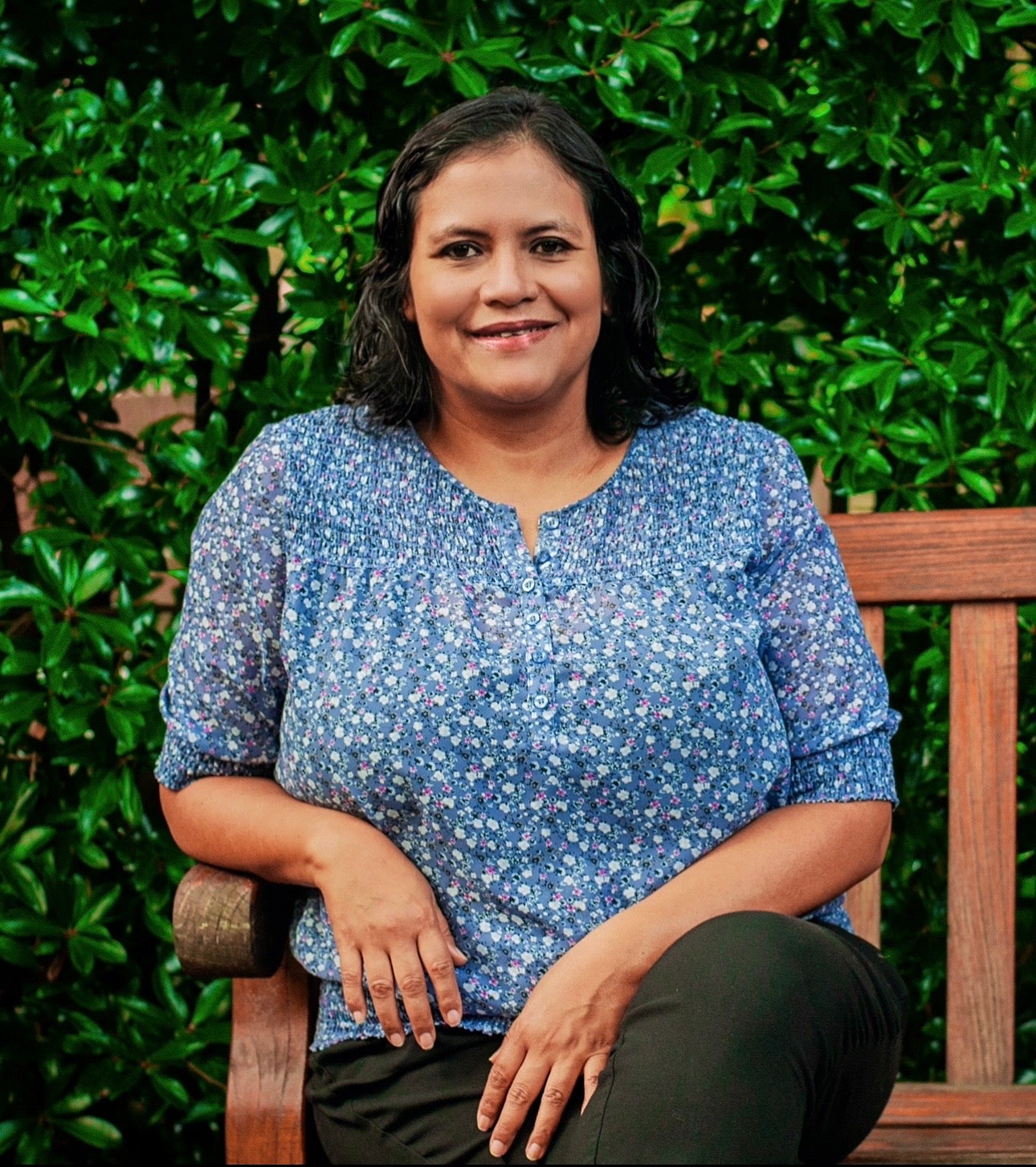
Dr. Ruth H. Matamoros-Mercado. Photo by Kalila Isabella Arreola.
Land and Miskitu Culture
AM: What led you to study land use in relation to Miskitu culture?
RMM: During the civil war, one conversation that was very constant was why the Miskitu people took up arms, why they organized in resistance. Words such as rights, land rights, Indigenous rights, and autonomy dominated much of the public discourse, including radio programs. These were words that stayed with me. I am sure this is what led me to study law, as a way to search for solutions to the problems I had been observing since childhood.
In 1987, the end of the civil war in Nicaragua, at least for the Miskitu people, culminated in the approval of Law 28, which established the structure of regional autonomy. I wanted to understand this process. I needed to understand it.
In 2003, the year I graduated from law school, another important law was passed: Law 445. After graduating, I returned to Bilwi and began working with communities, still operating from a legalistic vision, the idea that people needed to understand how laws work, how legal processes function, and how to organize themselves accordingly. However, through this work, I began to understand something fundamental: this legal framework was alien to the realities of the communities.
The way communities understood collective property and rights to land was very different from the legal framework the State was imposing. These were communities that had existed long before the State, that had lived and worked on their land prior to these legal structures, and yet they were being forced to adapt to laws they often did not fully understand. This felt profoundly unjust.
That is when I began to ask myself: what if we approached this the other way around? What if it were the State that tried to understand how Indigenous communities conceive of collective rights, particularly collective property? For example, why did communities have to produce maps as part of the demarcation and titling process? In many cases, these maps created more conflicts than they resolved, because they imposed physical boundaries in spaces that had previously been used collectively.
People did not imagine territory in terms of fixed borders, where one community ends, and another begins. It was a way of using space without fences, barriers, or rigid boundaries. To suddenly require maps and titles for lands that had always belonged to them, and where they had always lived, was deeply confusing. This was when I began to understand why issues related to collective property, collective rights, and Indigenous rights were so problematic when viewed solely from the perspective of the State.
At that point, my questions began to shift. I started asking: what would it look like for legal structures to understand Indigenous communities’ needs, or how communities conceive of territory and collective property? For a long time, collective property was not even recognized as a legitimate form of property in Nicaragua’s Constitution. I began asking what effect collective land ownership has for the social fabric of communities, for their economic, political, cultural, spiritual, and social life.
This became the focus of my doctoral research: to understand land and collective property from an Indigenous episteme, and to examine all the ramifications that flow from this relationship. Until then, both in law school and in my professional experience, I had understood these questions almost exclusively through the vision of the State and its legal framework. I wanted to create a dialogue between these two visions.
I am not a utopian dreamer. We cannot live at the margins of the State. However, it is also important to acknowledge that States have not taken up the task of understanding the Other, in this case, Indigenous Peoples. Instead, they impose their own visions of development, rights, and schooling. One of the most tangible consequences of this imposition can be seen in how Indigenous economies and social relations have been transformed over time. In the past, the economy and social life of Miskitu communities were sustained through relations of reciprocity among community members and with the land, from building homes to producing food. Today, those relations have been largely, if not totally, replaced by dependence on money. This makes autonomy a pending task, an unresolved project. The challenge now is to reconfigure autonomy from an Indigenous vision, rather than attempting to encapsulate it within the State’s framework, as articulated through the Autonomy Law.
AM: What does communal land ownership mean in practice, and how is it being challenged today?
RMM: The social fabric of Indigenous communities, particularly in the case of the Miskitu people, and autonomy itself, rests on communal ownership of land. Land is the raw material that makes social relations possible. When land ownership is held communally, the gears of social, economic, political, and even spiritual life can move.
In practice, communal land ownership means having the ability to work a parcel of land without having to prove individual ownership or navigate the bureaucratic processes required for other forms of property, particularly individual property. It means not having someone tell you, “This land is mine,” in an exclusive sense. Communal land is used and understood through shared practices rather than fixed boundaries. However, this system comes into direct conflict with State and market institutions, particularly through requirements such as mapping and titling processes that impose rigid borders on territories that were historically used collectively and without fences.
These tensions become especially visible in everyday economic practices. For example, if someone living in a community goes to a bank to request a loan and offers their house as collateral, the bank will not accept it. Communal residents do not hold individual land titles, so they cannot use their homes or land as guarantees. Meanwhile, colonos, settlers from outside the region, often from western Nicaragua, can appropriate land through private titles, even when those titles are fraudulent. They can then go to the bank, obtain loans, and use these lands for profit.
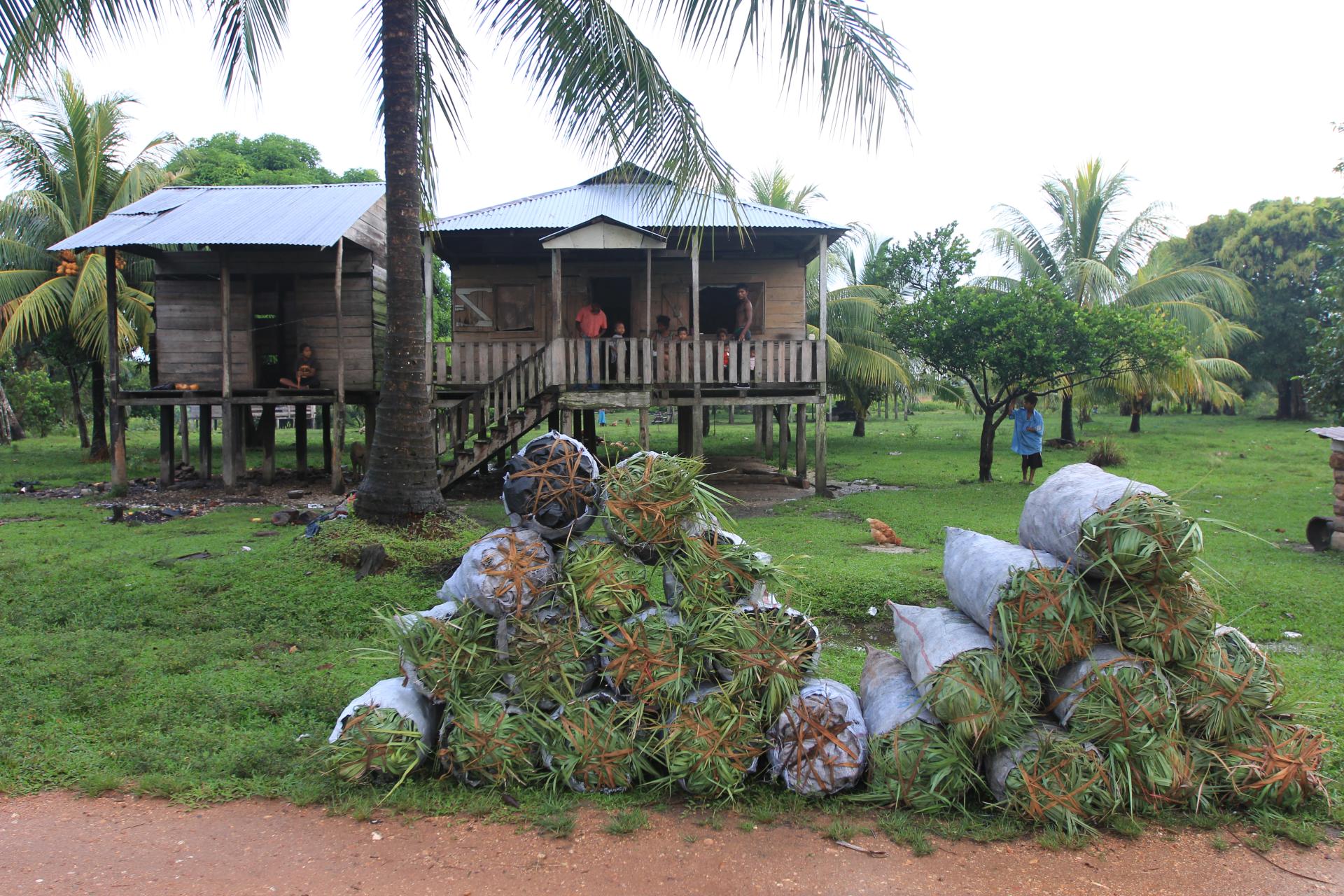
Traditional Miskitu house in the community of Sangni Laya with sacks of charcoal bundled with leaves.
Cultural Conservation, Orality and Plurality
AM: Can you say more about language and cultural change?
RMM: One of the elements of Miskitu life that has been actively preserved over time is the language. I think this is closely connected to orality, which is a defining feature of Indigenous Peoples more broadly, not only of the Miskitu. The oral transmission of knowledge remains central, and language is its foundation. In the mid-twentieth century, the State attempted to suppress Indigenous languages through education projects introduced into communities where Miskitu was spoken. At that time, speaking Indigenous languages was prohibited. Despite this history, Miskitu has endured. However, I believe we need to move beyond orality—not to leave it behind, but to complement it by systematizing knowledge in written form and teaching it in a more rigorous way, while still respecting oral traditions.
Spirituality adds another important layer to this conversation. Religious colonization led to a tremendous loss of Indigenous spirituality, which was deeply connected to the land and to supernatural beings of nature. These beliefs were demonized by Christian missionaries, and as a result, many people today associate them with something negative or demonic. Ironically, at the same time, churches made an effort to translate the Bible and religious songs into Miskitu. As a result, churches have become one of the spaces where the Miskitu language is preserved most strongly. Sermons are delivered in Miskitu, the Bible is read in Miskitu, and songs are sung in Miskitu. In this way, many people remain deeply connected to the language, even as other dimensions of Indigenous spirituality have been displaced.
AM: When most people think about Indigenous Peoples, they think of them as isolated, and they assume they are moving between their particular language and the language and culture of the State. But the truth is that in this region, in the Mosquitia, there are many cultural groups, correct? Miskitu, Sumu-Mayangna, Rama, Ulwa, Creole, Garifuna…they were all there before the Nicaraguan State was established. And in that multicultural environment, the life of a multilingual person is distinctive because you have options for communication.
RMM: Yes. In my brain, the language that dominates is Spanish. I think in Spanish, and then, depending on the context I am in, Miskitu or English can come forward and compete for space. My brain is configured in Spanish because throughout my life I have been required to think in Spanish, write in Spanish, and read in Spanish. That is how my education was structured. But the brain is a marvelous thing. I speak three languages, and sometimes I might be speaking in English, yet there is a better way of expressing what I want to say in Spanish or in Miskitu. Sometimes one of those languages has words or expressions that feel more precise, or more beautiful. In those moments, my brain offers that word to me, and suddenly I find myself speaking in English, and I insert a word in Spanish, or a word in Miskitu, or vice versa.
AM: Please give an example of when you have to use a word in Miskitu because there’s no other word that functions as well in that moment?
RMM: There are two Miskitu words that we use a lot in my home. They are quite funny, but we cannot find a better way of expressing them in either English or Spanish. One is puputni and the other is busur. Puputni describes a kind of color somewhere between brown and gray, but it also describes a very specific skin condition. When it is winter and cold, and your skin gets dry, you scratch yourself, and it leaves a light mark, or your skin looks that way in general because you did not put on lotion; that state of the skin is puputni. I do not know how to say that in Spanish or in English using just one word. So when winter is starting, and my children are getting ready to go to school, I remind them to put on lotion, because if they do not, they are going to be puputni.
AM: The corporalization of language!
RMM: Yes, the corporalization of language. Or, for example, busur. Busur is something that is hard to translate into Spanish or English. It refers to something that is furry, disheveled, almost like a bear coming out of hibernation, with its fur all messy. That state is busur. Sometimes my kids wake up and come out of their room with their hair completely messy. When they come out looking like that, I tell them, “Go comb your hair, you’re busur.” Or when my son needs a haircut, I tell him, “You need a haircut, you’re busur.”
AM: I love it!
RMM: I was once attending a service at the Moravian Church in Port Arthur, Texas, where many Miskitu immigrants live. One of the songs was a sung version of Psalm 23 in Miskitu. When we began to sing, I realized that it was Psalm 23, “The Lord is my shepherd; I shall not be in want,” and it came across as deeply beautiful to me. I actually liked it more in Miskitu than in the Spanish version I was familiar with, especially in the way it described the green pasture where one rests. In Miskitu, it was not only a green pasture, but a tender grass, sweet to the mouth, a pasture that invites you to eat from it. There is a reason that this language exists in Miskitu to describe that pasture in Psalm 23. Among the Miskitu, there was a hunting practice in which grass was burned so that new, tender pasture would emerge and attract deer. The deer would come to eat that smooth, sweet grass. That is why the Miskitu translation of Psalm 23 is so beautiful to me, much more so than the Spanish version. As I said before, there are certain contexts in which language exists to describe something, and Miskitu has the language to describe the world evoked in Psalm 23. Experiencing that was deeply moving for me.
AM: The resources are both in the environment and in the language. And it is very interesting to think about where you heard this, not only outside of a traditional Miskitu community, but in the United States. That is a sign of cultural resilience, for sure.
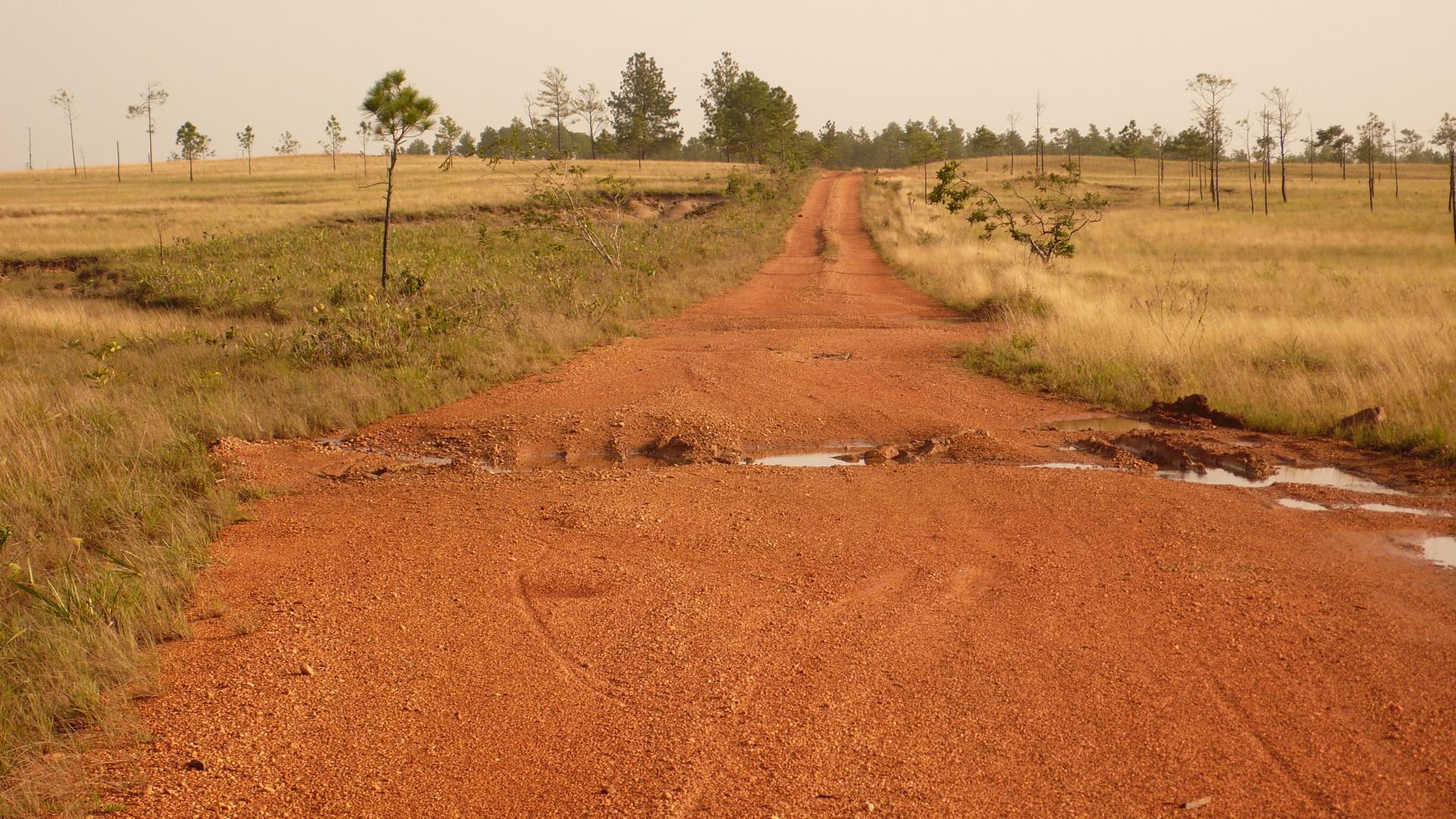
Road connecting Bilwi to Sangni Laya, Northern Caribbean Coast of Nicaragua.
Hopes and Futures
AM: I’m fortunate to be at the University of Oklahoma with amazing colleagues in Native American Studies who have been exploring Dr. Laura Harjo’s concept of “Indigenous futurities.” And this made me wonder, what gives you hope for the future of the Miskitu people?
RMM: What gives me hope is knowing our history and everything we have been through and realizing that we are still here. As you said, we have conserved our culture. We have survived very violent processes of colonization, assimilation, and mestizaje, and yet we continue. That is also why I believe my contribution is not to let these ideas disappear, but to write them. I remember when I was working on my dissertation, at a moment when I felt very frustrated and asked myself, ‘What is this going to be useful for? Who will care about this?’ My advisor told me, ‘Your role is to write it. It will not be your role to materialize all of this, but to describe it. The next generation will find value in this work.’ That conversation gave me encouragement and the energy to continue. This gives me hope: to know that the struggle continues, at least for now, in the field of ideas, because that is what we are able to do in this moment. We cannot do everything right now. But the broader global context regarding the recognition of Indigenous Peoples’ rights is, I believe, more favorable than it was fifty years ago, and that gives me hope.
AM: Is there something else you would like to share?
RMM: Just to thank you and Cultural Survival for being a venue not only to present myself, but to help present the Miskitu people. I do not claim to hold the absolute truth of the Miskitu people, of course, but through my research, I hope to bring to light who we are, where we come from, and where we are going. I also want to thank those who take the time to read this. I am open to continuing the conversation. If you would like to learn more, you are welcome to reach out to me.
AM: Thank you so much for sharing your experiences and for undertaking the work you are doing.
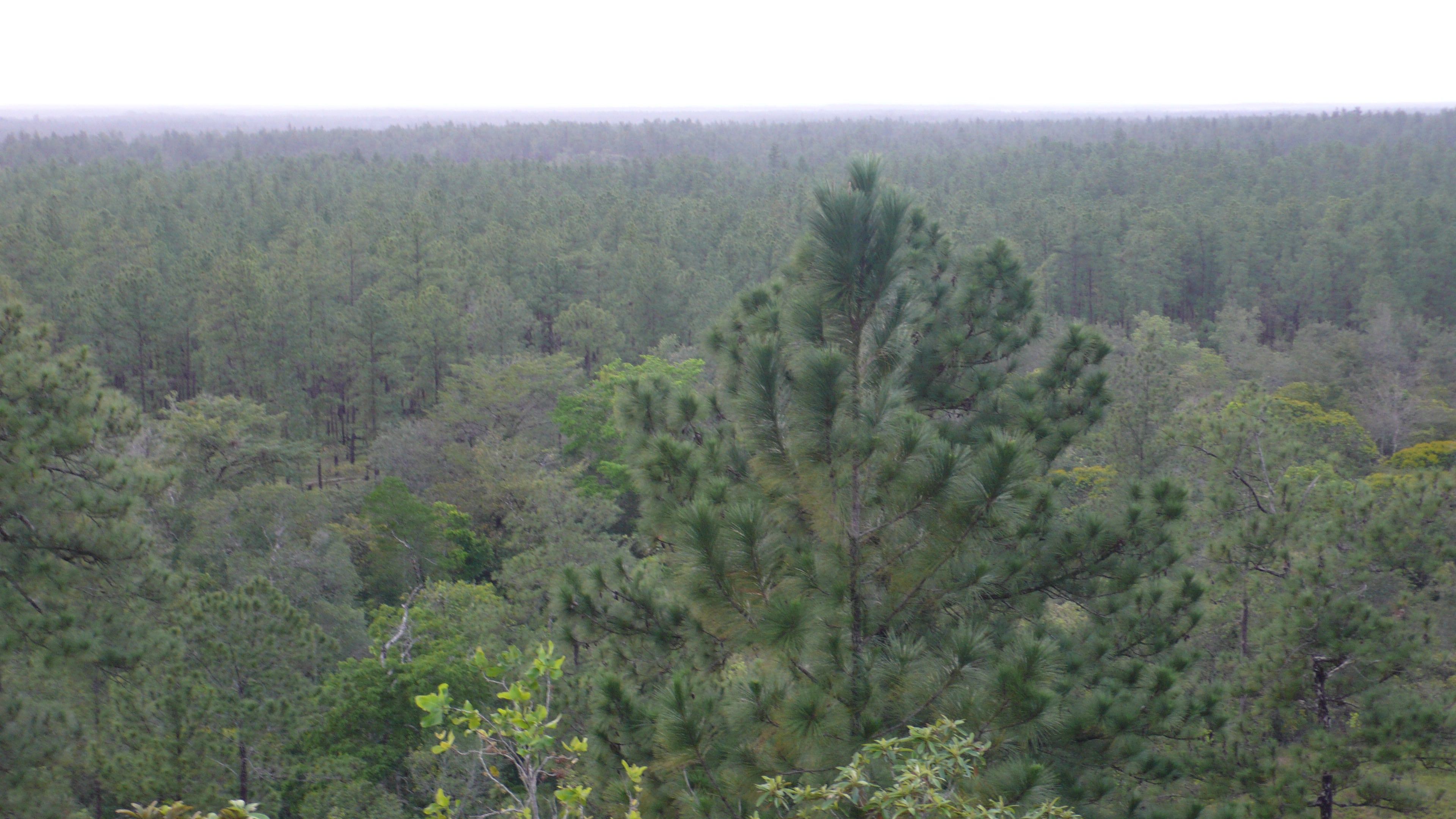
Top photo: Pine trees on the Northern Caribbean Coast of Nicaragua.