By Dev Kumar Sunuwar (Koĩts-Sunuwar, CS Staff)
Nepal’s human rights record was reviewed by the UN Human Rights Council’s Universal Periodic Review (UPR) Working Group for the fourth time on January 21, 2026. During the 51st session of the United Nations Human Rights Council, held at the Palais des Nations in Geneva, Switzerland, members of the international community assessed Nepal’s progress and the persistent challenges faced by Indigenous Peoples.
The UPR is a peer-review mechanism through which all UN member States have their human rights records examined every four years. The review is made based on a national report submitted by the State under review, information contained in the reports of independent human rights experts, known as the special procedures, human rights treaty bodies, and other UN entities, as well as reports provided by stakeholders, civil society, and national human rights institutions and regional organizations.
A coalition of Indigenous-led organizations, namely Sunuwar Sewa Samaj, Sunuwar Women Society, Indigenous Rights Foundation, Nepal Tamang Women Association, Indigenous Women’s League, National Indigenous Disabled Women Association Nepal (NIDWAN), and Cultural Survival, also submitted a stakeholder report for this review cycle, highlighting the gaps between what Nepal’s constitution guarantees and what Indigenous Peoples actually experience.
Nepal was previously reviewed in 2011, 2015, and 2021. Nepal was one of the 13 countries reviewed during the January 2026 session and faced inquiries from 101 countries that participated in the interactive dialogues. The UPR working group, comprised of 47 member States of the Human Rights Council, is scheduled to adopt a formal report and recommendations on January 30, 2026. Nepal will then indicate which recommendations it accepts and which it merely notes. The accepted recommendations will guide Nepal’s government in the coming years, especially in fulfilling its international commitments to the human rights of Nepali citizens.
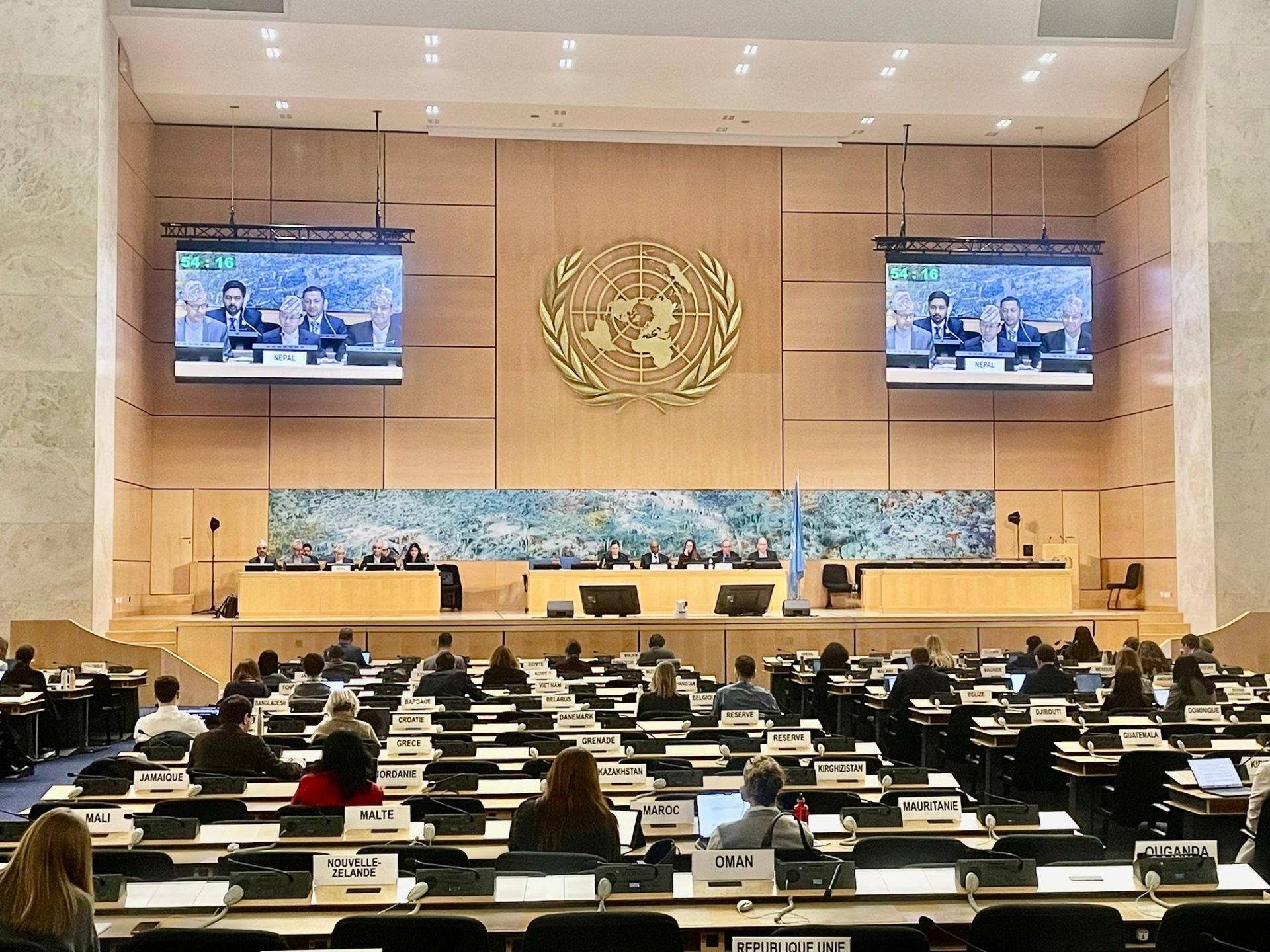
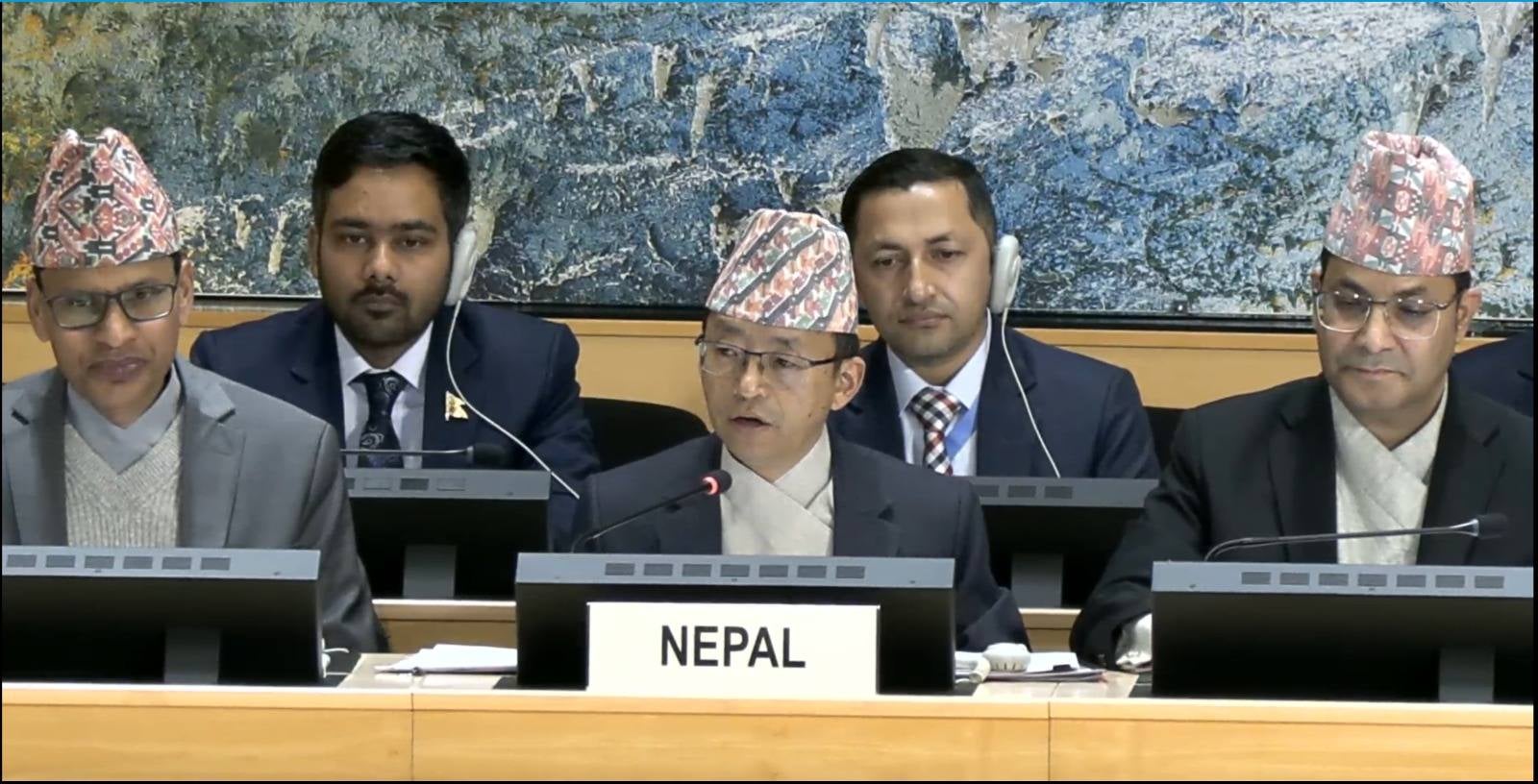
The high-level Nepali delegation, comprising senior officials from the Ministry of Foreign Affairs, Office of the Prime Minister, Ministry of Law, Justice, and Parliamentary Affairs, and Nepal’s Permanent Mission in Geneva, led by Foreign Secretary Amrit Bahadur Rai, presented the national report and reaffirmed Nepal’s full-fledged commitment to protecting human rights, detailing constitutional protections of civil, political, economic, social and cultural rights, including the rights of women, persons with disabilities, Indigenous Peoples, and other communities. He further noted that Nepal undertook legislative and policy reforms to promote inclusion and social justice, alongside progress in establishing the Indigenous Nationalities Commission as a dedicated body to oversee human rights issues and National Foundation for Development of Indigenous Nationalities (NFDIN), a body for the empowerment of Indigenous Peoples, and in implementing reservations in public services and politics to advance the representation of Indigenous Peoples. The delegation also highlighted affirmative measures, such as proportional representation quotas for Indigenous nationalities in elections and the civil service, as well as efforts to combat discrimination through legal reforms.
Although the national report and Nepali delegation emphasized the progress in advancing the civil, political, social, economic and cultural rights, six countries, namely Mexico, Spain, Armenia, Colombia, Venezuela and Finland, raised the concerns about the situation of Indigenous Peoples and made specific recommendations to address the right of Indigenous Peoples, underscoring the need to tackle discrimination, land insecurity and lack of access to basic services, and called on Nepal to take stronger measures for improvements.
Spain delivered a sharp critique, recommending that Nepal guarantee the rights of Indigenous Peoples, especially protection from evictions and access to drinking water. This recommendation follows years of advocacy from Indigenous Peoples Organizations against the “ruthless evictions” of Indigenous Peoples from the buffer zones near national parks and destruction of ancestral and territories in the name of State-led so-called infrastructure and conservation projects. Indigenous Peoples have repeatedly raised alarms about being displaced from their territories without adequate compensation. Spain further urged the government of Nepal, “to incorporate an intersectional approach into all policies to identify and combat any discrimination against women, LGBTIQ people, Indigenous Peoples, People with disabilities, and other minority and vulnerable groups.”
Similarly, Colombia echoed the issue of land ownership, urging Nepal to “promote measures to increase levels of land ownership by strengthening land titling processes and advancing reforms focused on small-scale farmers, women, youth, and Indigenous Peoples.” Nepalese Indigenous Peoples have long struggled to obtain formal collective legal titles for their ancestral land and territories, which they have stewarded for generations. They have often faced land grabbing by both the State and private entities, particularly in the name of hydropower projects and road expansion, which are frequently undertaken in their territories without Free, Prior and Informed Consent (FPIC).
Intersectionality was a recurring theme during the dialogue, with States highlighting how Indigenous Peoples’ identity overlaps with other forms of marginalization. Mexico recommended that Nepal “strengthen with an intersectional approach, the empowerment mechanisms of historically marginalized people and communities, including women and girls, Dalits, Indigenous Peoples, migrants, and people with disabilities.” Venezuela and Finland also echoed the same perspective, with Venezuela recommending continued adopting policies and legislation to “effectively protect women and girls, including Dalit women, Indigenous Peoples and Persons with disabilities.” While Finland called of the total elimination of “untouchability” and all forms of discrimination and violence against Dalit women and girls, underrepresented castes and Indigenous Peoples as well as persons with disabilities. Similarly, Armenia emphasized the need to intensify protection, calling on Nepal to “further intensify efforts to protect the rights of women, children, Indigenous Peoples, and other vulnerable groups, including in the digital environment.”
Nepal is home to 61 legally recognized Indigenous Nationalities, collectively known as Adibasi Janajati, who make up approximately 10.5 million (35.2%) of the country's 30 million population. Despite Constitutional recognition and international commitments, Indigenous Peoples of Nepal continue to face systemic challenges, including land dispossession, lack of political representation, and barriers to accessing education, healthcare, and employment. This UPR review took place against a backdrop of significant upheaval, including the recent political transition in Nepal following the Zen-Z movement held on September 8 and 9, 2025, the formation of the interim government, and preparations for the March 5, 2026, election. Internalization of recommendations from the international community requires sustained political will, particularly to address the implementation gaps from prior cycles and to ensure that Indigenous Peoples fully benefit from and realize the constitutional promises of equity and meaningful participation in decision-making and State structures.