
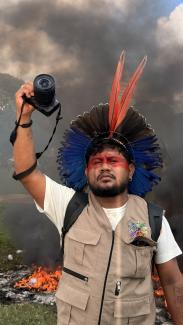
In a time of climate change, economic pressures, and growing threats to Indigenous rights, self-governance remains the most effective response for building a sustainable future for the next generations. The Indigenous Council of Roraima (CIR) in the Amazon rainforest demonstrates that Indigenous governance does not merely involve a recognition of Indigenous presence and political representation. It is a living process, built daily by communities, leaders, women, youth, and Elders who make collective decisions to protect their territories and secure the future of their Peoples.
One of the first regional Indigenous organizations in the Brazilian Amazon, operating for over 55 years, the CIR has strengthened its decision-making mechanism through community assemblies, regional meetings, and continuous dialogue between leaders and their communities. This model of regional governance and collective leadership has enabled them to confront historic challenges related to territorial defense and, more recently the increasingly evident impacts of climate change.
CIR’s area of work covers 35 Indigenous Territories in the state of Roraima, encompassing 10 million hectares and home to approximately 100,000 Indigenous people living in 271 communities, including the Macuxi, Wapichana, Ingarikó, Patamona, Sapará, Taurepang, Wai-Wai, Yanomami, Yekuana, and Pirititi Peoples. The organization works through 10 regional councils that form its operational base, covering the ethnoregions of Serras, Surumu, Baixo Cotingo, Raposa Serra do Sol, Amajari, Wai Wai, Tabaio, Serra da Lua, Murupu, and Alto Cauamé.
One of the most significant examples of this collective effort is the Territorial and Environmental Management Plan (PGTA), focused on climate adaptation. Developed by Indigenous Peoples themselves using a community-based methodology that combines Traditional Knowledge, territorial observations, and community priorities, these plans represent an innovative experience in self-determination and governance at the local and regional levels.
The PGTA is more than a series of technical documents: it is a community-built instrument that guides concrete actions for environmental protection, food security, sustainable natural resource management, and climate change adaptation. The plan reflects a profound understanding that protecting their territories is inseparable from protecting life, culture, and ancestral knowledge. Rather than relying on externally imposed, State-centered, top-down solutions, communities define their own strategies to address droughts, changing rainfall patterns, wildfire risks, and other threats affecting their daily lives.
Another important example of community-led solutions is the Wakywaa Indigenous communicators network, created to strengthen communication carried out by Indigenous people themselves. In a world marked by the rapid circulation of information, misinformation, and competing narratives about Indigenous Peoples and their territories, the network has become a fundamental tool for governance and community coordination. It plays a key role in documenting assemblies, monitoring territorial management, disseminating collective decisions, and keeping everyone well informed.
CIR shows that Indigenous governance is strongest when it is rooted in community and connected to the real needs of communities and territories. Their practices are not just examples of good policies, but ways of their own protagonism. For many Indigenous Peoples, this experience offers an important lesson: defending territories depends on strengthening community organization, valuing Traditional Knowledge, and creating Indigenous-led mechanisms for decision making and communication.
Charles Nogueira Tarepang (Tarepang) is Press Officer and Communication Coordinator at CIR.
Translation By Edson Krenak (Krenak, CS Staff).
Top photo: Charles Tarepang at the 2026 ATL Free Land Camp in Brasilia, covering the CIR delegation's work in front of Brazil's National Congress.
Photo by Joseph Tarepang.