By Cristina Verán
The Lima-dominated music industry of Peru has long segregated its performers into rigid categories: huayno or festejo here, marinera there, and classical opera tucked safely away in conservatories—to say nothing of rockeros and the raperos increasingly popular today. Renowned Andean soprano Sylvia Falcón (Quechua) has spent her career deliberately dismantling such barriers—which all too often act as unofficial, yet very real impediments for Indigenous artists. Inspired by the Quechua language traditions of her parents’ highland homelands, Falcón reverently summons the breathtaking technical agility of classical opera, the unpredictably dynamic architecture of coloratura, and the deep resonance and spirit of Andean music traditions into a singular, signature style through which she honors her heritage while charting her own path.
She approaches her craft with the rigorous eye and sensibility of a trained anthropologist — which, after completing her studies, she is! Falcón’s music, then, should also be understood as an act of cultural recovery. By drawing fluidly across Peru’s multi-regional geography, she wants Peruvians to understand that their country's musical diversity need not be shackled in separate silos, but can instead be engaged and appreciated as a sonic tapestry of ancestral voices and contemporary sounds.
In this expansive conversation with Cristina Verán, Sylvia Falcón reflects on her ethos as an artist, and what it means to carry an ancestral legacy forward into the future with uncompromising grace and power.
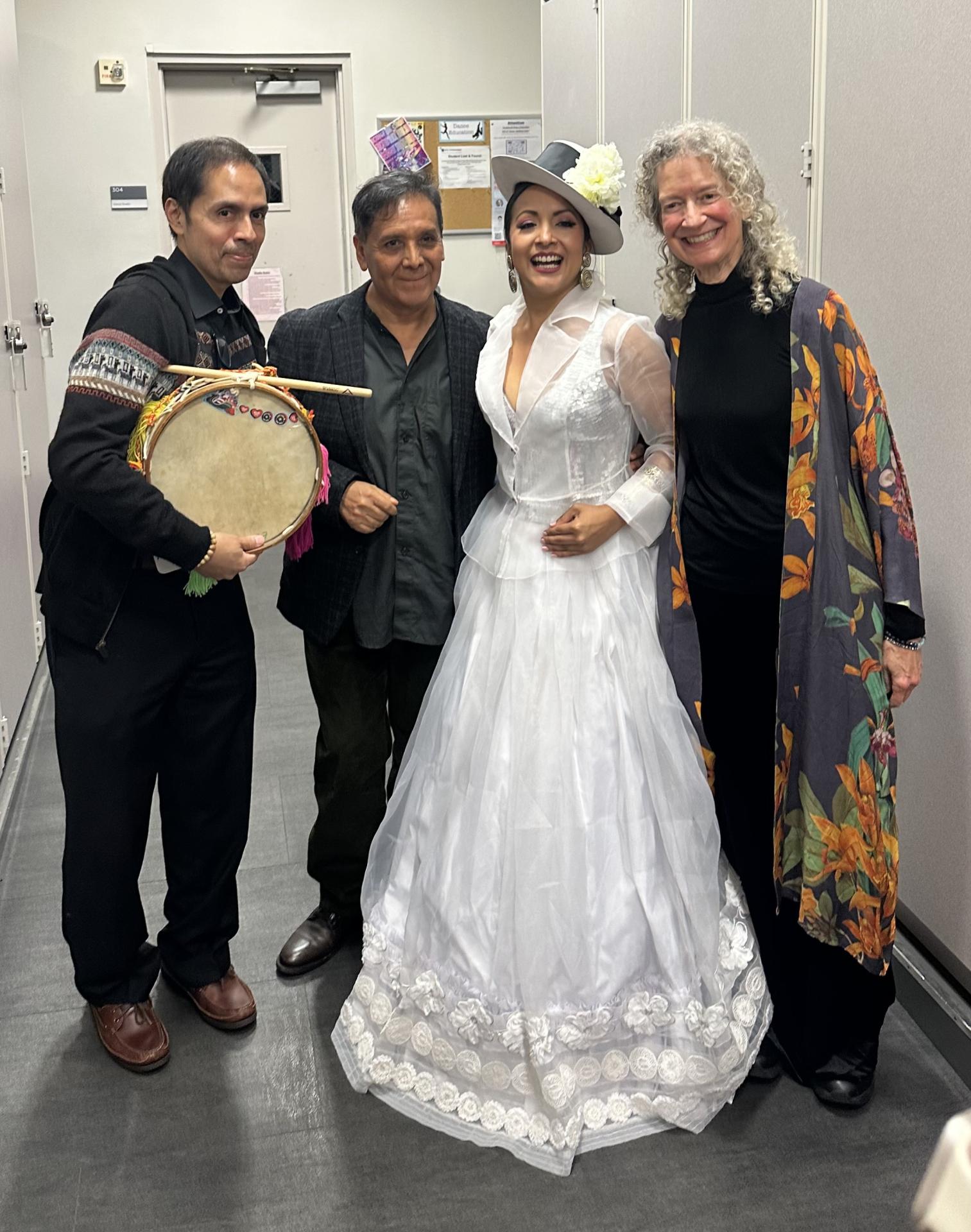
Backstage after a special performance at New York University (during the Rimaqpanpa International Andean Studies Seminar) with pianist Carlos Bernales, Quechua Professor Odi Gonzales, and violinist Rachel Evans. (2026). Photo by Cristina Verán.
Cristina Verán: Please tell us how you identify, personally and professionally.
Sylvia Falcón: Though I was born and grew up in Lima, my roots are in the Andean highlands; la sierra. My parents came from small Quechua-speaking communities—my dad from the Ayacucho region and my mom from the Huancavelica area—each very grounded in Andean culture. As an artist and a singer, I define myself as an Andean soprano. I’m also a producer, and have been doing much of the production work for my music throughout my career.
CV: How present was music in your childhood through your family’s experience and expression thereof?
SF: Since I was quite little, I felt very connected to my parents’ musical culture and artistic expressions. Whenever we had a celebration, for birthdays or something like that, their families would come over, bringing songs from their hometowns.
Also, Lima has these associations that people who’ve migrated there from small towns and communities around the country belong to. They host a lot of cultural festivities in the city, as a way to relive those that take place back in the highlands. I loved attending these with my family.
CV: What kind of music did you associate most with such occasions?
SF: At those festivals huayno and also more traditional tunes prevailed, but my family’s gatherings featured a largely Mestizo repertoire; a mix of Peru’s Indigenous music traditions and música criolla standards, which my mom loved so much. She had grown up in Ica (away from her Huancavelica community) and wanted to feel like a Mestiza, you could say. My dad, who was often singing, also loved to listen to Cuban music from the 1940s at home.
CV: Please tell us about a specific song or two, from childhood, that you have some special memory of.
SF: I loved this one called "Tantarchay Kichkachay” that, I’m told, my [paternal] grandmother would often sing. It’s a beautiful song that talks about the great difficulties one experiences when living with limited resources, in a small community up in the highlands. I never got to meet this grandmother, but in my father’s community, they say that I get whatever I’ve gotten in music from her. It makes me very happy to know that what I do with my voice represents my heritage through her. I chose to record that song, in fact, for my first CD.
I also really loved the huayno songs from Ayacucho and, when I was a little girl, my dad used to sing a special one to me: un huayno mestizo—"Negra del Alma" [Dark-skinned Woman of the Soul]—because I was the darkest girl in the family.
CV: Your parents were both native speakers of Quechua. But in Lima, there can be immense social pressure to reject one’s Indigenous mother tongue to fit in and also to avoid discrimination. How were you made to feel about it in your home, with your family?
SF: When we were little kids, my older sister and I liked so much to listen to them speaking Quechua, but they used it only for talking between themselves, or while singing the music we grew up listening to. They would never teach it to us.
At the time that they first came to Lima, it was—and still is, really—a very hostile place for living one’s Indigenous identity. For my dad, back in the ’60s, it was immensely difficult to be a little kid who only spoke Quechua. He’s got some truly terrible stories from then about how he was discriminated against, many, many times.
So, when he and my mom had a family, they didn't want us to suffer the way they had. They thought that as long as we never spoke their language, society wouldn’t discriminate against us. Of course it still happened, because we are their children—we look like them! No matter what language we speak, who we are is clear from our looks.
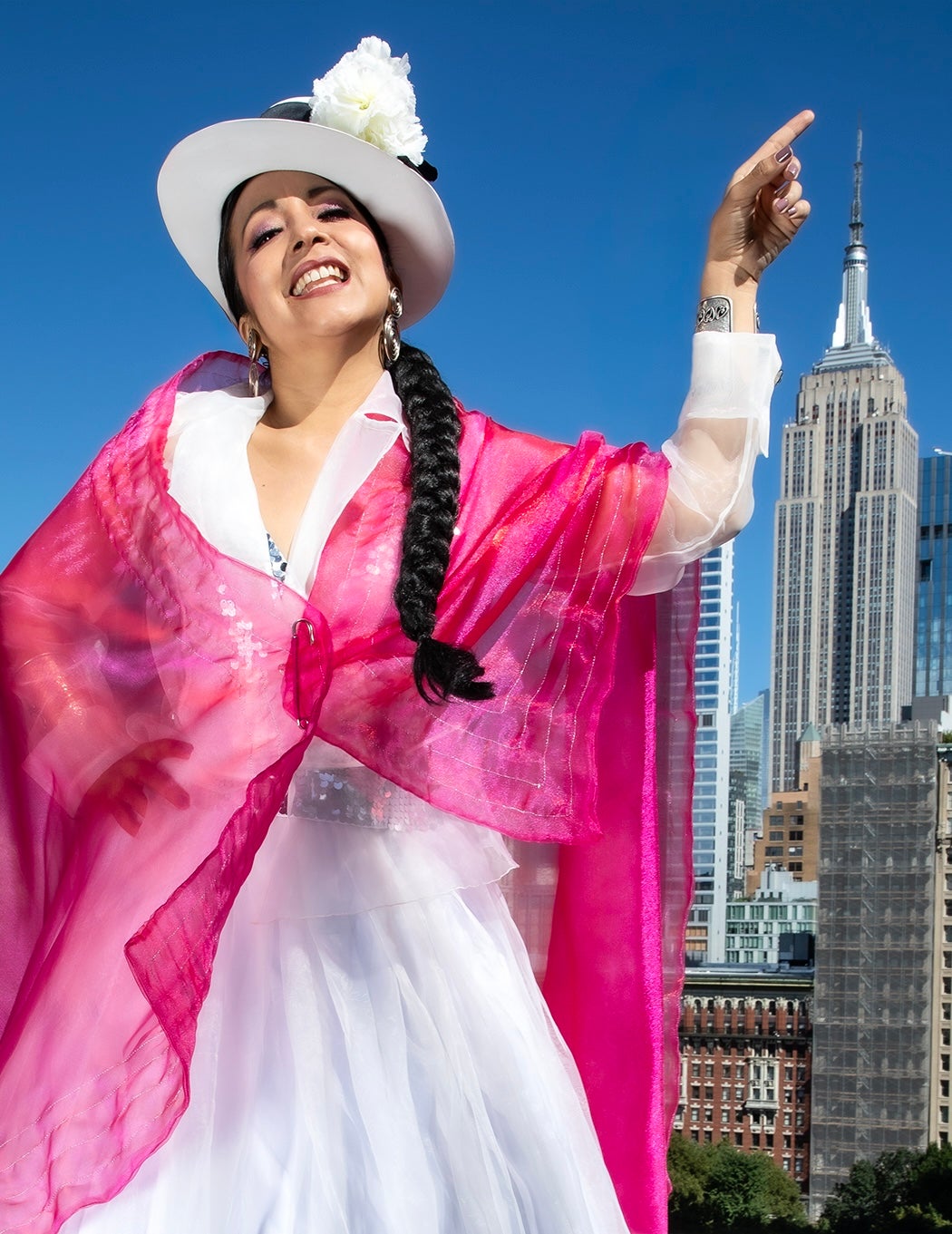
In Manhattan near the Empire State Building (2026). Photo by Omar Mariluz.
CV: Did you have to study Quechua then, on your own?
SF: Yes. Music is what really brought me back to it—though I don’t speak it fluently. Peruvians who speak only Spanish have been missing out completely on so much of this whole beautiful world of our Andean cultures and identities; entire ways of thinking and living that live through our Indigenous languages.
I feel very fortunate to have memories of my maternal grandmother telling us so many wonderful tales from our ancestors, all in Quechua. Even though I couldn’t understand them word for word, I enjoyed them so much.
CV: As a city girl, raised in the capital, how did you come to understand and experience your parents’ communities of origin?
SF: My mom and dad came from such beautiful places, and my visits to each of them were magical experiences that really shaped me.
The first time I visited my mom’s hometown, I was about 10 years old. It was like another world for me! I’d heard a lot about it before, of course, and I'd even sung some traditional songs from there whenever family gathered in Lima. But to actually be there myself with all the people of that community, seeing the terrain and the atmosphere… It felt like something suspended in time.
My father had lived most of his life in Lima, but he never forgot where he came from. Life there was [and remains] quite hard due to the poverty all around, but despite that, he had so much love and care for the land, for their culture. I think I got that from him—that passion, that love for our Andean culture and its connection to Mother Earth.
I came to understand that my parents were who they were not in spite of, but because of, an identity that arises from these lands; the mountains and the music.
CV: As a teenager, how in-tune and engaged were you with the musical whims and trends of Lima’s youth culture?
SF: I was always very alert to and aware of what was in vogue, whatever was popular on the radio. I loved all kinds of music though. At school I’d often sing and dance música caribeña, for example. But huayno songs were always favorites of mine.
CV: Both to listen to, then to sing, yes?
SF: Absolutely. When I started out professionally as a singer, though, my friends would say, "Why do you want to sing huayno? You have the voice to sing opera! Why not go to Italy and do that?” I didn’t care, though. This world has many opera singers in it, I thought; famous and wonderful. But how many great Andean voices does it have?
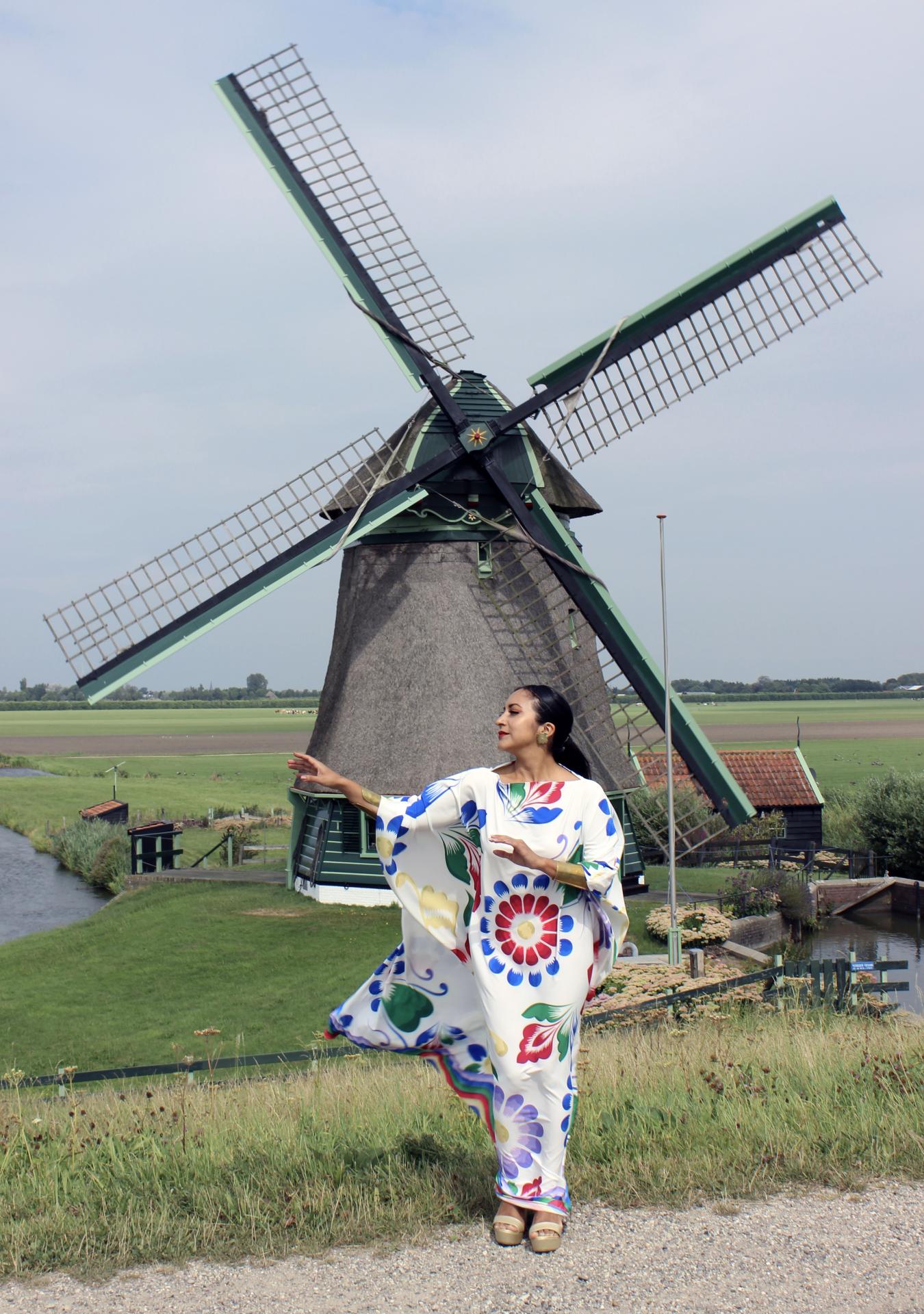
During a visit to the Netherlands.
CV: This reminds me of the great Peruvian composer Theodoro Valcárcel's story. I noted that one of the songs you performed recently, here at New York University, was his much-revered composition “Suray Surita.” As a young musical prodigy from Puno, proud of his Aymara roots, he was given the opportunity to study music in Italy. And yet, when he returned home, instead of just trying to become the best European-style classical composer, he devoted his talents to elevating the traditional sounds and melodies of his Andean heritage so they would be recognized as worthy of the same kind of prestige.
SF: I’m very familiar with his work, yes! What Theodoro Valcárcel accomplished as a composer was so important for music in early 20th-century Peru—not only the level of music he made, but also, as you said, how he advocated for our Andean identity through it. It's such wonderful music. I was fortunate to have met his nephew, the late Edgar Valcárcel, who had himself become a renowned composer decades later.
CV: In the past hundred years or so, the national culture of Peru has, in multiple waves, elevated some aspect or other of Andean culture (music, art, design, etc.), yet each lasted no more than a decade or two before fading. Now, though, a new generation of singers and rappers, too—Renata Flores, Lenin Tamayo, Liberato Kani, and so on—has emerged at a very different kind of moment. Armed with unprecedented access to recording technology, community radio networks, and global streaming platforms, they can bypass old gatekeepers and potentially sustain this Indigenous-centering movement long-term. What are your thoughts on this?"
SF: I really hope this movement will continue! That will depend, though, on how sincere we are as artists in embracing what I believe is a duty to celebrate and share the beauty of our Andean music, language, and culture—for more than just a trend-seeking moment.
CV: That was sort of the case for Yma Sumac’s career in the U.S., though, no?
SF: Yes. Still, the thing with Yma Sumac—and I truly believe this—is that Moisés Vivanco (her husband, who was also her manager and music collaborator) had such a deep knowledge and appreciation of traditional music in Peru. Their intent was never about taking advantage of our heritage for some fleeting wave of fame. No. Vivanco was not only a true maestro, but also a serious researcher who made a point of learning about all the distinctive styles of music that existed across the Andes. At the same time, he was not afraid to compose music that I would call disruptive, in the context of Peruvian musical history.
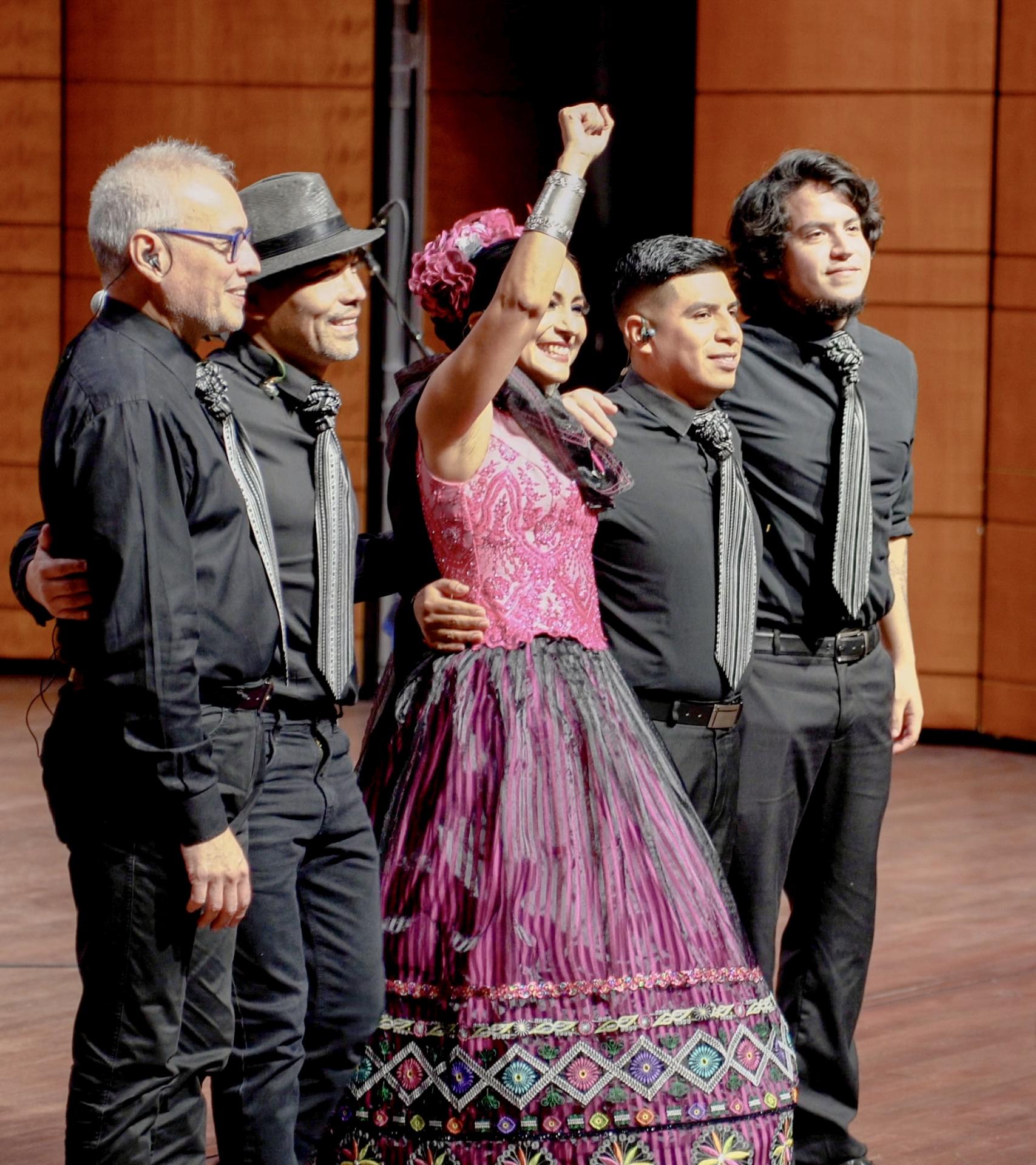
Post-performance during the Andean Diva Gala at the Kennedy Center in Washington, D.C. (2024).
CV: Despite Sumac’s triumphant success across North America, Europe, and the Soviet Union during the 1950s and ’60s, she never got this acclaim in her beloved homeland.
SF: Very true. Even while enjoying her biggest moments abroad back then, she was not popular in Peru. In fact, this young generation in Peru now still doesn't really know about her.
I first learned of “the myth of Yma Sumac” in the early 1990s; about this wonderful singer from Peru who sang for the world. I found her voice and style to be so far from, so different from my way of singing. It was as magical as it was difficult. Her music, meanwhile, was created by, from, and for our people. She sparked a whole new genre of Peruvian music, too, known as lírica Andina o coloratura Andina.
I never imagined being able to sing anything like she did, because her sound was so impressive, so perfect—and yet I did end up doing just that.
CV: Now you’ve begun to incorporate her songs in your own recordings and performances.
SF: Yes! I met this wonderful musician in Peru, Maestro Daniel Kirwayo [with whom I eventually recorded my first two CDs], and after hearing my voice he told me, matter-of-factly: "You can sing coloratura!" He then gave me two songs to learn—and I did. Next, he had me go through Yma and Moisés’s entire repertoire, and I became enchanted with all of it; every song. Each presents a challenge for the voice as well as for the performer overall. I got really deep into all of it—in a very personal, almost selfish way—and decided, "I'm going to take these songs as far as I can."
CV: Beyond the Andean canon, Sumac also recorded and performed works from other genres, other lands—from opera to mambo. You seem similarly inclined at this point.
SF: I am, yes. When you see my shows, my concerts, I try to offer a glimpse of what I find most dear in my heart—which can be many things, just like Peru is, itself! Peru is coloratura andina, it is huayno, it is the ícaro chants of the Amazonia.
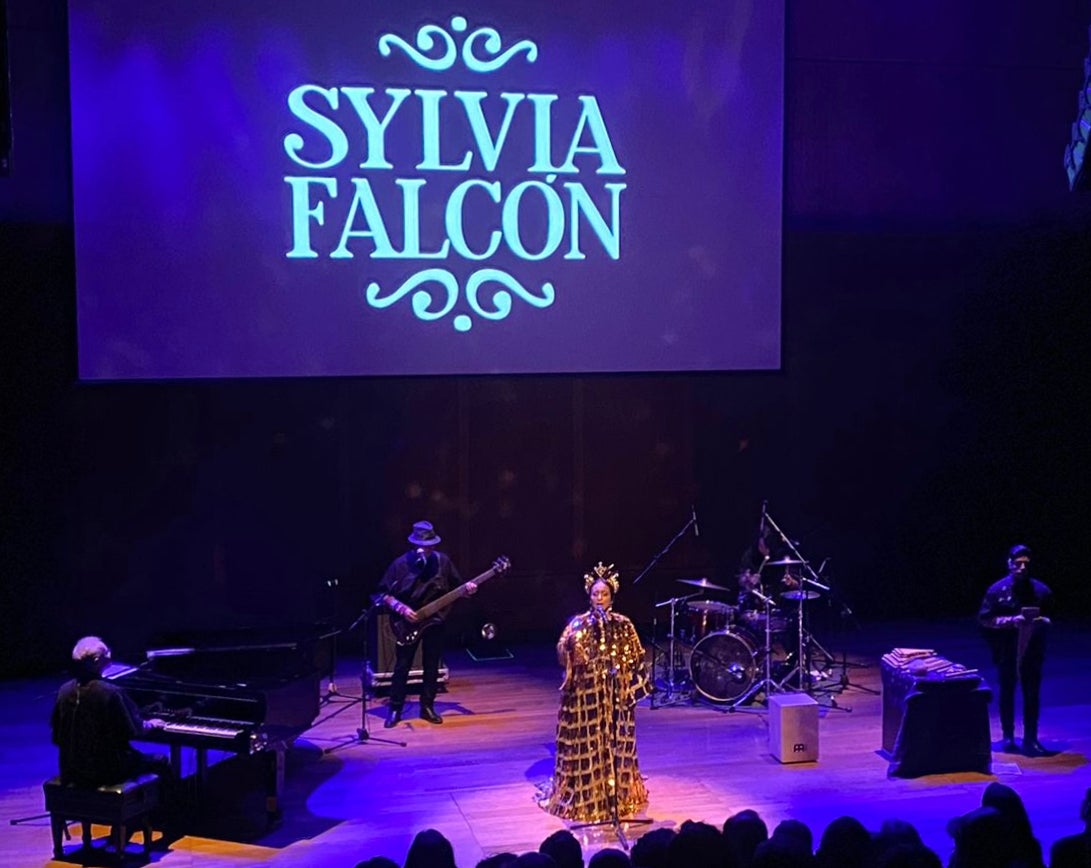
In concert at Teatro Mayor Julio Mario Santo Domingo in Bogotá, Colombia (2023).
CV: This openness is not common among Peruvian singers, from what I’ve noticed.
SF: No, it’s not. In Lima, the music scene has always been very specialized. The industry dictates, for example, that Andean singers cannot sing música criolla and, in turn, música criolla singers cannot sing the music of the sierra or from the Amazon—much less opera. Once a singer becomes associated with a particular genre, it's expected that they’ll just continue like that, and that's all. I really want to show my audiences a different way to see things; to not only engage the full diversity of genres we have in Peru, but to also prove that a vocalist can actually perform more than one type of these in a show—as I do. I must say that I have the great privilege of working with Pepe Céspedes, my husband. He is a great pianist as well as a master of jazz and the coastal rhythms of Peru, and I have learned a tremendous amount from him about more detailed aspects of music, like structure and patterns.
CV: How were you able to find someone, a voice coach, to help you navigate such varied ways of singing?
SF: I was just finishing my anthropology studies—which had already taken me five years to get through—so I didn't want to go to a conservatory. Besides that, the academic vocal instructors in Peru focus mostly on opera—perhaps the most difficult kind of music of all to sing—and sometimes look down on traditional Andean singers.
It’s from a mistaken belief that what they do is easy. Quite the contrary! I’ve found that even what’s supposed to be “simple” in this music can, in fact, be quite difficult to achieve. It's not easy to sing a huayno, for example. Singing them with flavor and rhythm in an authentically native swing, it's quite complex.
I knew I needed somebody who understood what I wanted to do, and could—just by hearing my voice—truly know what it was capable of. When I finally found the right teacher, David Gordon, he was not even in Peru, but in California! I believe that connection was destiny.
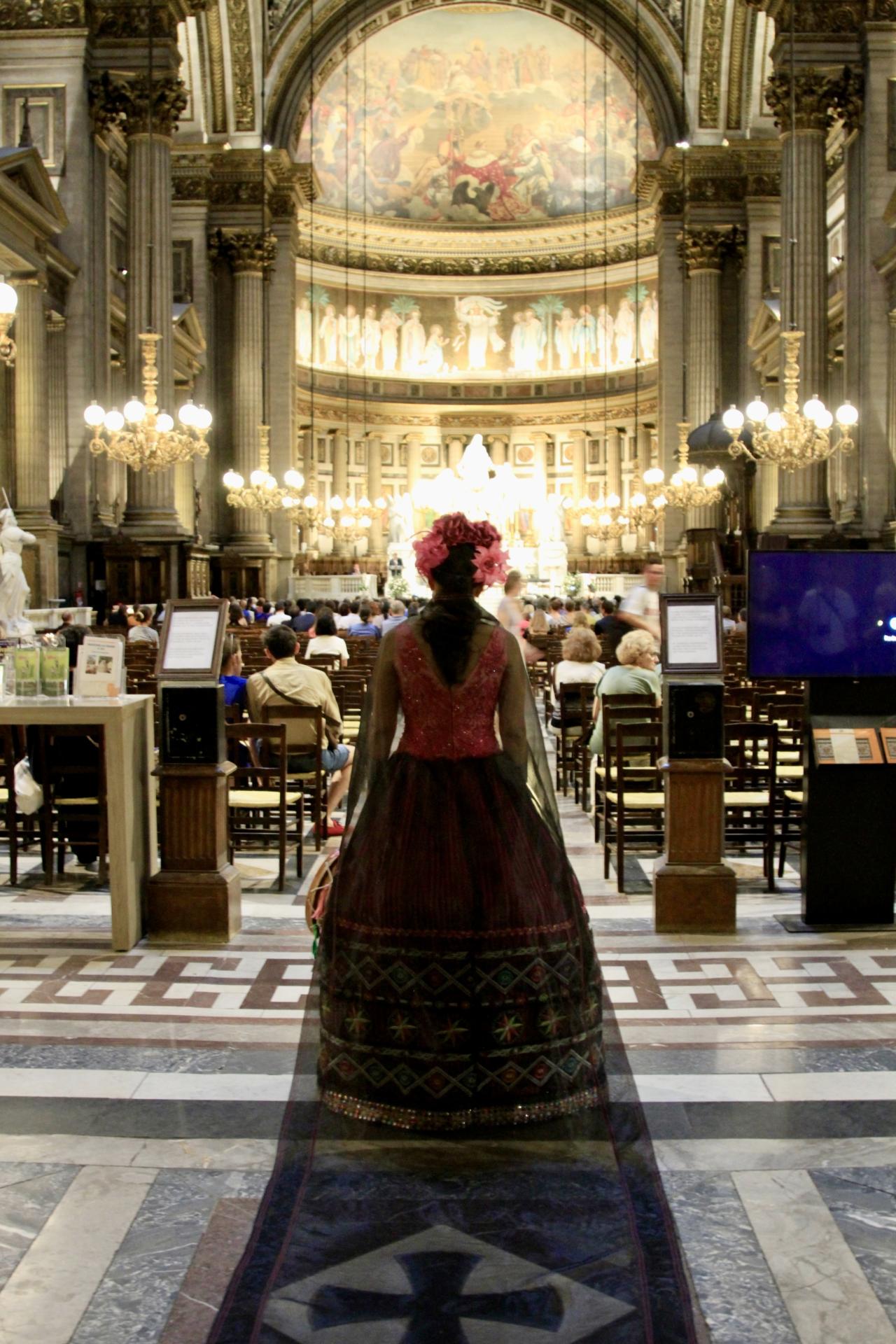
At the Church of La Madeleine in Paris, France (2022).
CV: There is a very specific, quite high and distinct pitch for a lot of Andean music not common to other styles of music—although I find some Hindi singers in India come close to it.
SF: Yes, and beyond that style, that pitch, one has to know what I would describe as the “flavor” of it as well; to understand what’s inside or behind the music. It has its own language—by which I’m referring not just to Quechua but to the musical language within it.
CV: Would you say that your anthropology interests directly intertwine with who you are as a singer? Or, are these more like two separate worlds?
SF: From the start, my anthropology was and remains linked to music—which was actually the focus of my thesis at la Universidad Nacional Mayor de San Marcos, in Lima.
CV: You’ve got a book coming out soon from that, right?
SF: Yes, from the research I did for my licenciatura—the “license” one must complete in Peru after completing five years of study for the bachelor's degree. In order to achieve this and to produce your thesis, you are required to complete some kind of research study.
CV: What was its central assertion and subject?
SF: My thesis was about the musicians from my dad's hometown of Pausa; about music, memory, identity, and, shall we say, goce [a kind of physical, spiritual joy]. I sought to describe how music gives the musician—and vice versa—a capacity for living an identity, and can then spread this feeling of identity, as projected by their music. It’s part of la memoria colectiva.
Now it’s the subject of my book, "Identidades, Memoria Colectiva y Goce desde la Música Pausina" ["Identities, Collective Memory, and Joy in the Music of Pausa"].
CV: Let's circle back for a moment. While you now perform in prominent venues and for large audiences, the music world of Lima’s expectation—that a performer must “stay in their lane,” so to speak—remains. Was there resistance to the kind of music you wanted to sing in those venues?
SF: Fortunately, such things never held me back, as far as being able to sing what I wanted to sing.
CV: What might have insulated you from that—or was there perhaps something in you that was uniquely able to push through those social presumptions and barriers?
SF: Well, I've always been this very proud kind of person; confident and unafraid to speak up for what I wanted to do. My mother got it right when she bet on education as the key to bring possibilities for my sister and for me. She was always telling us that education would send us to places not otherwise accessible to them—no matter how hard they worked. Fortunately, I loved reading and learning, as this education would come to form a great part of my development as an artist.
CV: That’s quite an investment for the family.
SF: My parents sent us to the best schools they could afford. They owned a little liquor store in Lima, where they’d work very long hours, from 7:00 AM to 11:00 PM every day—like little worker ants—all for us.
CV: At what moment did you come to realize that you might actually have a big career ahead of you?
SF: Ah, that was definitely back in 2015, when I performed at the Gran Teatro Nacional in Lima.
CV: Surely you already had an audience by then, no?
SF: I guess you could say that. I had already been performing on various occasions, recording music, making video clips, and so on. But that particular show was the first time I was given the opportunity to perform what was entirely my own show at that venue—for more than 1,400 people! I felt really comfortable in that big theater and, while it certainly presented a challenge to me as a performer, I knew, "I can do this!"
CV: What was your first international show or tour?
SF: One of my first performances abroad was actually in New York, back in 2011, at Baruch College Performing Arts Center (BPAC). I came back in 2014 to perform at New York University—which I was very happy to return to recently for a special performance during the Rimaqpanpa International Andean Studies Seminar.
CV: Earlier this year, you sang in Abu Dhabi—a place with a number of exciting and international stages. What brought you to the United Arab Emirates?
SF: My first time performing in the U.A.E. was actually in Dubai, back in 2023. This last time, I was invited to Abu Dhabi to be part of a celebration to mark 40 years of diplomatic relations between the U.A.E. and Peru. I'm honored that my country chooses to call on me for these big events.
CV: What was one of the first such honors that you experienced in Peru itself?
SF: Ah! The very first time I was asked to sing the national anthem at the Palacio del Gobierno—which I sang in Quechua. I've since sung there many times, and for many presidents. In such moments, I feel like I'm carrying this little flag for our Andean identity, our Andean culture, into battle.
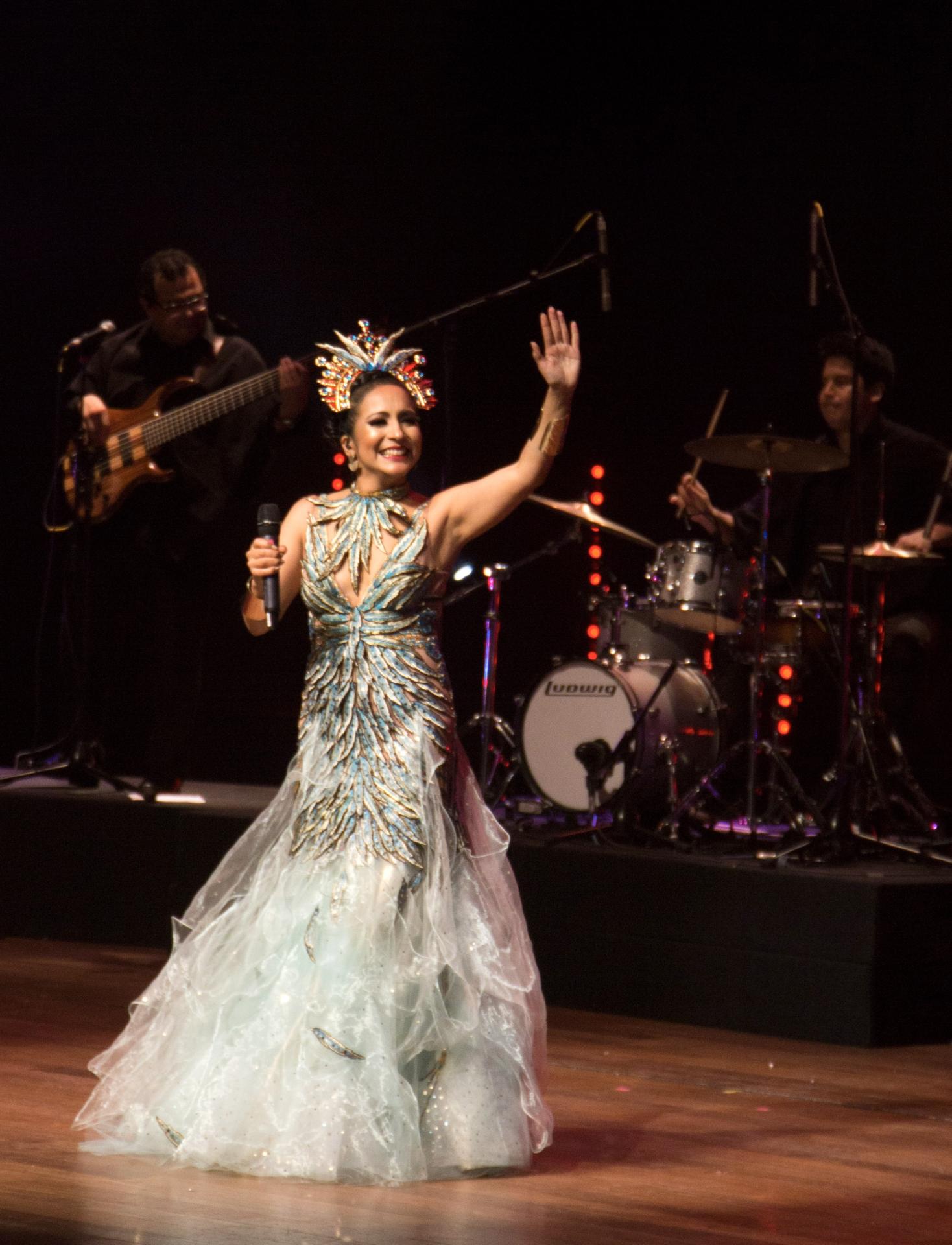
At her gala show "Sylvia Falcón Presents Yma Sumac: 100 Years," at the Gran Teatro Nacional in Lima, Peru (2022).
CV: Is it apt to refer to you as a “cultural ambassador”?
SF: I think so, yes. I’ve been called that many times, and I'm very proud of what I've been able to do in service to Peru, for the Andes. It makes me think often about the power of art, the power of culture, the power of music, and how something so subjective can nevertheless affect change in our society. That's the most wonderful thing: to see how singing our Andean songs can reach through to the soul of the people. It's a real privilege for me to be able to do that.
CV: Something you’ve also been lauded for is the fashion sensibility you project from the stage, swathed in exquisite Andean couture and regal accouterments. Who has designed some of your favorite pieces?
SF: I have worn Meche Correa, Ani Alvarez Calderón, and lately I'm associated with José Miguel Valdivia; truly wonderful Peruvian designers who are aligned with my passion for iconography. One piece that I find particularly endearing is the cape of Inka tocapus, which I showcased in my video clip for “Paras”. It has a story of its own and was hand-embroidered with great love by women who are experts in traditional Peruvian embroidery.
CV: Is there anything else you would like to share with us—some new music in the works, perhaps?
SF: Yes, in fact, by the end of November, I’ll be releasing my version of the “Mambo” album originally recorded by Yma Sumac! I’m very excited about this.
CV: Might you tour some performances of this project beyond Peru?
SF: Hopefully, yes. It will be a bit of a logistical challenge because it's a whole big band thing, but perhaps I can work with locally based bands in other places somehow.
CV: Finally, at this point in your career, do you prefer to focus more on one style of music at a time? Or, is the repertoire you’ve amassed something that your concerts will continue to draw from, in all its diversity?
SF: My shows are always very dynamic, in terms of the music itself and also the vibe, you could say; never just high notes or low notes exclusively. I love to include a variety of sounds and rhythms—which exist even within the classics. "El Cóndor Pasa” to “Bello Durmiente” or "El Mambo de Machahuay" to "Za Za Za”; from las canciones cusqueñas to la música amazónica, I want to sing and celebrate all of it.
--Cristina Verán is an international Indigenous Peoples-focused researcher, educator, advocacy strategist, network weaver, curator, and mediamaker. She was a founding member of the United Nations Indigenous Media Network and the UN Indigenous Language Caucus. As Adjunct Faculty at New York University’s Tisch School of the Arts and Affiliate Faculty of the NYU Center for Latin American and Caribbean Studies, she brings emphasis to the global histories, expressions, and socio-political impacts of Indigenous contemporary visual and performing arts, design, creative tech, media, and popular culture(s). She is originally from Peru.
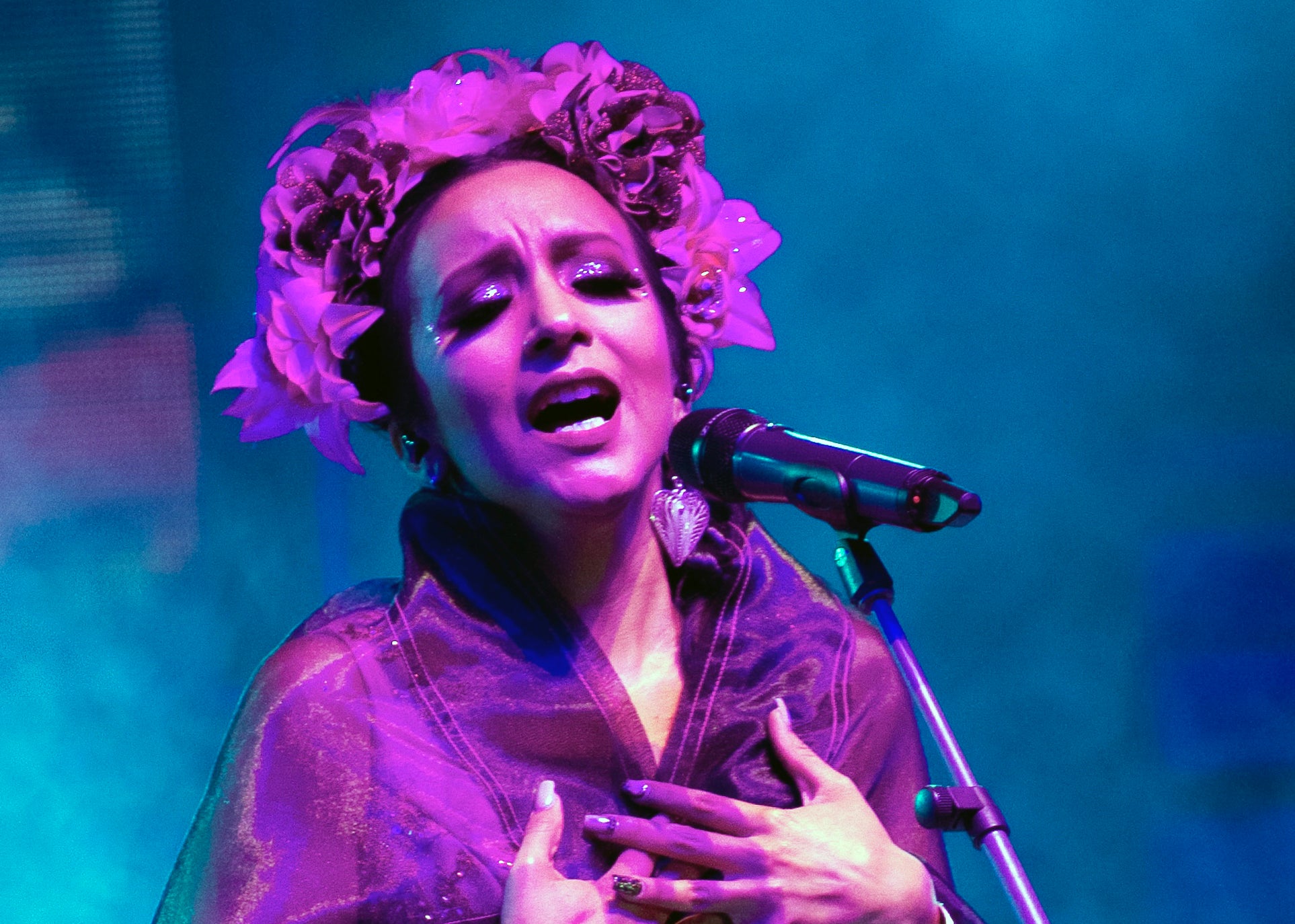
Top photo: In concert at Foro FIL in Guadalajara, Mexico (2021).
All photos courtesy of Sylvia Falcón.