By Cristina Verán
Across the Ecuadorian Amazon, daily life for Indigenous communities is steeped in the sounds of the river and rainforest, where the melodies of countless ancestors intertwine. Enter Nadino Calapucha (Kichwa): climate ambassador and committed defender of Indigenous rights across the Amazon basin and beyond. For him, this sonic vernacular gave rise to an inspired musical venture with mass appeal. Starting in 2016, with his group Kambak, Calapucha channeled his voice, through song, to amplify the interests and the language of his Peoples—to the delight of a broad range of audiences across rivers, mountain ranges, and oceans beyond.
During Climate Week and the UN General Assembly in New York, Cristina Verán spoke with Calapucha about his life of service and the journey that has brought grassroots resistance, full force, from his Kichwa community and its neighbors to the global stage. Stepping back from the music industry now in order to prioritize political advocacy work in the climate movement and safeguarding the Amazon, he works to ensure that Indigenous Peoples remain the rightful stewards of their territories, as essential, integral partners and collaborators in the fight for its (and by extension, our own) survival.
Cristina Verán: First, where do you call home—the place you live now as well as the specific Kichwa community you come from?
Nadino Calapucha: I live in a small city called Puyo, the capital of Pastaza Province, which is like the cradle of all the Indigenous nationalities of Ecuador. It’s where a lot of things happen in our struggle and where we come together to strengthen connections among each group, holding trainings and continuing to build the resistance. Puyo is about an hour and a half away from my actual community, Shiwakucha, at the center of the Amazon.
CV: Please share a bit of its history and when your Peoples began living there.
NC: It was founded in the 1950s on the banks of the Arajuno River—which feeds into the larger Napo River to ultimately create the mighty Amazon—by my grandfather and my uncles, you could say. My grandfather was a navigator who transported goods in his canoe, and the moment he first saw this land, he felt compelled to build a new village there. They named it in honor of the many palm trees (shiwa) and the large pool (kucha) nearby.
CV: At what point did Shiwakucha first come into conflict with the state and its policies?
NC: Almost from the very beginning. Cut to the 1960s, when the Ecuadorian government instituted its Reforma Agraria (agrarian reform). They did not recognize the Indigenous Peoples living there and declared that these lands had no owners, individually or communally. They started to bring non-Indigenous people from outside to solidify the government’s position there. My grandfather had to lead in resistance to this policy and to make an alliance with the church to help the community translate its complaint into a language that the justice system and the government in Ecuador can understand. So we come from a long history of struggle.
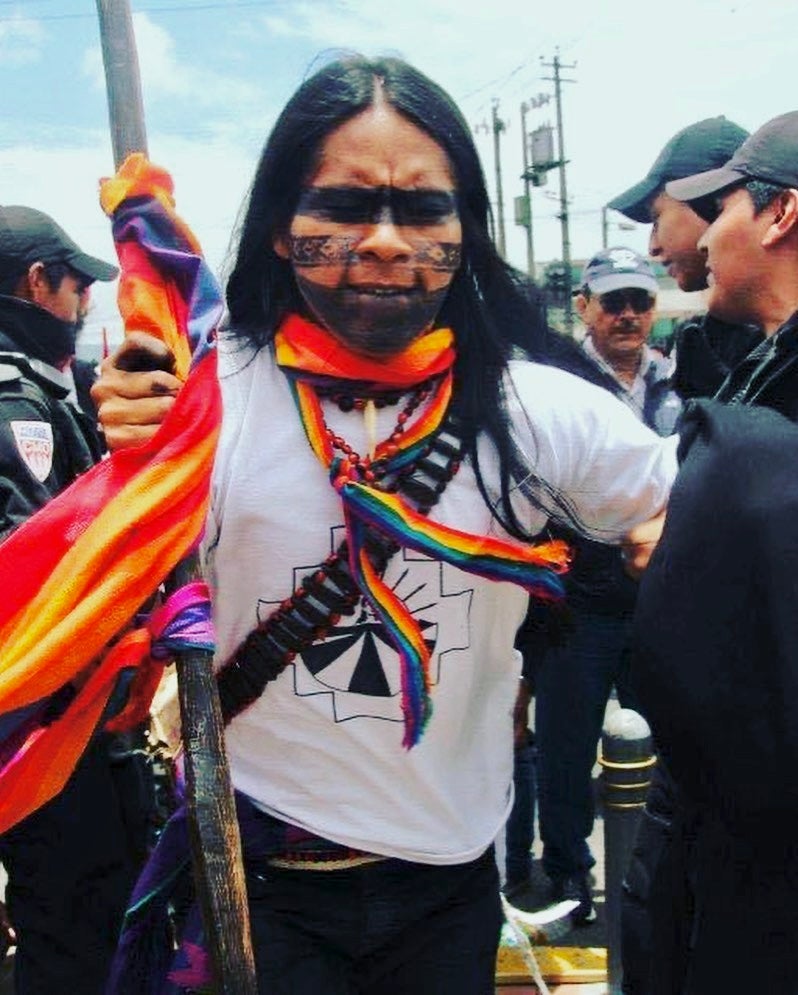
At the Indigenous Uprising for Water and Life in Quito, Ecuador (2012).
CV: Such reforms—which typically include a redistribution of land and other agricultural resources—are commonly presented as inherently “for the people.” Which begs the question: “Which people?” It sounds like yours were not a priority for this one.
NC: These reforms, as I see them, have too often been used by governments to justify the invasion of Indigenous territories, arguing that they are without owners and therefore belong to the state. They come without consulting, without coordinating, without respecting the self-determination of those who live there and have a relationship to the land. My grandfather, for example, is a naturopathic doctor, well known for his deep knowledge about plants and many cures that could be made from them. The government did not consider things like this when imposing its so-called reform.
CV: How did your own and other surrounding communities find their political footing, to directly respond and stand up to these kinds of things?
NC: Part of my family had been protagonists in several aspects of the building of the Indigenous movement in Ecuador, especially in the Amazon. They established, first, an organization called ACIA (Association of Indigenous Communities of Arajuno), and then another one, PIP (Organization of Indigenous Peoples of Pastaza), and were involved with others, too, at the national level. I grew up in the midst of great leadership.
CV: There isn’t one singular moment or experience of colonization that speaks for all of South America—much less the Amazon. When did it come to your region?
NC: Although the colonization of Abya Yala began around 534 years ago, the Amazon region took a bit longer for the Spaniards to reach because of its geographical and climatic conditions. When they finally arrived, though, the results were catastrophic.
CV: What were some key historic moments that exemplified that?
NC: As far back as the 1500s, they enslaved our Kichwa ancestors to harvest ishpingo [a variant of cinnamon native to their territories] for them, violating our human rights as they also imposed their foreign culture throughout the Amazon. Then, in the 1800s, for a more recent example, the rubber boom brought yet another wave of terror to our communities to satisfy the greed of the rubber market. And now, it's the oil companies that come to invade and extract.
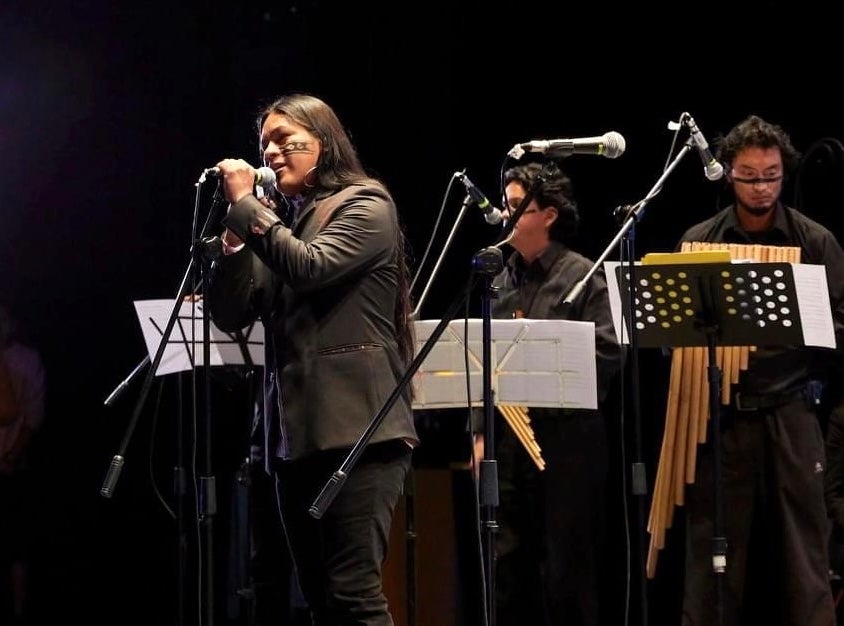
Kambak in concert, accompanied by a symphonic orchestra, for the 2021 Anniversary celebration of COICA (Coordinadora de las Organizaciones Indígenas de la Cuenca Amazónica).
CV: Kichwa Peoples’ territories span vast areas of Ecuador, not only the Amazon, correct?
NC: Yes, that’s right. We have our own distinct communities, and yet we are all Kichwa.
CV: And is there one single Kichwa tongue that all Kichwa People speak and understand?
NC: We all speak Kichwa, but there are numerous Kichwa dialects. For example, there is one used in Pastaza, especially along the Bobonaza River; one spoken by the people of Sarayaku—who, in turn, have a totally different dialect from those of Napo and the communities along the Arajuno River. Overall, we can understand each other, though certain words will be totally different from one community to the next. I speak, sing, and can make people understand me in two dialects.
CV: How prevalent and strong does this language remain in your own and among neighboring villages?
NC: When everyone still lived in the community, all we would speak was Kichwa. But with new roads making it easier for people to go out to work or study in other places, this is no longer the case. The community’s codes of coexistence are changing, and many children only understand our language but cannot speak it. There’s all this colonial thinking that our language should not be valued as much as Spanish, and that speaking Kichwa guarantees that society will discriminate against us.
CV: What roles or functions does music serve in the culture of your Peoples?
NC: In the Amazon, music manifests itself in different ways: to summon, to call, to heal, to harmonize, and to celebrate. It can also be a call to fight. A traditional instrument of my community is a kind of drum that is played with a stick to announce that something important to celebrate will now begin. We also use a kind of shell that summons everyone. And we have flutes made with bird bones—pingullos and holohuatos—used exclusively for harmonizing.
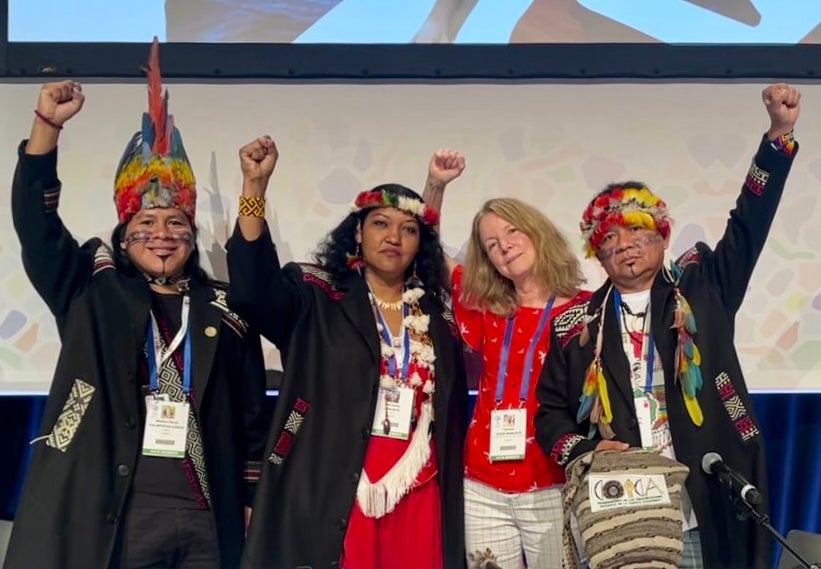
Participating in the IUCN (International Union for Conservation of Nature) World Conservation Congress in Marseille, France (2021).
CV: Describe an everyday community scenario in which music is an integral experience.
NC: Sure. So each day, in the early mornings when a family wakes up, the grandfather will summon his grandchildren, his relatives, to listen and read the fire. They’ll drink guayusa tea together and start talking about their dreams from the night before—the interpretation of which my people believe should guide them in planning their days. Music is an important part of this process, as the wise men of our community—the yachak—sing and invoke the spirits through their songs. Each of these songs will include some kind of coded message that only they possess the knowledge of; a special language and understanding of sounds and messages taught to them by the spirits of the jungle.
CV: Has contact with outsiders altered these practices? If so, in what ways?
NC: The Catholic church arrived on our lands about a century after the initial invasion of the continent; say 400 years ago or so, and its religious colonization began to adapt our musical traditions to include instruments that they brought with them. The violin, for example, is now common in many communities.
CV: Who should we know about, among those that taught or otherwise first inspired your musical journey?
NC: One would definitely be my grandfather, who played a flute that we call a guadua during our traditional dawn gathering. I also had an uncle who played the violin for traditional ceremonies and weddings. They helped me to connect a lot with music. I was also always curious about our wise men, who sing whenever they take ayahuasca. Who do they sing to? Why do they sing? What are they singing?
CV: Your inquisitive nature must surely have been helped by your access to education, both within and beyond your community.
NC: Yes, well, when I was younger, it was very difficult and quite far to go out from my community to any city. In fact, I hadn’t even been to one until I was 12 years old, and left home to continue my studies. [There was no secondary education in my community at the time.] I was able to do this because my father’s work as a medical practitioner gave my family the right economic conditions. The long journey to get to that school took about six hours of walking first, and then four hours by bus.
When I first arrived, I found myself in a very difficult situation, facing a lot of racism and discrimination. Being a teenager also made me vulnerable to many things. I was considered poor, not only in economic terms but also as a person in front of society facing the world—a world which did not speak my language.
CV: How did you begin to reckon with things and settle into this phase of your life?
NC: At first, I just wanted to return to my community. I felt sad, always wondering what my grandfather or grandmother was doing there. And I didn't identify at all with that new place. But as I was questioning things, questioning myself, I began to learn more about the issues that were threatening our Peoples and our lands. I realized that if I don't learn what I’m supposed to learn here, if I don’t get trained in the important things so I can do the work, sooner or later these threats will impact my own community, and I won’t be prepared. I knew I had to stay there at school then, and stay strong.
CV: Were you eventually able to find other like-minded students?
NC: Fortunately, yes. I found a good group of Indigenous friends, and some cousins who also arrived there to study, and we became like one large family. As we started talking about what was happening, we knew that we had to unite.
CV: The school administration, meanwhile, presented its own challenges.
NC: Indeed. They forced us to cut our hair to be able just to enter the school building, and so we decided to rebel. We started painting our faces from that moment on.
Soon there were many of us with painted faces there! We grew our hair long again, and this unity made us strong enough to demonstrate our identity without fear. From then, other Indigenous students there—Shuars, Achuars, Sáparas, etc.—also began to identify with what we were doing. We would all get together socially for activities, like fútbol and danza, and soon we began to lead student actions all across the campus.
Music was part of it, too. I remember one music teacher in particular who was very good and influenced us a lot, Jaime Cubi, who really liked Andean music. I wanted to perform with a music group then, but I didn’t have money yet to buy an instrument I could play in one.
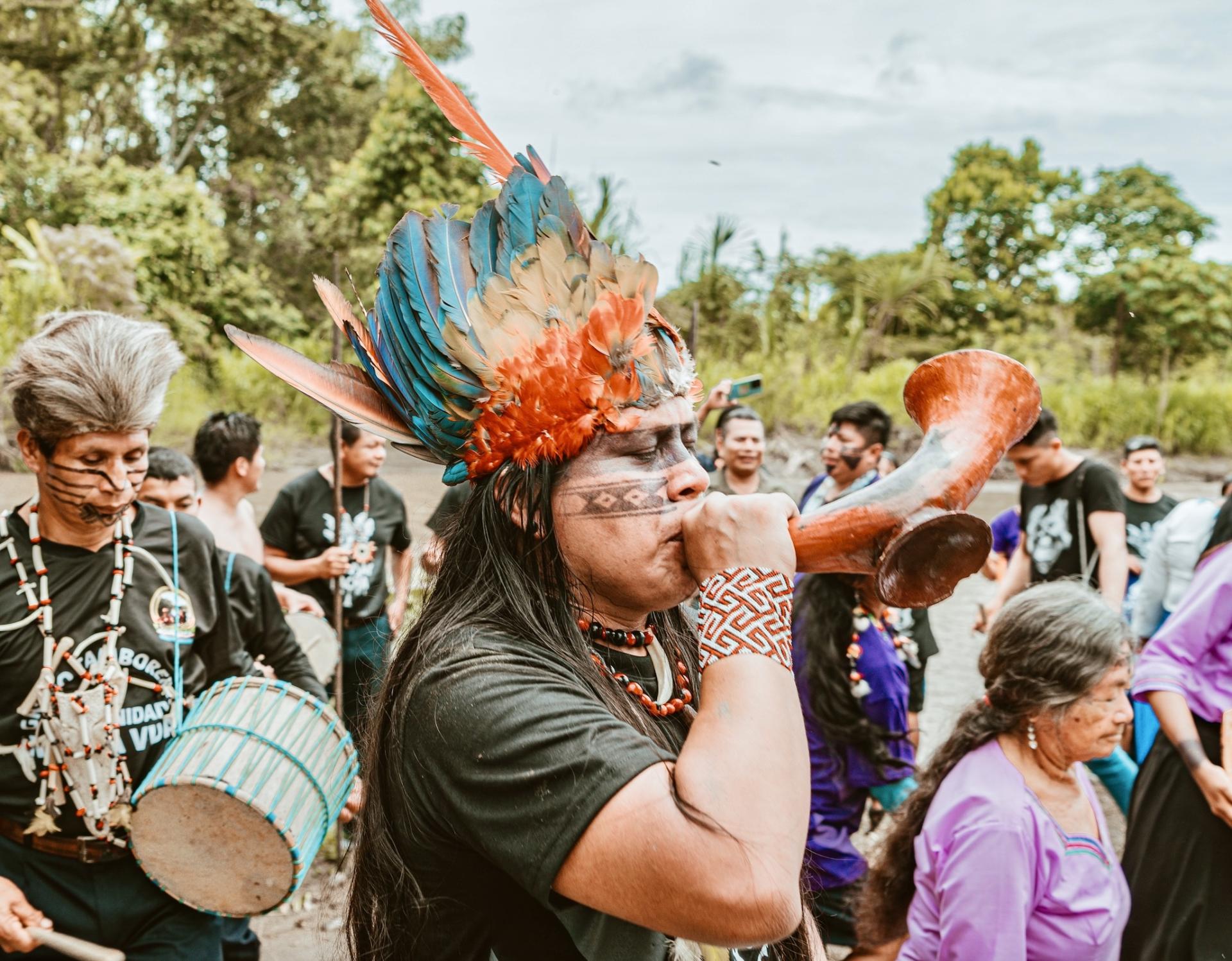
Celebrating the ancestral Kawsay Pacha Raymi festival in his community of Shiwakicha (2026).
CV: You were still a student, a teen, when you first came to the United Nations, right?
NC: Yes, that was back in 2006 or 2007, when I was about 16. We’d started building our youth movement by then, and I was invited to the UN as one of its main spokespersons; part of a delegation of three teenagers there to present the work we were doing. It was all so crazy to me, a Kichwa kid from a small town in the Amazon, finding myself in New York, the capital of the world! At the UN, they gave us some money (as a stipend), but I didn't spend any of it. Instead, I returned to Ecuador and bought myself a quena and a guitar, so I could play music.
With my own instruments finally, I was able to join the group at school, and music became my passion. I was also dedicated fully to the work of the Indigenous movement, so when I began to get opportunities to travel, in any country that I would visit, I’d always bring a musical instrument from home and find one from there. When I was in Senegal in 2012, for example, I carried a West African djembe drum around with me.
CV: With the growth of organized Indigenous political movements in the 1970s that you’ve noted, was there perhaps a certain musical sound, or particular songs, associated with all that?
NC: The first popular groups, the conjuntos, to emerge from communities in the Ecuadorian Amazon created a popular canon of songs that, in terms of their sound, would feature our traditional Kichwa instruments as well as guitars or violins. These were sung in the Kichwa language, and the lyrics were meant to express many feelings about our culture and the importance of our territories. They recorded their first albums in the ‘70s and ‘80s.
At that time, the only means of outside communication that reached our communities were FM radios, and our local stations played the songs from this musical movement all the time. In the ‘80s and ‘90s, these Kichwa groups would go out and give concerts in all the different communities.
Next came another kind of fusion in music, a bit more contemporary, you could say, featuring pianos as well. The artists making it continued to sing in Kichwa though, using traditional Kichwa vocal tonalities, and they became legends—without losing their identity.
CV: Were any cross-border exchanges happening among musical groups in the Peruvian Amazonian; from the scene in Iquitos perhaps?
NC: I don’t know. But an interesting related fact I learned—one that connects Siwakucha with Iquitos—is that my grandfather is supposed to have reached there in the past by navigating the rivers in his canoe!
One thing I have been particularly interested in, otherwise, is my community’s curious connection to the huayno music of Peru. My uncles really love it, and they know all of the old huayno songs. This can be attributed, as I believe, to the effects of the Reforma Agraria; which help this music to make its way from the mountainous Andean part of the country all the way to the Amazon interior. Music has always accompanied and adapted to these kinds of transformations, and it has served as a potent way of expressing resistance; a good comrade in the struggle.
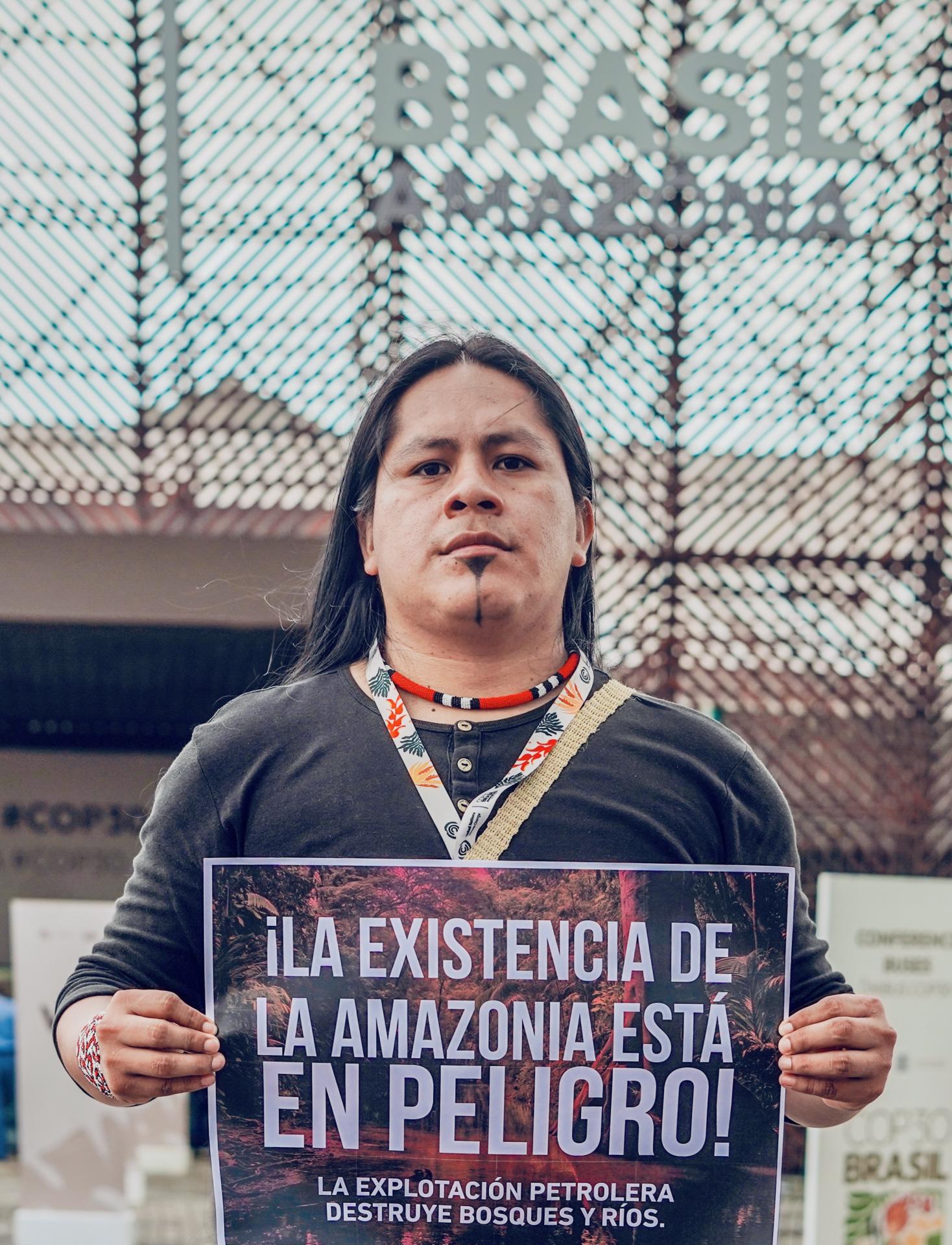
Nadino at the COP30 in Brazil (2025).
CV: How did you first connect music to your ideas about advocacy and organizing?
NC: It started with political organizations in my community, where the elders were always planning some actions; discussing and debating what this or that process should be, and how to sustain and unite the community. There was always music there in those spaces, and that really caught my attention.
I thought of using music—singing in Kichwa—as a pedagogical tool initially; something for children to be empowered, to feel proud of their language, so that they would not lose it.
CV: What’s the origin story then, of how your group Kambak came together?
NC: I had some friends in Puyo, and I said to them, "Let's make music!" So we started to work together on that. In the field of music, confidence is one of the strongest challenges for those who want to take such a difficult path. We recorded our songs with the help of a friend, Ardito Cerda, and a violinist from País Vasco in Spain, Aitziber Quintana, who’d come to Ecuador for an internship and exchange focused on education issues. Together we started to build this project little by little.
Most of our song lyrics are my creation, and the arrangements we share in common. We managed to produce our first album in 2014/ 2015 called “Kambak” for the name of the group, which means "yours" or "for you." And the concept behind our using it was that it's your language, it's your culture, it's your territory, it's your music. This is for you!
We didn't imagine that we were going to have such an impact. Between 2016 and 2022, it was Kambak everywhere! In our communities, in the cities, on buses, on radios, everywhere.
CV: How did you decide what kind of music style or genre to sing?
NC: Back then, we were witnessing our communities being invaded, you could say, by music from outside, like reggaeton. It was imposing itself at Kichwa gatherings and negatively impacting children who would sing along with its raunchy songs because the lyrics are very catchy—but these were not in line with our values. I was quite worried about this.
How should we respond, I wondered. How do we make our music enter not only community spaces, during the festivals, but also enter into the ears of el pueblo; their hearts and their minds? Earlier Kichwa music recordings had a very monotonous, very linear sound, while the popular music of today is much faster, very danceable, with highs and lows. That is why I made it a point to use both contemporary as well as traditional instruments, and to sing our songs in our language. I knew we had to adapt in some way, but without losing the essence.
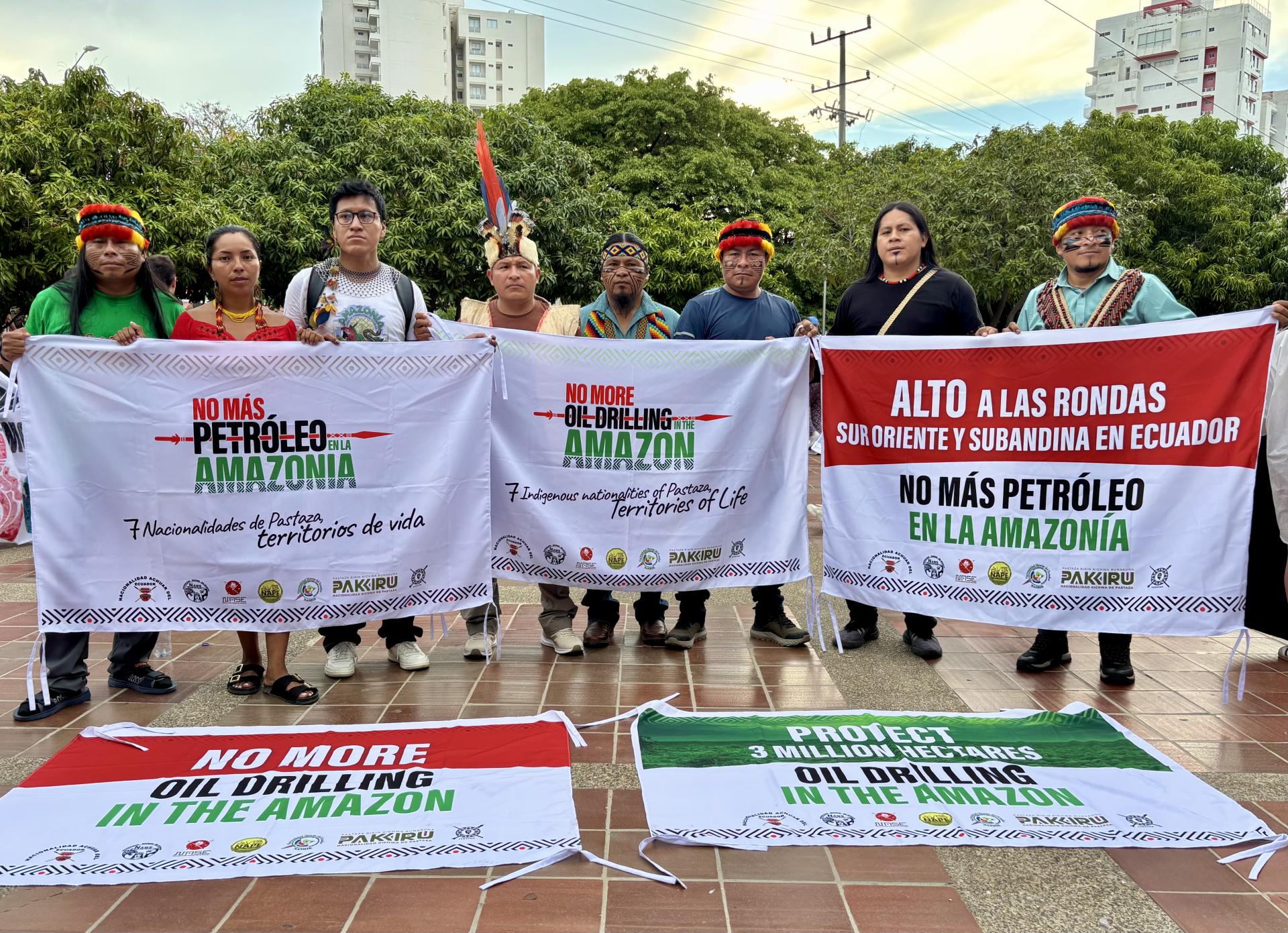
Participating in the mobilization in Santa Marta against oil company expansion in Ecuador (2026).
CV: Which song would you say made the group's first big impact?
NC: It was definitely "Sikwanka”—which means "toucan." My grandfather had told me about this bird; it lives in the heights of the Amazon rainforest and can see everything that happens below. There’s a saying that, if you want to know something, you have to go ask a sikwanka. I sing to it, saying: “Who was it that walked these territories for the first time? Who was first to cross these rivers? Who built the first houses here? It wasn't Christopher Columbus or Francisco de Orellana, no! It was us, the Indigenous peoples.” And I mention not only Kichwa, but also the Shuar, Achuar, Waorani, Sápara, Andwa, Shiwiar, Siona, Secoya, and Cofán.
So many people identified with “Sikwanka”—even Mestizos [of mixed Indigenous and European descent who are disconnected from and don’t typically identify with their Indigenous ancestral communities]. The song transcended all kinds of borders. Mothers from other cities would reach out to tell me, excitedly, that their 3-, 5-, and 7-year-old children wouldn't stop listening to it! They’d refuse to go to school or eat their soup without hearing it.
CV: Tell me about a few memorable music-related experiences you’ve had outside of Ecuador.
NC: Well, I got to sing "Sikwanka" at the Pan-Amazonian Social Forum in Belém, Brazil, back in 2008. The first demo for it was actually recorded then, six years before the album it later featured on was formally produced. Then just when the song had begun to go viral throughout the Amazonía and neighboring regions, FILAC (Indigenous Fund for Latin America and the Caribbean) launched a call for “young innovators creating positive change”—and we applied. From the hundreds of applicants, in total, our Kambak project was selected, and I was invited to Lima to receive an award. From there, in 2019, COICA (Coordinator of Indigenous Organizations of the Amazon Basin) declared me a cultural ambassador of the Amazon basin youth.
CV: How did you handle the fame that, I would imagine, came with it all?
NC: I think it was a nice stage to experience, but there were also moments that I did not like. Fame needs protocols. People in that world began to isolate me from my family, my community, and the organizational work that was important to me—in their attempts to “take care of” my image. That's one reason why I stepped back from music for a bit, to focus fully on advocacy work. It had become a constant battle between the music and my activities in political uprisings and assemblies. Meanwhile, every time I would arrive at a family gathering, they wanted me to sing, making me feel like I always had to perform. Things have finally calmed down, though, and my life is more balanced.
CV: You mentioned a demo and songs that have gone viral, and of course there are many more that you’ve performed for live audiences. How many official recordings have you produced thus far?
NC: There are two Kambak albums and several official singles. The first album is called “Muskuy” ("Dreams"), which is out on streaming platforms. Beyond "Sikwanka" that I mentioned earlier, it featured another popular song of ours, "Charapa Shunku" ("Heart of a Turtle").
On the second album, “Kawsaymanta” (“From Life”), the song I put the most heart into is “Amazonia Indomable.” It tells the story of the Amazon as it’s facing oil, mining, monocultures, and fires—yet it remains indomitable, continuing to fight. Another song I arranged is "Ama Wakanki / No Vayas a Llorar," which addresses relationships between couples, encouraging them to care for each other without violence or insults and to protect family and community harmony.
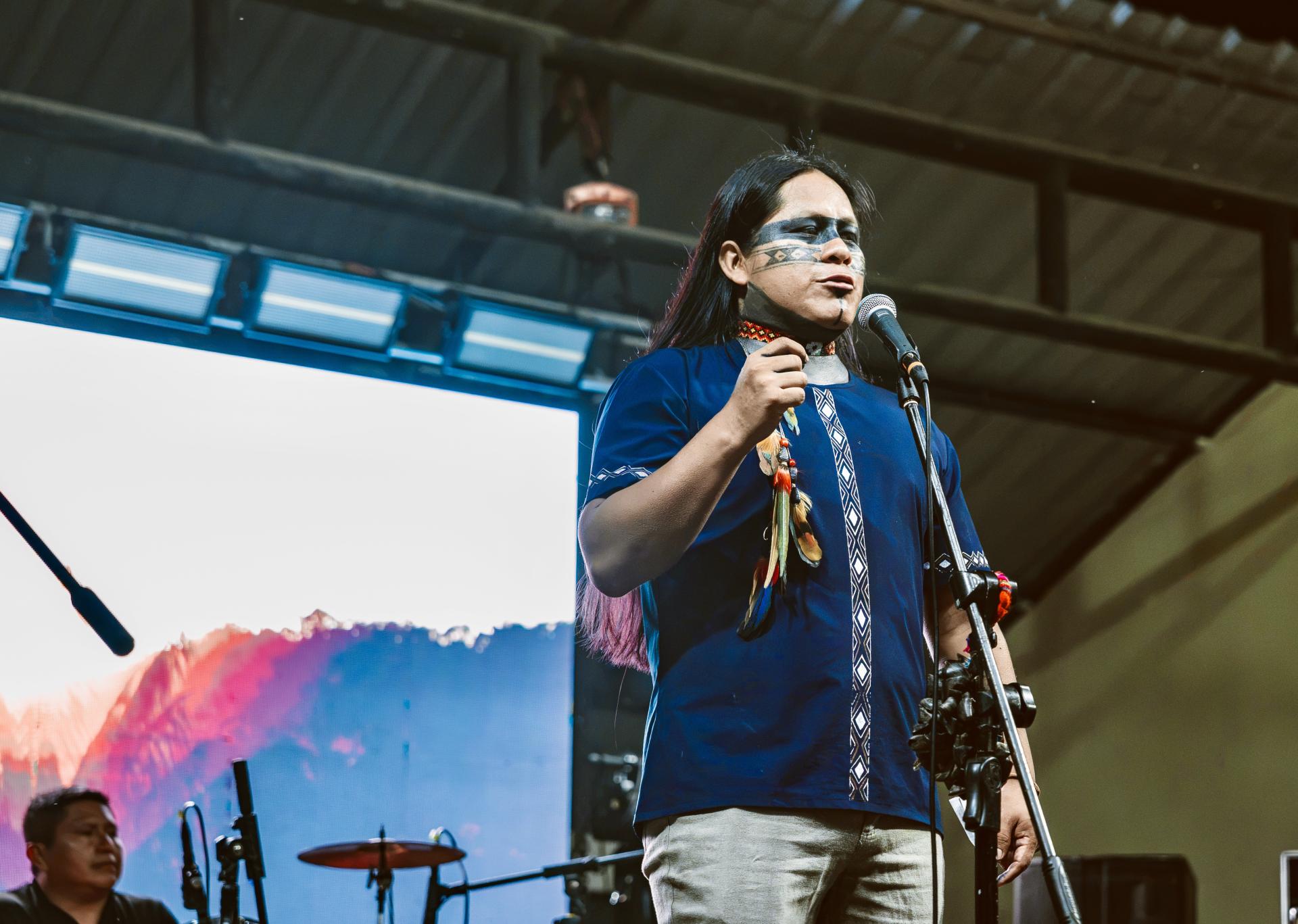
CV: Today, do you identify more as a musician, as an activist—or both?
NC: I prefer the word "defender." Whether as a musician, an educator, or a leader, I have been and will continue to be a defender for Indigenous peoples, especially in the Amazon, so long as our rights and territories remain under threat. Nowadays I almost never sing in public, and I play very rarely; usually just for myself. But the music is there permanently for everyone to enjoy, on social media, streaming platforms, and the radio.
CV: And finally, to speak of Climate Week, what were some key concerns that brought you here to New York for that this year?
NC: We’re now facing the climate emergency, and there is a lot of work to be done with regard to issues such as securing Free, Prior, and Informed Consent, direct financing mechanisms, and a just transition. So I came to New York again, representing Tu Amazonía (Your Amazon), the organization I created back in 2020, to talk not just about the defense of territory, but about the defense of its Indigenous Peoples. Yes, biodiversity matters, but the humans who protect all of it must be recognized as such. A report by the Science Panel for the Amazon (2021) has warned that the Amazon is fast approaching the tipping point where it will no longer be able to sustain itself. If we do not protect Indigenous peoples and guarantee their livelihoods, many will leave their communities or be forced to ally with illegal activities.
I also want to emphasize, always, that Indigenous Peoples are not mere "beneficiaries" of the Global North—we are allies and partners. They may have the political power, the technologies, and the financing, but it is we who have the territories and the biome that not only depend on, but are crucial to ensuring climate stability for all. We must discuss and plan for the future together.
--Cristina Verán is an international Indigenous Peoples-focused researcher, educator, advocacy strategist, network weaver, curator, and mediamaker. She was a founding member of the United Nations Indigenous Media Network and the UN Indigenous Language Caucus. As Adjunct Faculty at New York University’s Tisch School of the Arts and Affiliate Faculty of the NYU Center for Latin American and Caribbean Studies, she brings emphasis to the global histories, expressions, and socio-political impacts of Indigenous contemporary visual and performing arts, design, creative tech, media, and popular culture(s).
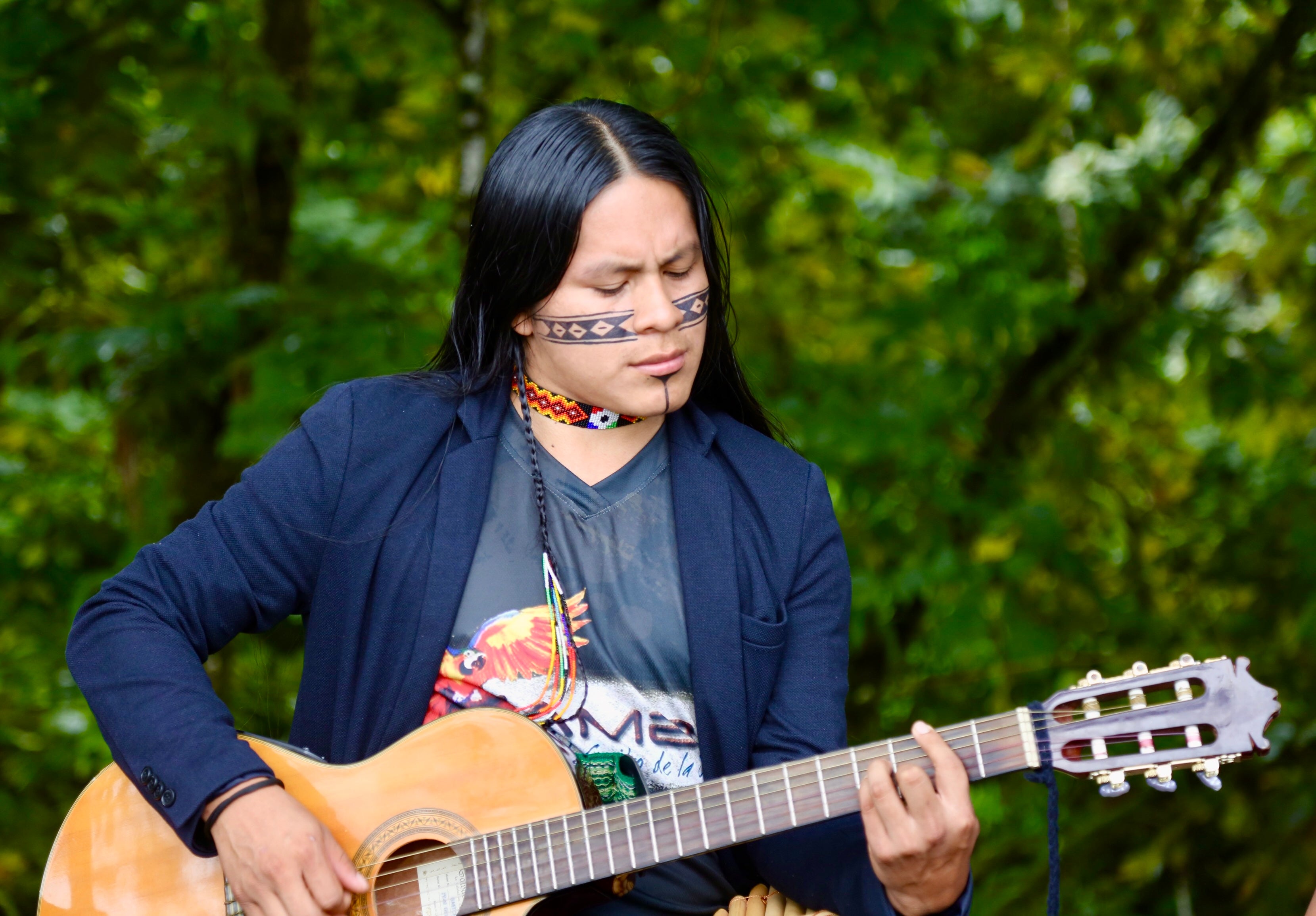
Top photo: Performing in Puyo, capital of the Amazon province of Pastazo in Ecuador (2017).
All photos courtesy of Nandino Calapucha.