Indigenous Peoples in Canada, through diverse ways of organizing—whether traditional and hereditary Chiefs, Chiefs and Councils, or collectives and organizations—have a clear direction at the core of their existence: the protection and continuous relations with Mother Earth and all beings on the land for generations to come. “For us, knowing the land, knowing the plants and animals, knowing the health of the territory, conducting collective decision-making about how something is going to be impacted by the decisions that you are making—this is why our Peoples have been doing it for thousands of years,” says land defender Molly Wickham (Wet’suwet’en).
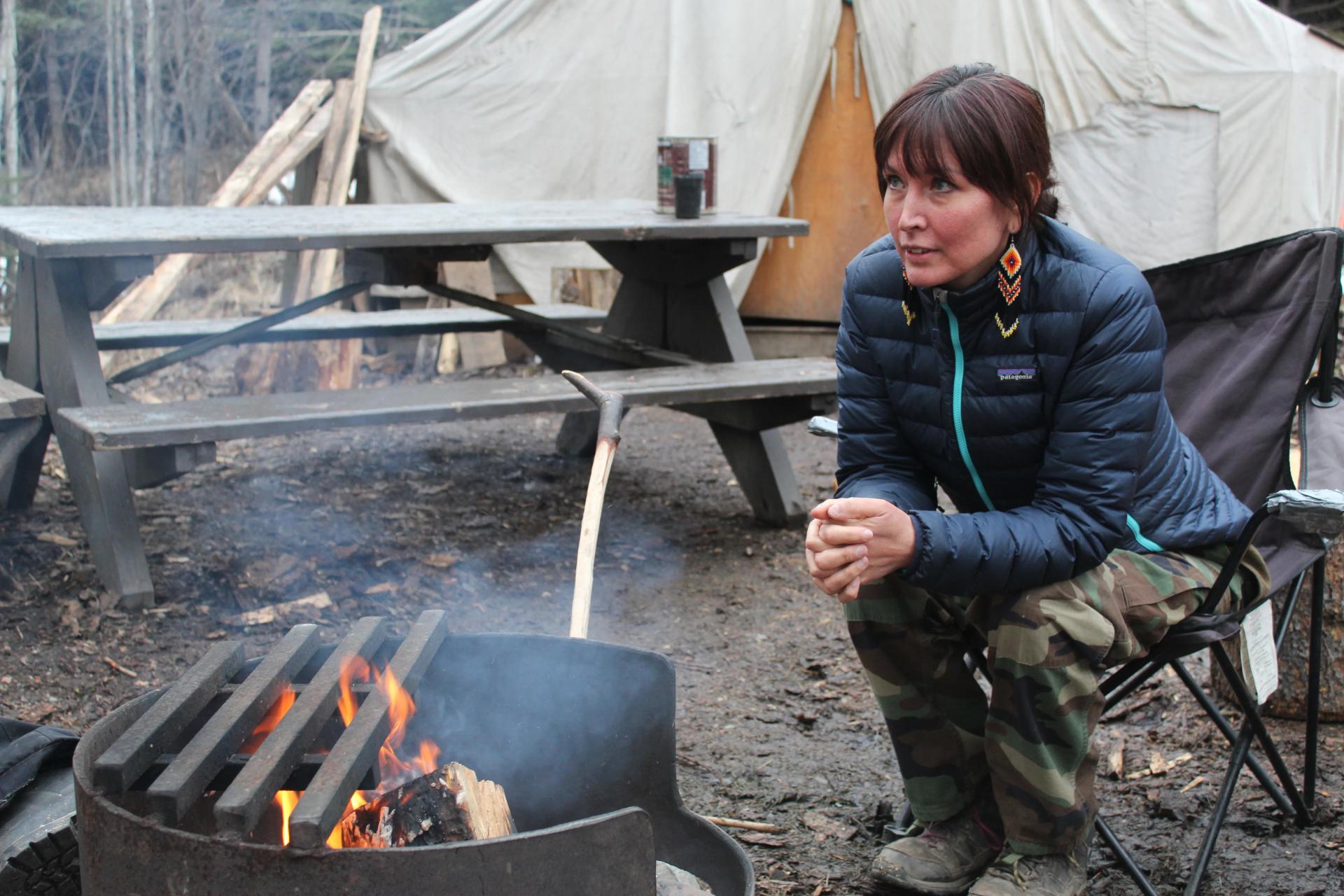
Sleydo’ (Molly Wickman) at a campfire at Gidimt’en camp, British Columbia, Canada. Photo by Brandi Morin.
A significant part of Indigenous identity stems from the fact that Indigenous Peoples live in relationship to the land. We are the Nations of the world that did not lose our earth-based spirituality, cosmovisions, and ways of life dependent on the land. Even when Indigenous communities were colonized by a religious order, we kept some of our traditional practices in parallel to those religions. Most First Nations continue to obtain their food from the land through hunting, fishing, and foraging.
“It is our responsibility to take care of the land, and the land will take care of us,” explains Freda Huson (Wet’suwet’en), also a land defender. “Annually, we use the harvest as part of our governance; we give it away in our feasts. We hunt moose and deer, and we preserve them. We depend on the land for a food source. That is why we fight so hard to keep it intact—so that we can continue to teach the next generation how to live off the land.”
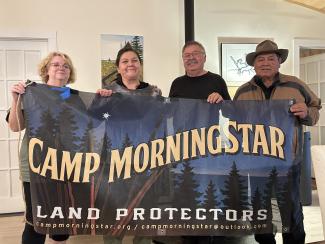
This sense of responsibility is why Indigenous Peoples in Canada continue to oppose and resist major developments in their territories. They know how such projects will negatively impact the land, the animals, their own communities, and the entire ecosystem. In the last decade, Canada has seen ongoing resistance from Indigenous communities to large-scale resource extraction. The Wet’suwet’en Peoples’ resistance against a pipeline in northern British Columbia in 2018 and against sand extraction at Camp Morningstar near Winnipeg Lake in 2021 are only two examples. This resistance is usually met with repression and violence, rather than dialogue and protocols to address Indigenous inherent rights issues.
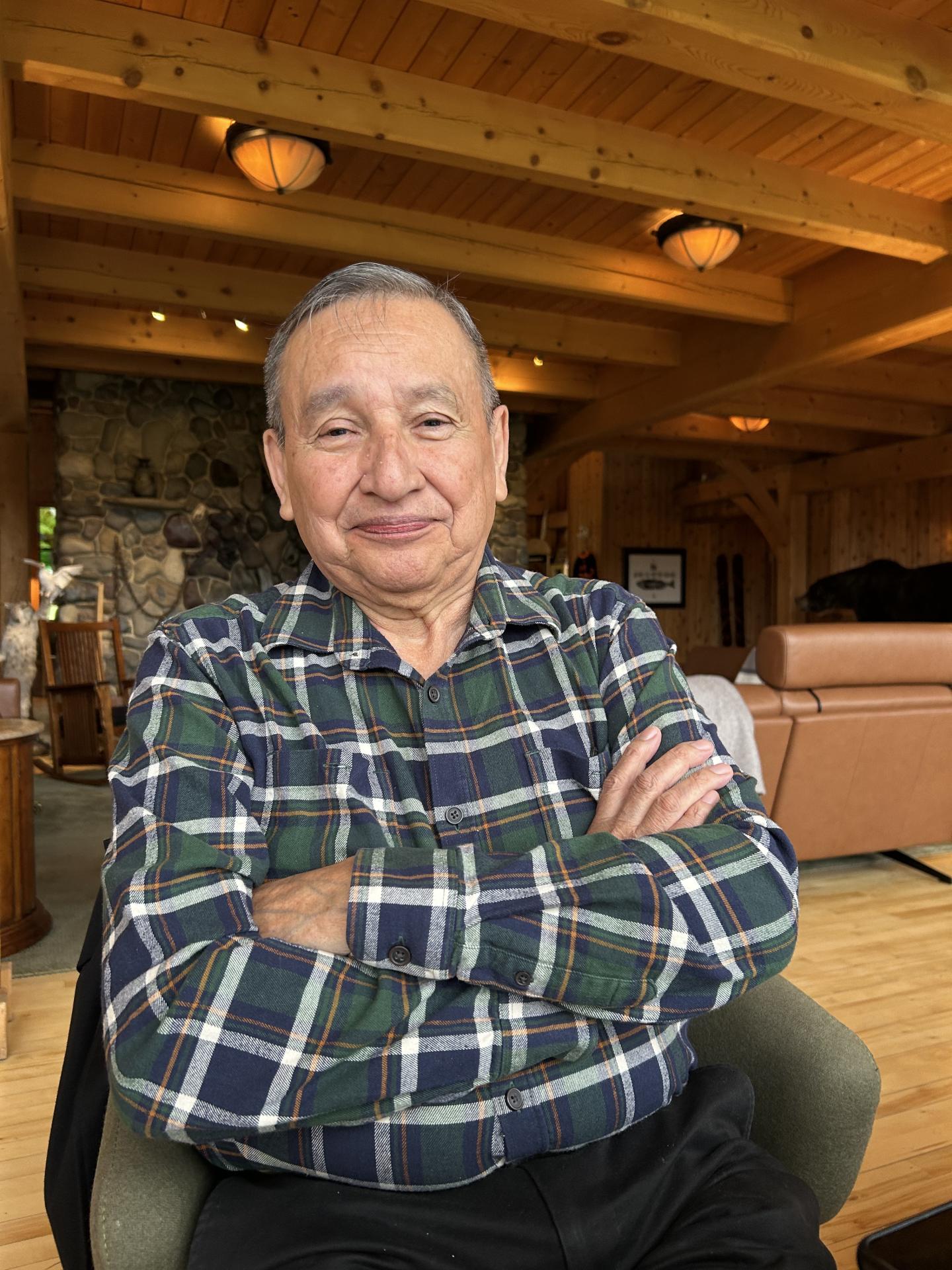
Grand Chief Steward Phillip, Union of British Columbia Indian Chiefs.
Grand Chief Steward Phillip (Syilx Nation) of the Union of British Columbia Indian Chiefs describes some of the violence. “The Canadian government used the [Royal Canadian Mounted Police]. It was a paramilitary enforcement regime. It was impossible to differentiate the RCMP from the military because they used assault weapons, drones, and helicopters. People were arrested, injured, and there are still court cases about that abuse of power. That is the dynamic of colonialism and neocolonialism. It continues to be the same for many Indigenous Peoples around the world, where there is more brutality than before when Indigenous Peoples oppose hydroelectric dams, mining, and other extractive industries. This dynamic has not changed for hundreds of years,” he says.
There is also the misuse of the justice system to criminalize Indigenous defenders. Amnesty International declared Chief Dsta’hyl, a Wet’suwet’en leader and defender, a prisoner of conscience in 2024 after he was sentenced to 60 days of house arrest for resisting the Coastal GasLink pipeline on his territory. This is the first time Amnesty International has given this designation in Canada, indicating that the right to Free, Prior and Informed Consent was not upheld by British Columbia or Canada.
The Assembly of First Nations, a national organization representing 634 Chiefs and their communities across Canada, is currently opposing Prime Minister Mark Carney and the Liberal government’s plans to fast-forward the approvals of major development projects affecting the environment and Canada’s Indigenous Peoples without proper consultation. The right to Free, Prior and Informed Consent is enshrined in the United Nations Declaration on the Rights of Indigenous Peoples, an international set of standards that Canada accepted and ratified in 2021. In addition to the Declaration, Section 35 of the Canadian Constitution affirms Aboriginal and Treaty rights for Indigenous Peoples, indicating that Canada has a legal obligation to respect First Nations, Inuit, and Métis land rights, self-determination, and self-governance.
First Nations, Métis, and Inuit Peoples are the original occupants of what is now known as Canada. From the moment of colonial contact in the 1500s, the British and French governments entered into treaties as sovereign Nations and recognized Tribes as self-determined Nations. The British and the French who came to these territories saw Indigenous Peoples as enemies who could kill them or prevent them from settling in these lands peacefully. The Crown, through its representatives, and Indigenous Peoples, through their traditional leaders, sat together to negotiate and sign treaties. Many First Nations in Canada did not sign treaties, and therefore have not surrendered rights to their land and self-determination. These lands are known as unceded territories.
In our current moment of history, Canadians need to see that at the point of contact with the Indigenous world, the colonizers treated Indigenous Peoples and Nations as equals. They knew that the so-called democracies that they proclaimed would not be fulfilled unless Indigenous Peoples were part of the decision-making powers. Today, Canada doesn’t regard Indigenous Peoples and their governments as equals. “The Canadian government wants Indigenous Peoples to be a delegation of their power, like a municipality,” Grand Chief Phillip says. “And [that] doesn’t come close to the sovereign political rights they deserve as the First Peoples of Canada.”
Among the most important rights that Indigenous Peoples in Canada are asserting is the right to self-determination and self-government, as written in Articles 3 and 4 of the Declaration. Article 3 refers to the right of a People to determine their political status and to be the decision-makers in their economic, social, and cultural development. The right to self-government (Article 4) refers to First Nations having their own governance structures, in accordance with their cultures and traditions.
“Self-government is based on Indigenous history, traditional laws, and cultural values in taking care of the land and people. There are groups that are incredibly powerful in terms of their culture, language, traditions, and governance. They are directed by Elders, knowledge keepers, and people who actually depend on the land for sustenance and as part of their cultural heritage. They have their own decision-making mechanisms, and everything is done according to Indigenous law and ceremony,” Grand Chief Phillip explains.
In Canada, most of the current Indigenous governance systems were imposed by the Indian Act, commonly known as the Chief and Council system, which follows Canadian government rules. However, there are also hereditary and traditional governance systems that survived colonization. These systems do not involve monetary compensation, as they are based on service and follow the cultural laws of those Peoples. Traditional leadership is an expected and recognized role in the community. While traditional and hereditary governance systems exist in many Indigenous communities, they are not recognized by the Canadian government when federal and provincial economic and political interests have priority.
Recent legislation, such as Federal Bill C5, Ontario Bill 5, and British Columbia Bill 14, which allow the federal and provincial levels of government to expedite large development projects, will bring another wave of large-scale resource extraction across the country without proper consultation, consent, or adequate participation from Indigenous Peoples. One option is to continue labeling Indigenous Peoples who resist these projects in defense of the land as being against the country’s prosperity; to continue violently persecuting them while also creating an image of an anti-democratic government that misuses power and loses significant money in the process.
A better option is to act in historical justice and involve Indigenous Peoples and their governments, including traditional forms of governance, as equal partners at the federal and provincial levels in decision-making about the future of Canada. Such a change will benefit all Canadians by bringing leadership to the table that aims to balance prosperity with the sustainability of natural resources for generations to come.
Avexnim Coiti Ren (Maya K’iche’) is Cultural Survival Director of Programs.
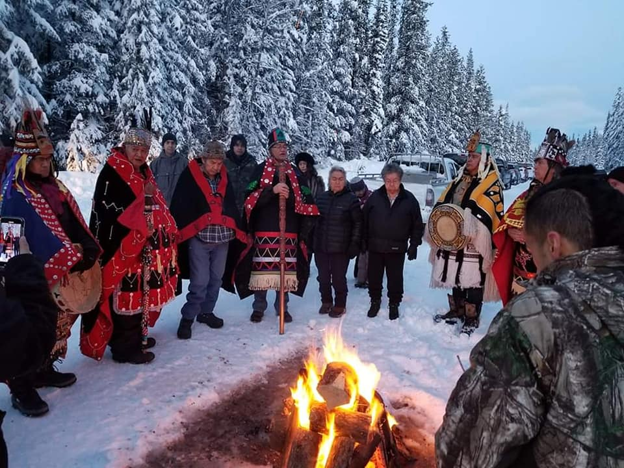
Top photo: Members of Camp Morning Star, Winnipeg Lake, Manitoba, Canada.