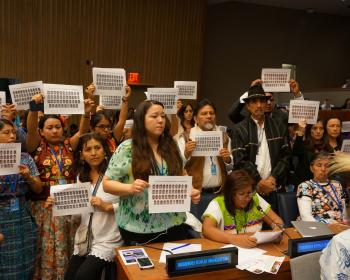

Photos by Vera Narvaez.
By Agnes Portalewska
May 12, 2015
Proud to Be Indigenous Week starts Monday, April 20. Are you part of it yet?!
On January 19 – 30, 2015, the 21st session of the Universal Periodic Review (UPR) took place and included the review of Kenya, Lao People’s Democratic Republic, and Guyana by the UN Human Rights Council. Several areas related to Indigenous Peoples were addressed.
By Madeline McGill
From March 9 to 20, 2015, thousands of women will be meeting in New York City for the Commission on the Status of Women (CSW59) at the United Nations. Representatives of Member States, UN entities, and non-governmental organizations will be gathering to evaluate the progress in the implementation of the Beijing Declaration and Platform for Action, which was originally adopted 20 years ago in 1995.

Land Acknowledgement
We acknowledge that we are headquartered on Massachusett land, in Cambridge, MA, and we thank the past, current, and future Indigenous stewards of this territory.