
Despite centuries of colonial assimilationist policies, self-governance among Indigenous Peoples is a living history that continues to unfold. And while Indigenous Peoples around the world have diverse mechanisms for self-governance, they all share the fundamental principles of an inseparable link among community, culture, and territory, as well as a collective vision of life and the exercise of power. For many Peoples this does not begin with the law, but with memory, daily practice, and the continuity of their own ways of organizing life.
Self-determination is not a permission granted by the State. It is the recognition of a collective right that existed long before it was codified. Autonomy is expressed through practices passed down from generation to generation—most often orally—where dialogue, reconciliation, and communal life are real ways of making and implementing decisions. To govern is to care for collective life, the relationship with the territory, community safety, and the exercise of power.
Colonizer nation States attempted to erase Indigenous Peoples’ organizational structures in favor of a homogenized identity, language, and way of living. They did not succeed in complete erasure, however. In various communities across Abya Yala, the assembly remains the space where ideas circulate and decisions are made collectively. Within it, leaders are not chosen based on popularity or purchasing power, but on their track record of service to the community. Assuming a community position entails a permanent responsibility and the obligation to be accountable to the people. Likewise, in many Indigenous communities, models of self-governance include a Council of wise people or Elders, whose role is to guide and support younger generations. This role is not acquired solely by reaching a certain age. It is based on the community’s recognition, a proven track record of service, and a life experience.
Political life among Indigenous Peoples cannot be understood in isolation from territory. The care of resources, community spaces, and sacred sites is part of the very logic of governance. Justice, too, is understood from a different perspective; it is grounded in dialogue, reconciliation, and reparations. These forms of conflict resolution stand in stark contrast to colonial imperialist models that are based on punishing individuals.
The coexistence of Indigenous governance systems and State structures has not been easy. Indigenous Peoples continue to operate within legal and administrative frameworks that employ complex legal and technical language and are enforced in a non-Indigenous language. When self-governance is recognized, it is typically in a partial and conditional manner. Indigenous authorities can exercise specific functions, though always within structures they do not fully control. These spaces, while important, do not equate to full autonomy. When Indigenous Peoples receive resources allocated by the State to carry out their functions, it further exacerbates the unequal power dynamic by creating mechanisms of dependency.
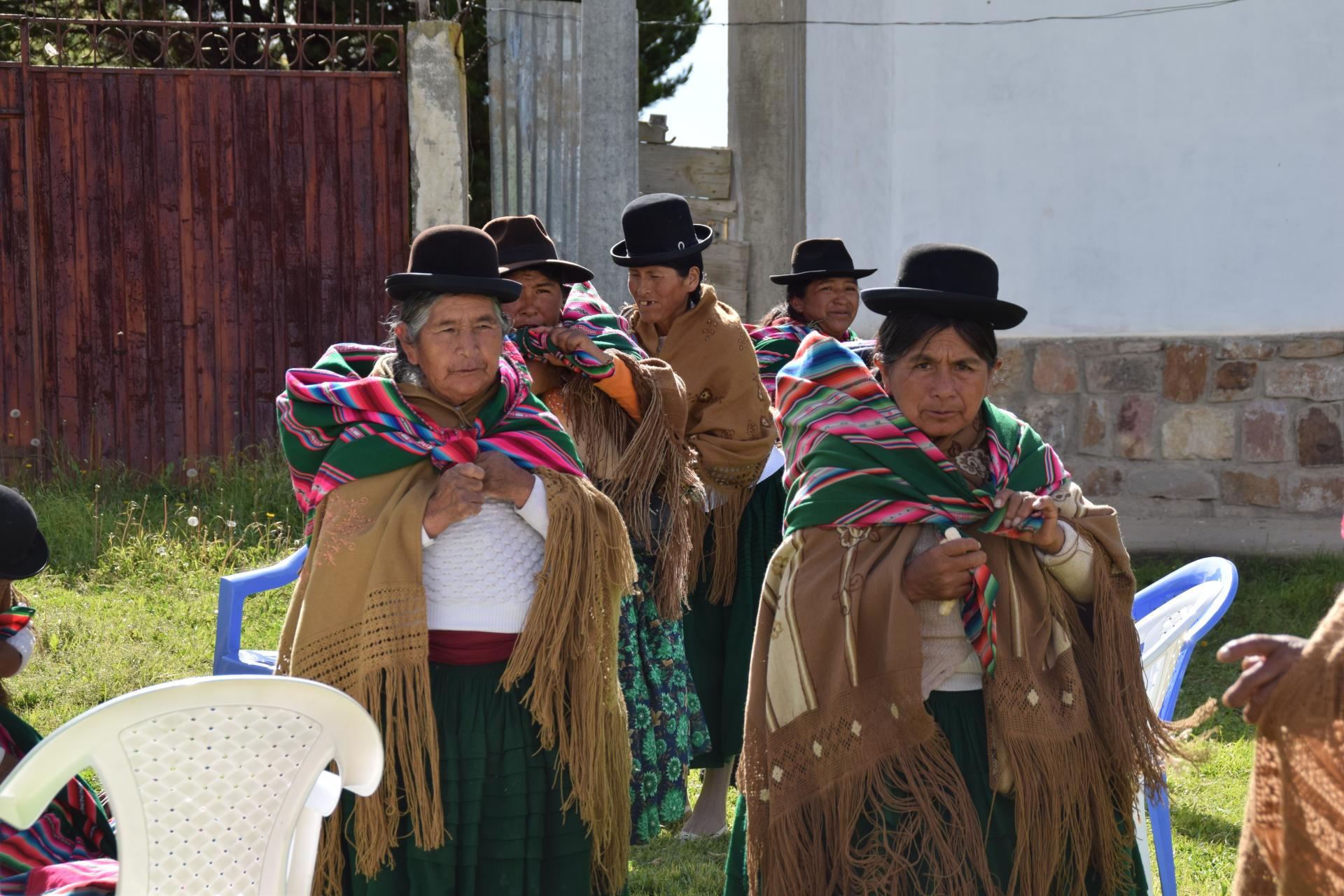
Aymara women leaving the House of Justice after a gathering of community authorities in Chiripaca, Bolivia. Photo by Elvia Rodríguez.
For a long time, States used categories such as “customs and traditions,” “local customs,” and “local practices” to refer to systems of Indigenous self-governance, thereby simplifying and diminishing them. Naming is not a neutral act: to name is to decide what is validated and what is left out. In response, Indigenous Peoples have insisted on affirming their forms of organization as their own systems of government—not only to be recognized, but also to reclaim the place that historically has been denied to them within the State.
Although recognition of Indigenous self-governance has been gaining ground, putting it into practice remains fraught with obstacles. Policies aimed at Indigenous Peoples continue to be designed from a welfare-oriented and paternalistic perspective, focused more on meeting quotas than on responding to their realities, needs, and unique forms of organization, and ignoring community dynamics.
All too often, the demands of Indigenous Peoples are downplayed or distorted. The case of the Māori illustrates this clearly. Their proposals for co-governance, aimed at building shared decision-making, have been labeled by some as “Māori privilege” or “ethnic elitism,” highlighting how recognition becomes contentious when it involves redistributing power.
Another challenge is the inclusion of women in local governance. Attempts to increase their participation often fail to account for the burdens they already bear. Women take on community roles while simultaneously shouldering household responsibilities, doubling or tripling their workloads. For this, they are often questioned or discredited, even subjected to violence, based on patriarchal arguments rooted in exclusion.
State policies have exacerbated these inequalities by failing to address the barriers women face or provide real support, shifting more responsibilities onto them without changing the underlying conditions. At the same time, Indigenous territories face the growing pressures of mining, monoculture farming, water and land grabbing, real estate developments, and tourism, leading to intensified conflicts, dispossession, criminalization, and heightened risks for those community defenders.
In this context, political participation within State institutions remains limited. Even where progress has been made, such as the parliamentary representation of Māori, a fundamental question remains: to what extent does presence in these spaces translate into real participation in decision-making? Simply being present does not guarantee having an impact.
The distribution of public resources has also introduced new tensions within Indigenous communities. Access to funding through government programs can generate disputes over their administration and control. In some cases, it has fostered internal divisions and corruption, consequently weakening the community fabric and complicating self-governance processes.
Continuity of Indigenous Self-Governance
Indigenous self-governance is not a thing of the past. It can be seen in the daily lives of various Peoples, who, despite changes and external pressures, have managed to maintain and adapt their own forms of organization within contemporary States. For them, autonomy is not an abstract idea; it is a living practice, built day by day.
In Mexico, this continuity is evident in numerous regions. Data from the Oaxaca State Electoral and Citizen Participation Institute shows that 417 of its 570 municipalities are governed by Indigenous regulatory systems. More than just a statistic, this reflects the persistence of communal forms of government that continue to organize political life according to Indigenous Peoples’ own principles.
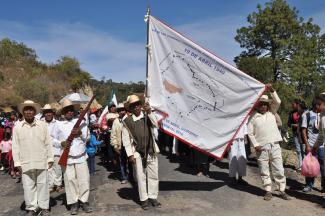
In the Ñuu Savi communities, for example, the assembly remains the space where ideas are exchanged, and decisions are made collectively. There, leaders are elected, paths forward are agreed upon, and forms of accountability are established. Those who assume office are appointed based on the experience they have accumulated within community life and on the service records they have built as community members. These positions are, for the most part, unpaid, reinforcing the idea that authority is a responsibility assumed for the benefit of the people. Communal property authorities, whether agrarian or territorial administrators, demonstrate how governance and territory are deeply intertwined, particularly in the stewardship and administration of collective resources.
For the Sámi Peoples in northern Europe, institutions such as the Sámi parliaments established in Norway, Sweden, and Finland have successfully created spaces for representation and dialogue with the respective States from which they participate in decisions related to their rights, cultures, and territories. These mechanisms have enabled progress toward forms of intercultural governance that incorporate Indigenous perspectives into State structures that had historically excluded them.
These advances, while largely positive, also have their limits. The existence of parliaments does not imply a full transfer of power, and fundamental decisions regarding legislation or territorial management remain concentrated in the hands of the States. Even so, the Sámi experience highlights the importance of building spaces for dialogue and addressing the consequences of historical assimilation policies through truth and reconciliation processes.
The cases of the Ñuu Savi, Sámi, and Māori Peoples are not isolated experiences, and demonstrate forms of governance that have persisted through their ability to adapt. Their paths have also been marked by resistance, mobilizations, and, in some cases, armed struggles that have resulted in loss of life. Faced with exclusion and dispossession, these Peoples have chosen to raise their voices and defend their rights rather than disappear in silence.
Fully recognizing Indigenous Peoples entails more than creating international mechanisms and amending local laws. It requires transforming the way we understand power, territory, and life in community. In doing so, it opens the possibility of building communities where difference is not a cause for exclusion, but the foundation for a shared future.
Elvia Rodríguez (Ñ’a Ñuu Savi, Ñuu Yuku Tuyuja) Is Cultural Survival Community Media Assistant.
Main photo: Ñuu Savi Peoples and Agrarian Authorities take part in a parade in Santo Tomas Ocotepec, Oaxaca, Mexico, commemorating the autonomy of their communal territory. Photo by Prócoro Rodríguez.
