By Timas Letitia Petersen (KhoeSan)
The Khoe and San communities are the oldest people in the world. It has been scientifically proven that our way of life, culture, ancient click languages, rock paintings and engravings, as well as archaeological and DNA evidence, date back thousands of years.
Our DNA belongs to the L0 Khoisan haplogroup, the world's most ancient people, dating back more than 200,000 years. It means that KhoeSan communities of South and southern Africa are the originators of mankind. We gave Africa and the world its gene pool. The Khoe and San communities are the first inhabitants of South and southern Africa. Our ancestors have been found in South and southern Africa since the beginning of humankind.
Our ancient click languages like IXam, INuu, !Xuntali, and Namagowab are scientifically dated to be more than 30,000 years old, making them the oldest and most complex languages on Earth. Yet none of our KhoeSan ancient click languages are recognized as official languages in South Africa or being taught in mainstream schools.
The South African coat of arms motto is in the ancient click lXam language. The motto reads: “!Ke e llxara llke,” meaning “Unity in Diversity,” or literally, “People, different come together.” This appropriation is a deliberate act of the government to erase KhoeSan communities and our ancient click languages, land, and identity. They are implementing similar strategies to those of the previous apartheid government, as well as the colonizers. Most of the KhoeSan communities were, and are still, classified as “Coloured,” a classification associated with apartheid.
Words have power. They create how we see ourselves, how others see us, and how history remembers us. We are the creators of the first fire and first civilizations. The term “Coloured” was imposed by the colonizers on the KhoeSan communities, intentionally used as an instrument of erasure. Before KhoeSan communities were forcibly given this classification, our Aboxan (ancestors) were called Auten(tu). The word was corrupted to “Hottentot,” which means “Ancients.” The classification “Coloured” was a deliberate strategy by the British and apartheid governments to declare KhoeSan communities as nothing and to sever us from identity, language, culture, resources, and land.
There were also similar strategies done in other parts of the world to declare the original inhabitants as “Coloured.” Aboriginal Australians were labeled “Coloured” in the 1800s, as were the Cherokee Indians of Carol County in the United States.
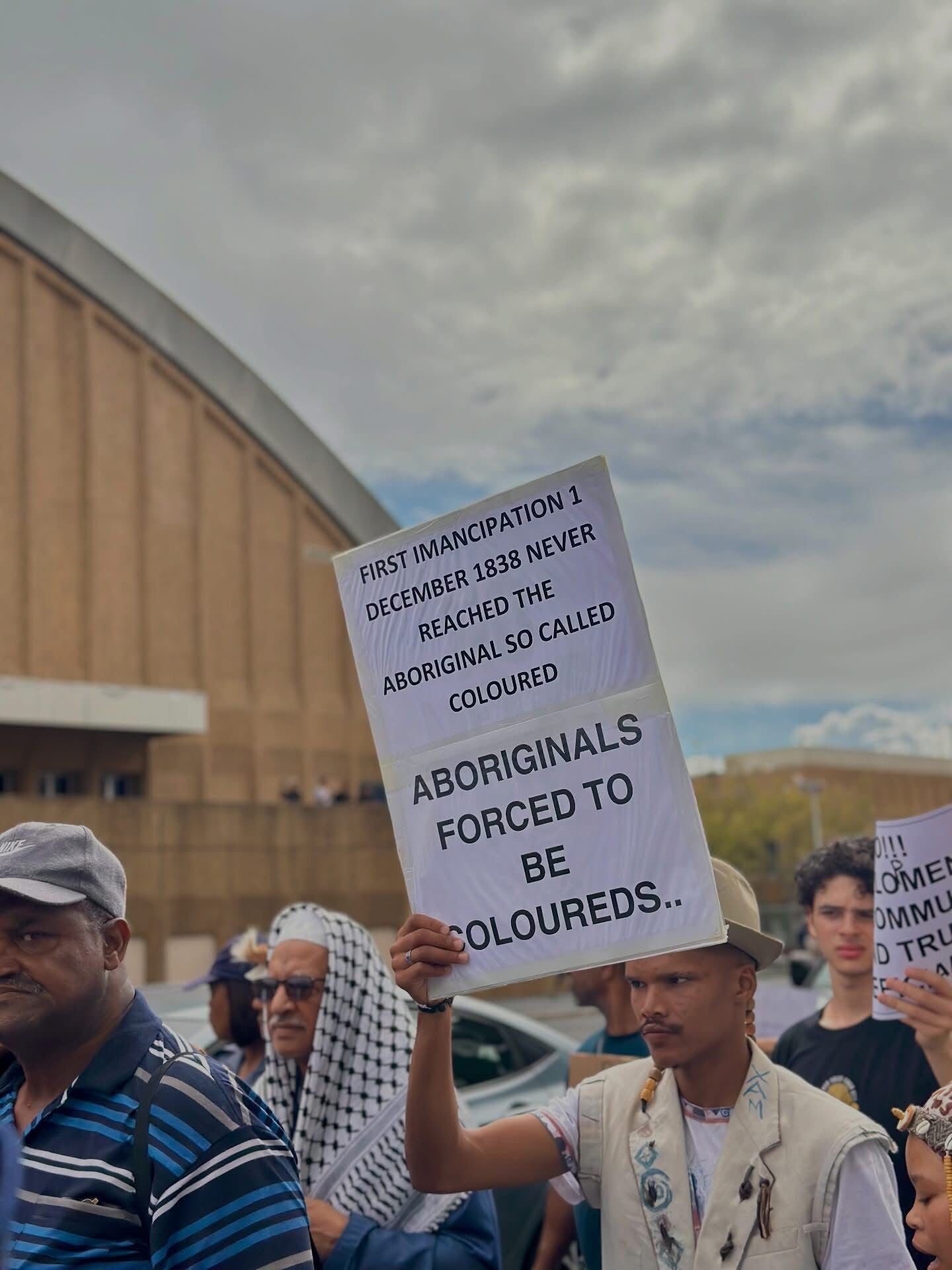
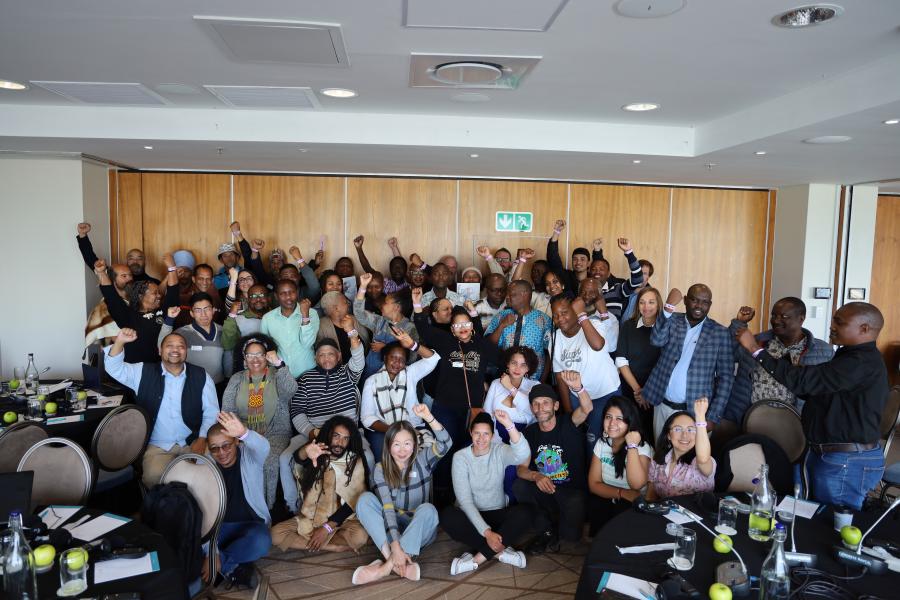
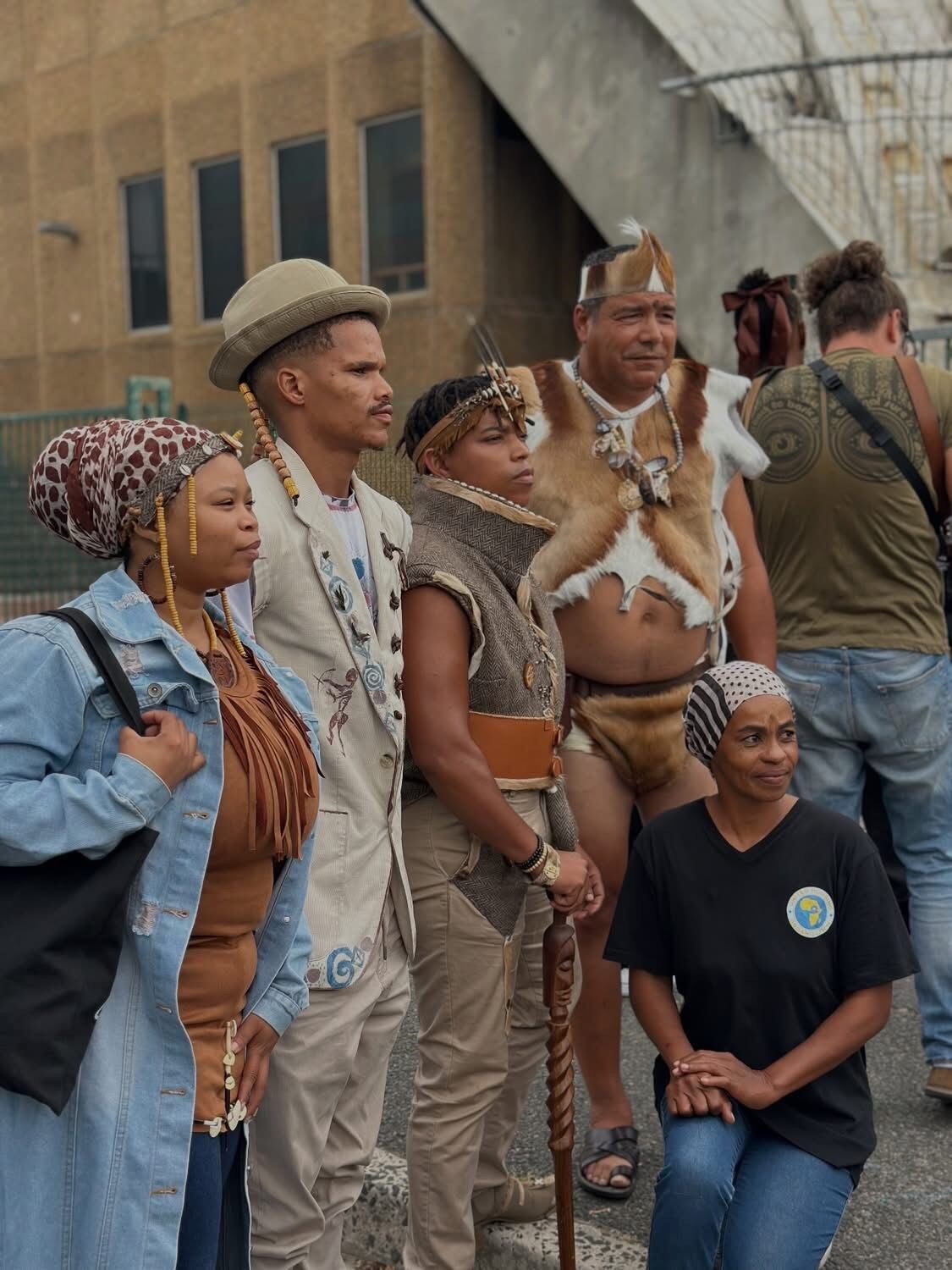
Protest that took place on the 24th of February 2026, in Cape Town (//Hûi!gaeb), where KhoiSan communities gathered to protest against the Cape Town Democratic Alliance-run municipality, which wanted to sell 50 pockets of land without the KhoiSan communities' consent or consulting with them.
The South African Human Rights report has highlighted that KhoeSan communities face severe, ongoing human rights violations, including a lack of formal recognition, land dispossession, and poor access to basic services. A 2018 report by the South African Human Rights Commission found a decline in our KhoeSan cultures and languages and called for stronger constitutional protection and government support. One specific recommendation was that the forced classification of KhoeSan as “Coloured” should be stopped. As of 2026, none of the recommendations have been implemented.
Our ancient rock art, engravings, and other forms of communication are carbon dated to more than 60,000 years old, indicating a complex society. They predate the hieroglyphics of Egypt, which are about 6,000 years old. Yet we are still being marginalized and victimized in South Africa, despite our resilience and determination to survive as groupings or Nations with distinct cultures, languages, morals, and ways of life.
The continued survival of many of our groupings and Nations remains at risk, as they continue to face daily challenges and rights violations. In the San communities, there are distinct groupings like #Khomani, lXam, Haillom, Khwe, !Xuhn, Nharo, and !Xoo. Each group has its culture, ancient click language, and way of life.
The San used to be recognized for their hunter-gatherer lifestyle, but their hunting grounds have been encroached upon, putting their way of life in critical danger. Khoe Nations are mainly Nama, Damara, Griqua, !Ora (Korana), and Cape Khoe groupings (Hessequa, Goringhaikona, Attaqua, Inqua, Hancumqua). Traditionally they have kept livestock and had trading routes. Today, most have been dispossessed and live in townships.
The Khoe and San groupings originate from one common ancestor. The Khoe groupings were hunter-gatherers, but later acquired livestock and traded. The term “KhoiSan” was coined by a German named Schultze in 1928. It is an artificial word used for convenience, a way for linguists and the government of South Africa to lump together distinct Nations like Nama !Ora (Korana), Khwe, !Xun, and #Khomani.
The different Khoe and San groupings were not sitting ducks, as the colonizers and history writers tend to portray to advance their false narratives. They were fierce warriors who resisted for their land for more than 300 years. The Khoe and San groupings were the most resistant to colonizers across Africa. They fought in more than 14 wars of resistance and numerous battles against the Portuguese, Dutch, British, and Germans. The last wars our Aboxan fought were the Namakho-e-German wars in 1904-1908.
The KhoeSan groupings were traders for thousands of years and traded with the Chinese, Phoenicians, Indians, and Egyptians thousands of years before they traded with the English, Portuguese, Dutch, and French. Chinese traders recorded trading with Khoe traders in the 11th century.
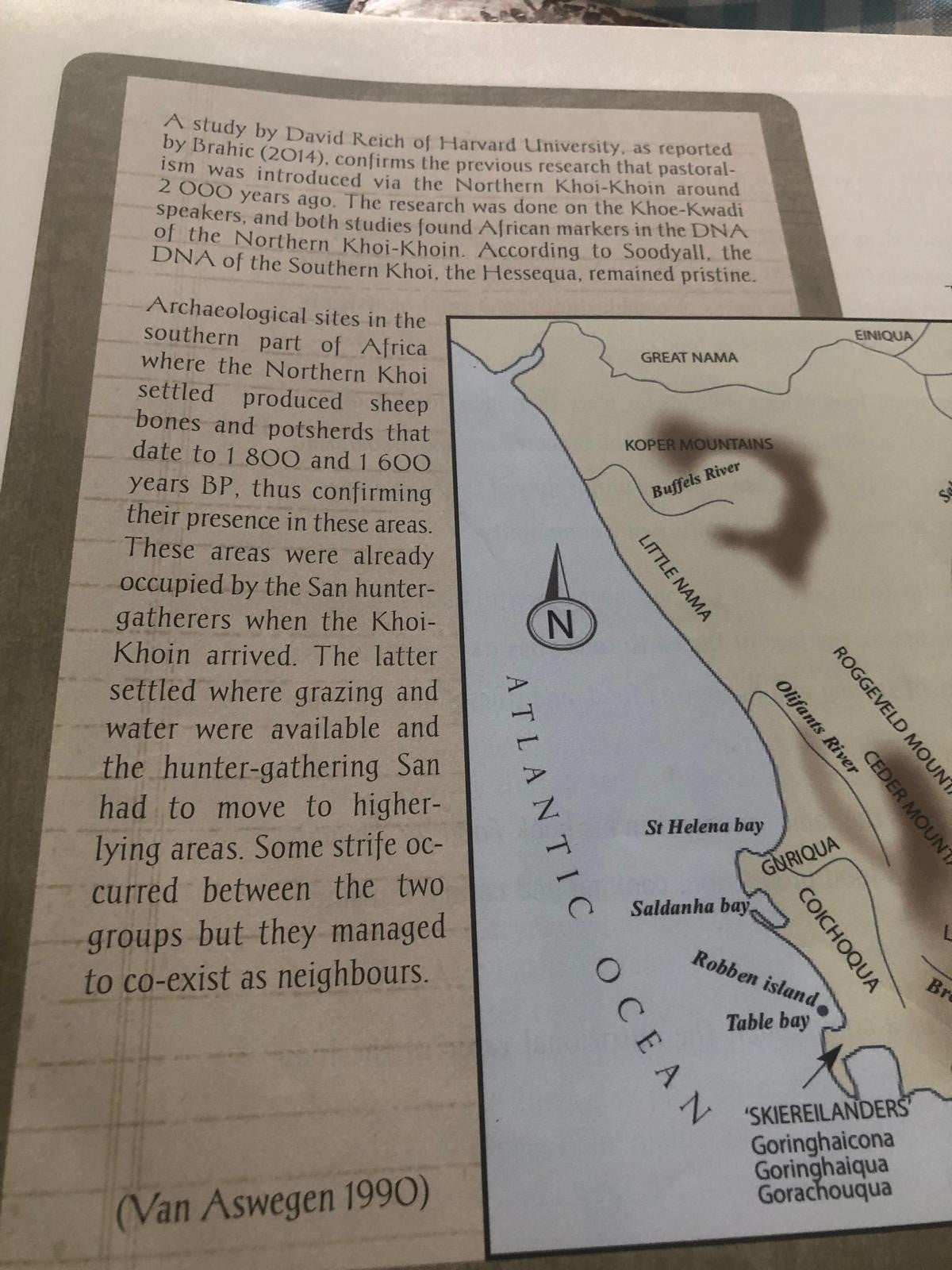
Map depicts the different Khoe and San groupings in the 1700s in the Cape area. The Roggeveldt are where the Dutch- Bushman War took place.
A Synopsized Timeline of Colonizer Contact
In 1448, Portuguese explorer Bartholomeus Diaz circumvented Africa and arrived at the Cape (llHûi!Gaeb) and found Khoe-khoe groupings. On March 1, 1510, the viceroy of the Portuguese State of India, Francisco de Almeida, docked at llHûi!Gaeb and wanted to negotiate with the Goringhaikona Khoe. After the negotiations failed, they attempted to steal Khoe women, children, and livestock. But the Khoe men retaliated using their livestock as shields and killed 150 Portuguese men, including de Almeida.
At the head of the thriving Khoe trading in the 1620s stood Gaob (King) Kx’aothumathub, also known as Autshumato, a rich Khoe merchant and King of the Gorihailona Khoe people. The Dutch called him “Harry de Strandloper,” meaning “Harry the Beachcomber.” Ship crews came ashore and traded with Autshumato, exchanging goods for fresh water, salt, fruit, root vegetables, livestock, meat, and minerals.
By 1630, a British ship took Autshumato to the East Indies where he stayed for a year and learned to speak English and Dutch, along with British trading practices. In 1632, Britain returned Autshumato to llHûi!gaeb in an attempt to open communication and trade with the Khoe People. Autshumato traded with the Portuguese, English, Dutch, and French and could speak their languages. He was also used as an interpreter between the Khoe Nations and the Dutch, French, Portuguese, and English.
Between 1600 and 1652, more than a thousand ships were recorded to have docked at llHûi!gaeb for trade. Contrary to the colonizers’ lie that the Khoe were savages, our ancestors were in fact prosperous. They were rich kings, queens, traders, and merchants leading a sophisticated trade route spanning the entire continent of Africa.
In 1643, Jan Van Riebeeck was exiled to llHûi!Gaeb as a prisoner. History was distorted to advance the colonists' narrative that Van Riebeeck first visited the Cape in 1652, when it already had a thriving trade operation. This means that Van Riebeeck already knew the layout of llHûi!gaeb and had an advantage stemming from his previous exile there. The Dutch had a disagreement with Autshumato, who wanted more money for the ships to dock at the Cape, and the Dutch refused. They then retaliated, arriving in 1652 with the military, merchants, and warship fleets under Van Riebeeck.
The first land grants were made to settlers in the Cape in 1654, who were allowed to carve their own land. One Khoe group, the Cochoqua, refused to accept the Dutch attempt to control their land and continued to graze across the East India Company-controlled gardens. Captured Khoe would be held prisoner for digging for silver and catching seals.
In 1658, Van Riebeeck took Autshumato hostage, seizing his cattle and imprisoning him on or !Homgu !na !nuib (Robben Island), which, ironically, was also one of Autshumato’s trading posts. The following year, the first Khoekhoen-Dutch War broke out over the loss of grazing land by the Khoekhoen. The war ended on April 6, 1659 with a “peace” agreement. The Dutch told the Khoekhoen, “People have once and for all lost the land around the Cape through war and... must accordingly never dwell on the idea of getting it back through peace or through war.”
In May 1659, Gaob Doman led the Khoekhoe into resistance against the Dutch, destroying food supplies and farms of colonizers and stealing cattle and sheep. He ordered his attack in the rainy season, knowing the Dutch match could not ignite gunpowder. That December, Autshumato escaped from !Homgu !na !nuib on a rowboat. In 1673, the second Khoe-Dutch war broke out based on suspicions by the Dutch that Gonema, a chief of the Cochoqua Khoe, was instigating a series of attacks on European hunters and settlers. The Dutch seized 2,000 cattle and 5,000 sheep from Gonema.
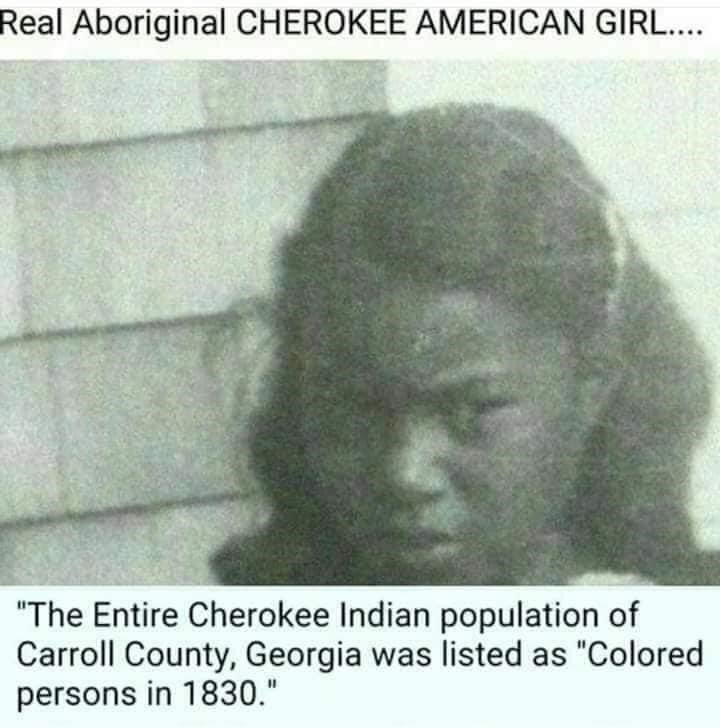
This picture is to illustrate what is mentioned in the article that the First Inhabitants across the world, including the KhoeSan communities' genocide and erasure was by design because the strategies implemented by the colonists to the First Nations across the world was similar and cross-cutting. The KhoiSan communities was deliberately called Coloured to sever them from languages, identity, land, culture etcetera. Similar to what happened to Cherokee Indian in 1830,.Aboriginal Australians and other First Nations who was also called "Coloured".
The first recorded deliberate extermination of the San, whereby men were killed while women and children were captured and turned into slaves, happened in 1731, followed eight years later by the so-called San/Bushman war. From 1754-1755, war broke out between the Khoe and the Dutch in the Roggeveldt after the Khoe were accused of stealing cattle. Subsequently, more wars and skirmishes occurred between the Dutch and the Khoe and San. There were also British battles with Chief Klaas and Dawid Stuurman, Uithaler, Boesak, Trompetter, and Matroos on the eastern frontier, the present-day Eastern Cape.
In 1868-1869, the first Korana (!Ora) war broke out after lXam speaking San groups joined forces with the !Ora to halt the advance of white settlers who were taking their land and grazing pastures. In 1877, a second !Ora war broke out, which lasted until the following year around the Orange River (Kai)!Garib with the British. Finally, from 1904-1908, the Nama-Herero-German war took place mainly in present-day Namibia, spilling over to present-day South Africa as well.
We have a saying in Nama, “Khoe-i-ge-khoe-e xu-a khoe,” which means, “A person is a person through a person.” This saying can also be “Khoe!nasib,” which is similar to the Bantu Peoples’ word ubuntu, which means humanity. These are the values and principles we were raised with as KhoeSan, Nama, #Khomani, and !Ora children in present day South Africa, Botswana, and Namibia.
Other morals and values that were taught were that “We are Xam (Gam/Ham), or the children of lXam or Xam, which means lion. It teaches us to be strong, steadfast, and not give up in times of hardship. We must tell stories rooted in ancestral memory or oral history and not colonial mythology. We must also remember that our ancient click languages are the progenitors of all languages on earth and are 30,000 years old. Every language originates from our languages. Therefore, it is important to !hôa (speak) and teach others to !hôa for generations to come, so that the language does not become extinct.
Language is a part of identity, culture, and heritage. The use of the mother tongue creates a solid pillar for education. Our future Khoe Nations will know themselves not through imposed categories, but through heritage and knowledge passed down from generation to generation and, in some instances, lineage.
We are not what they named us. We are who we say we are, and always have been.
-- Timas Letitia Petersen (Khoesan) is an activist and the founder of Mûbasen. She has been involved in promoting, preserving, and developing KhoeSan culture, belief systems, and ancient click languages like Nluu and Nama since 1996 as a youth. She was fortunate to have been taught since childhood the ways of her culture, Indigenous knowledge systems, and healing by her mother, Marie, who is a !Gâixa. Her Nama KhoeSan name, Tima(s), was given to her by her maternal grandparents, Abraham (April), Gaxab (Slagab), and Christine.
Petersen has been archiving and documenting folk stories and Indigenous knowledge and healing systems through print, audio, and visual formats, especially the #Khomani, lXam, and Nama Khoesan Nations from which she originates, since 1996. Her organization, Mûbasen, is women-led, and focuses on promoting, preserving, and developing KhoeSan culture, healing, Indigenous knowledge systems, and ancient click languages. Its core focus is to teach her People how to be self-sustaining and self-reliant through farming activities like producing and processing vegetables and herbs, among other activities.
In 2025, Mûbasen received a Keepers of the Earth Fund grant to support their work in farming, animal husbandry, and tannery in Andriesvale and Upington. Their objective is to produce sustainable vegetables and KhoeSan medicinal plants, as well as transfer knowledge about how to keep goats and sheep, from the elders to the youth and children, therefore ensuring that the knowledge of ancient healing, farming, housing, tannery, arts, and crafts will be passed down or carried on to the next generations.
Top photo: Protest that took place on the 24th of February 2026 at Cape Yown against the auctioning of 50 pockets of KhoiSan land by the Cape Town municipality without the consent of the KhoiSan communities.