The Warã Archive Project is teaching Brazilians about Xavante culture and fostering cultural exchange among its youth.
The archive, a project of Cultural Survival, has become one of the largest sources of Xavante information in the world. An exhibit of photographs and artifacts from the archive has toured several Brazilian museums, including Jataí and Goiânia. While the exhibits were on display, the museums hosted interactive demonstrations by Xavante children, who taught their peers from Brazilian cities how to play traditional Xavante games.
“ Xavante kids have little exposure to life outside their communities,” said Laura Graham, a coordinator of the Warã Archive Project. “It was a great opportunity for both the Xavante and Brazilian kids.”
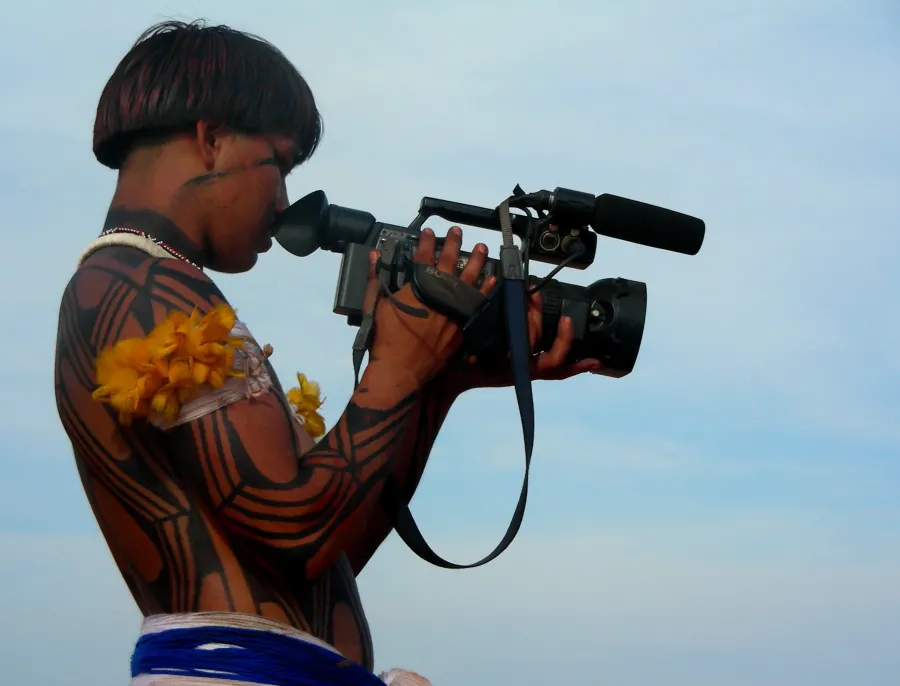
The growing archive is based in the home community of one of its project coordinators, Xavante leader Hibaridi Top’tiro, in Mato Grosso, Brazil. It contains books, articles, and newspaper clippings, videos, taped interviews, maps, artifacts, drawings, and photographs collected from Xavante of all ages. A group of Xavante women have recently started to collect women’s knowledge of traditional food to lend to the archive. They intend to create cookbooks for Xavante and non-Xavante with instructions on how to prepare traditional meals and recipes. The Warã Archive Project also hopes to document women’s knowledge about childbearing and midwifery.
The Warã Archive Project is succeeding thanks to work by Xavante community members, and with support from outside donations. For further information on the project and how to donate, contact Laura Graham at laura-graham@uiowa.edu or Cultural Survival, 215 Prospect Street, Cambridge, Massachusetts 02139, www.cs.org.
Katy Henderson is a Cultural Survival intern.