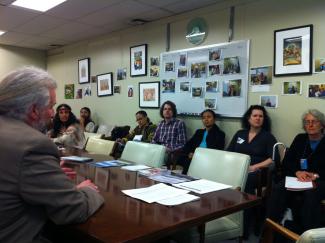

Participants from Cambodia, Russia, Thailand, the United States, and Uruguay gathered at 2 UN Plaza last week during the final week of the United Nations Forum on Indigenous Issues in New York City for Cultural Survival’s workshop "Indigenous Language Survival and Revitalization: Film, Radio, Web, and Growing Speakers from the Grassroots.” Hosted by Cultural Survival’s Endangered Languages Program with staff from Cultural Survival's Community Radio Program, and the Smithsonian Institution’s Film and Video Center (FVC) of the National Museum of the American Indian, the session brought together language advocates, filmmakers, educators, and activists to learn about media tools and community-based models to engage new generations of Indigenous children in learning to speak their mother tongues.
Attendees learned about Cultural Survival’s Community Radio network and training workshops throughout Guatemala’s Indigenous Mayan communities, and the on-air programs hosted by young people in various Mayan languages. Cultural Survival’s Endangered Languages Program presented an overview of successful networking and fundraising efforts during the past four years that have helped to generate nearly $1 million for local language immersion education, including preschool classrooms, master-apprentice teams, after-school programs and language camps—while leveraging more than $2 million in federal, tribal, foundation, and private donor support for Indigenous language programs from Alaska to Massachusetts. The Our Mother Tongues website introduced the diverse workshop participants to Cultural Survival partners programs serving youth in the Alutiiq, Euchee (Yuchi), Sauk, and Wampanoag tribal communities.
The Smithsonian Institution’s Film and Video Center (FVC) of the National Museum of the American Indian, is a unique national center for Native American and Indigenous film and media. Through its screenings, festivals, and information services, it provides the public with in-depth access to film and other media produced by and about Indigenous Peoples of the Western Hemisphere and Hawai’I—including the CD Living Voices/Voces Vivas, presented to all workshop attendees.
The FVC presents daily screenings for children and the general public, touring video showcases, and other special programs, including the Native Networks website, which contains in-depth information about Native film, mediamakers, and media organizations. The FVC also maintains an extensive study collection of Indigenous productions, housed in New York and available for viewing by appointment.