New Zealand

Date: February 19, 2013

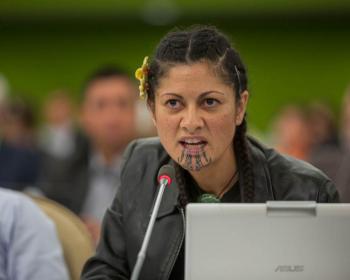
Our series spotlighting the work of our board members continues with newly elected board member Che Philip Wilson (Ngāti Rangi from the North Island of Aotearoa-New Zealand).

Date: February 8, 2013

“Ahakoa kei whea, Ahakoa āwhea, Ahakoa pēwhea, Kōrero Māori!”-- Te Māngai Pāho Māori Broadcasting Funding Agency
(“Māori language - everyday, everyway, everywhere”)

Date: November 26, 2012

When an agreement recently signed in Aotearoa (New Zealand) proposed the acknowledgement of the Whanganui River as a legal person, many saw it as an innovative resource management solution.

Date: September 14, 2012
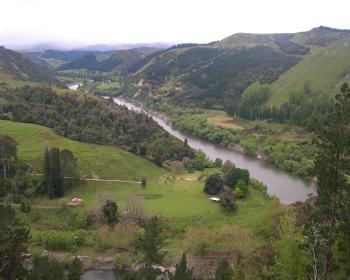
New Zealand’s longest navigable river, the Whanganui, has been given “legal standing and an independent voice” under a framework agreement to settle the historical claims of Indigenous people, the Whanganui Iwi.
Date: September 20, 2010

New Zealand (Aotearoa is the Maori name) proudly displays evidence of its Maori culture, whether it be the dozens of replicas of Maori crafts, carvings, and paintings at the airport, the Maori flag flying alongside the Aotearoa flag, or non-Maori performing the haka, the traditional dance of the Maori peoples.  What’s harder to see is the level of discrimination that the Maori of Aotearoa continue to face despite the country’s pride in its Indigenous population.

Date: September 20, 2010

According to the Maori origin story, the tribe originated on an island called Hawaiiki and traveled to New Zealand in large canoes, bringing with them stone tools and a collection of plants that included coconuts, bananas, breadfruit, and kumara—what Europeans would call sweet potato. Of these crops, only the kumara could adapt to New Zealand’s cooler climate.

Date: June 9, 2010

A new wave of racism against indigenous peoples is emanating from figures so hallowed they are intimidating to confront. But confront them we must; and recognize their words and deeds for what they are.

Date: May 26, 2010

The governments of South Africa and New Zealand must do more, more quickly, to address the inequalities between their indigenous and nonindigenous populations, according to two recently released reports by U.N.

Date: May 26, 2010

The Maori Party formed in 2004 around Tariana Turia, a former Labor Party member and cabinet member, largely in response to the Foreshore and Seabed Bill. At the abbreviated hearings about the bill in November 2004, Turia gave an impassioned speech against the legislation. Excerpts from that speech appear below.

Date: May 10, 2010

Date: May 7, 2010

Aotearoa/New Zealand is not known for egregious breaches of indigenous peoples’ rights. Nonetheless, New Zealand’s legal system is ineffective at implementing international and domestic laws that protect the rights of Maori. This has been seen most starkly in the Foreshore and Seabed Act of 2004, which had the effect of extinguishing Maori aboriginal title to the foreshore and seabed areas and was passed despite almost universal Maori opposition.

The problem lies in the structure of the country’s legal system.

Date: May 7, 2010

During the first United Nations International Decade on the World’s Indigenous People (1995-2004), there were a number of positive developments for the world’s indigenous peoples. Many countries adopted legislation concerning land, resources, culture, language, education, justice, intellectual property rights, and in some instances, legal pluralism, autonomy, and self-governance. In 1989, just before the decade began, the International Labor Organization adopted Convention #169 on indigenous and tribal peoples, and since 1996 the U.N.

Date: May 7, 2010

The conclusion of the first International Decade of the World’s Indigenous People provides a moment to reflect on the history of the indigenous rights movement, which was spear-headed centuries ago by indigenous peoples and their allies in response to the moral exclusion, extinction, or assimilation policies prevalent during five centuries of conquest, colonization, and state sovereignty.

One of the first individuals to raise his voice in defense of indigenous rights was Bartolome de Las Casas, whose father sailed with Columbus on the Santa Maria.

Date: May 7, 2010

He Paua, He Korowai,Me Nga Waahi TapuHe Paua, He Korowai,

Date: May 7, 2010

The experiences of the Kakai Tonga Tu’a (Tongan people who have migrated to Aotearoa—New Zealand–from the Kingdom of Tonga) can be interpreted alongside the patterns of the tapestry of the lives of Tangata Whenua (“First People of the land”) in Aotearoa and indigenous colonized peoples elsewhere in the world. Our heritage can be traced to the islands of Niua Fo’ou, Niua Toputapu, Vava’u, Ha’apai, Tongatapu, and ‘Eua, which are collectively called the Tonga Islands. The diversity among Kakai Tonga Tu’a is acknowledged and, as a Kakai Tonga Tu’a teacher, I am one of many voices.

Date: April 9, 2010

Many of those involved with the mining industry, or with mining related issues will by now be aware of the Mining Minerals and Sustainable Development Project (MMSD) being managed by the International Institute for Environment and Devel

Date: April 9, 2010

Maori origins are traced back to the beginnings of creation -- Te Kore (total darkness). There was no life, only potential. Papatuanuku (the Earth Mother) and Ranginui (the Sky Father) were clasped together, stifling all growth.

Date: April 2, 2010

Michael Jackson

Duke University Press, 2000

ISBN 0-8223-2538-1 (Paperback)

Date: April 2, 2010

Over the past two decades or so, the Western intellectual property rights (IPR) legal system has increasingly found itself on a collision course with the cultural and intellectual heritage rights system of indigenous and traditional peo

Date: April 2, 2010

The year 2000 heralds a new beginning for Cultural Survival's Education, Research and Advocacy Program.

Pages

Subscribe to New Zealand
owleye